
Copper is crushing gold, and AI valuation pullbacks cannot stop this “strategic metal” revaluation
The Zhitong Finance App learned that as artificial intelligence (AI), power grid investment, and defense spending drive demand for copper as an industrial metal, copper is becoming more and more strategic for governments and industries, and this year's performance has also significantly outperformed gold, which has continued to shine in recent years.
Currently, the price of LME copper is fluctuating at a high level within a narrow range of around 14,400 US dollars per ton. As of press time, it was reported that it was 14,350.88 US dollars. However, the apparent calm has overshadowed a steep upward curve during the year: since this year, copper's cumulative increase has reached 15.8%, and in the past 12 months it has risen by more than 30%. In contrast, gold futures fell 4.11% during the year and fell 4.52% over the past 12 months. Spot gold fell 4.89% over the past 12 months and fell 4% during the year.
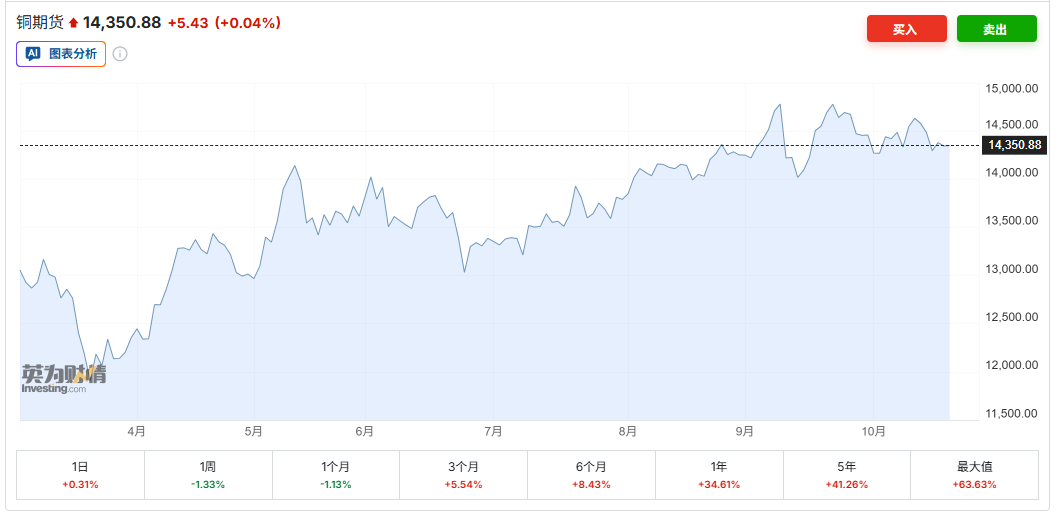
A variety that has long been regarded as a “cyclical industrial metal”, has systematically overtaken traditional safe-haven assets in terms of return. This reversal is not an accidental asset rotation; it is a clear sign that the copper pricing anchor is shifting from the inventory cycle to geopolitical and structural demand.
Metals Redefined: From “Economic Barometer” to “Strategic Infrastructure”
The traditional analytical framework for copper is based on construction starts, manufacturing output, and inventory cycles. In this framework, copper prices are a thermometer of economic activity, and their rise and fall are viewed as a map of aggregate demand. However, the 2026 copper market presents a paradox that is difficult to explain in the traditional framework: the global refined copper market was once in a state of phased excess in the first quarter. The International Copper Research Organization (ICSG) estimated the surplus amount of about 396,000 tons, yet the price set a new historical record.
Total excess coexists with new price highs, pointing to a clear conclusion: the marginal pricing power for copper has been transferred from total supply and demand to regional allocation and strategic expectations. In an interview during LME Week, the global metals industry's annual event, Taylor Melvin, CEO of Ivanhoe Electric, said, “The world we live in today, the varieties that have always been known as key metals, are evolving in all aspects into strategic metals.”
Currently, governments and industry are focusing their attention on copper from “whether the price is cheap” to “whether the supply is reliable.” The United States included copper in the list of key minerals. Copper from the Democratic Republic of the Congo (DRC) officially entered the US strategic mineral reserves in mid-October. Swiss commodity trader Mercuria delivered the first batch of 12,000 tons of Congolese copper to the “Treasury Program”, all operationalized implementation of this logic. Copper's strategic attributes are no longer limited to the headlines of research reports, but directly intervene in the liquid volume of the spot market in the form of geographical inventory migration and reserve system construction.
“Inelastic” characteristics of demand structures
What supports copper prices to remain high in the midst of fluctuating macroeconomic sentiment is a set of demand groups that are difficult to be adjusted by price signals in the short term.
The first is AI computing power infrastructure, which has always been at the center of capital market topics. Speaking about the technology industry's demand for copper in an interview, Melvin said that AI “is a new field of demand, and it is almost a rigid demand for copper.” He also added that when tech giants decide whether to invest in hyperscale data centers, the cost of copper weighs very little in their capital expenditure decisions, which makes the technology industry's demand for copper “almost inelastic.” In other words, even if the valuation of AI stocks fluctuates drastically due to financing conditions or the pace of monetization, the purchase of copper by data centers that have already entered the construction cycle will not be cancelled.
“It's hard to imagine any of these big tech companies deciding whether to invest in hyperscale data centers based on the cost of copper,” Melvin said.
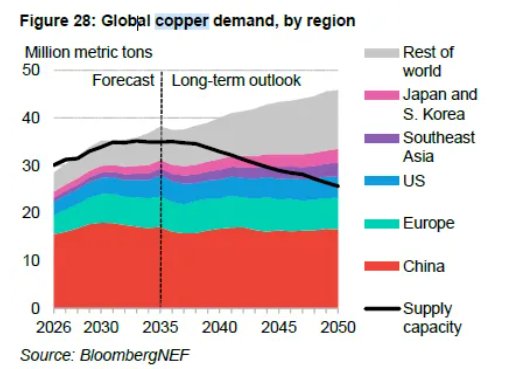
Second, copper is also the biggest source of demand for grid modernization and electrification. According to statistics, the electricity sector is steadily the largest sector of copper consumption, accounting for more than 40%. UHV construction, new energy grid connection, and distribution grid upgrades together form a sustainable demand base. BNEF predicts that copper demand associated with electrification will jump to 23.3 million tons in 2050, up 89% from current levels, accounting for more than half of total consumption.
The agency's analyst wrote, “E-mobility is the fastest growing sector in copper applications. The penetration rate of electric vehicles, electric trucks, and electric buses will increase dramatically between 2026 and 2050, and their motors, inverters, battery packs, high-voltage wiring, and charging facilities all require copper.”
Furthermore, the structural expansion of defense spending has also become a new area of rigid demand for copper. “There is another emerging demand that is also characterized by rigidity — the national security and defense budget,” Melvin said.
Steve Schoffstall, managing partner and head of ETFs at Sprott Asset Management, once pointed out that the global defense budget exceeds 2.6 trillion US dollars, NATO's goal is to use 5% of GDP for national defense, while defense copper is expected to expand at an annual growth rate of about 7%. Notably, unlike AI demand, defense procurement is driven by a security agenda, and sensitivity to price signals is in a very low range.
This triple demand exists at the same time as high prices, which explains why copper prices have not declined under the drag of traditional cyclical forces. BNEF's estimates also provide a long-term anchor point for this judgment: without additional mine investment of about US$332 billion, the copper market will face a 20 million ton supply gap by 2050; even with the investment in place, it will take an average of 17 years for a new copper mine to be discovered and put into operation, and the gap will not be systematically narrowed until at least 2043. This means that supply-side rigidity is not a matter of one or two years; it is a structural constraint on a ten-year basis.
Tariff suspension and inventory siphon: a self-reinforcing supply constraint mechanism
If the demand structure provides “bottom support” for copper prices, then the uncertainty of US refined copper tariffs acts as an amplifier of short-term price elasticity.
According to information, in 2025, the US Department of Commerce has proposed a 15% tariff on refined copper from January 1, 2027, and further raised to 30% in 2028. However, no final decision on the proposed tariff has been publicly announced. The “pending” itself, rather than any announced policy, has become a substantial variable in the operation of the market.
The reason why this tariff policy will affect the trend of copper prices is because traders will accelerate the shipment of refined copper to the US before the window period closes, based on expectations that tariffs will be implemented in 2027. According to statistics, COMEX copper stocks soared from about 84,000 tons in February 2025 to over 650,000 tons in early August 2026, breaking the 100-year record since COMEX had complete statistics; according to general estimates, the total amount of copper reserves in the US has far exceeded 1 million tons.
Goldman Sachs raised its 2026 US copper inventory accumulation forecast sharply from 550,000 tons to 900,000 tons in June, then further indicated that the copper supply gap in markets outside the US had widened from the previous forecast of 640,000 tons to about 950,000 tons.
Geographic migration of inventories has created an asymmetric shortage. At the level of total volume, global copper has not disappeared; however, at the level of circulation, apparent inventories in non-US markets have been systematically thinned. According to analysis, LME stocks fell from a high level of about 400,000 tons in April 2026 to about 250,000 tons, and copper stocks in the previous period plummeted from 3591,000 tons at the end of March to 471,000 tons in late September. Domestic social stocks once hit a recent low of 783,000 tons.
The analysis points out that even if the COMEX and LME price differences have recently declined due to the narrowing of the arbitrage window in recent months, as long as the 2027-2028 incremental tariff expectations are not officially lifted, there will always be structural incentives for traders to ship copper to the US in advance. The US government does not require direct funding to establish reserves; simply by maintaining tariff expectations, global copper resources can continue to be sucked into domestic inventories, turning private commercial stocks into actual “quasi-strategic reserves.” This mechanism will continue to provide copper prices with a risk premium generated by policy uncertainty itself until tariffs are officially implemented or explicitly abolished.
“Due to possible US tariffs, a large portion of the world's copper is currently stored in the US, and it is unclear whether these stocks will be supplied to the rest of the market,” said Iain Pyle, senior investment director at Aberdeen Investments and co-manager of the abrdn Future Minerals Fund.
“Meanwhile, Chinese inventories seem abnormally low, and local premiums are rising,” Pyle added.
In an October 15 report, Pyle also said that copper is the “clearest example” of a market where supply is unable to keep up with demand, and “there is a need to provide stronger incentives through the continued rise in copper prices.”
“There is still some risk of a pullback before and after the tariff announcement, but we think there are clearly too many fundamentals, and the possibility of a sharp rise in prices has increased.”
At the time of AI valuation pullback, copper's “decoupling” logic
The current background of copper price analysis is that global AI-related stocks are experiencing a significant round of valuation contraction.
For the week ending October 16, the NASDAQ 100 index fell about 5.5% in a single week, the biggest weekly decline since April 2025; the Philadelphia Semiconductor Index fell for eight consecutive trading days, retreating by 11.5% in a single week, directly falling into the technical correction zone. Nvidia (NVDA.US) has retreated more than 10% from its high point on October 6; CoreWeave (CRWV.US) plummeted by more than 25% in a single week, and its 2031 bond yield hit 16%. The five-year CDS spread exceeded 1,100 basis points, and the probability of default implicit in market pricing increased significantly.
The driving factor behind the sell-off was not the falsification of demand for AI computing power, but rather the tightening of financing conditions and repricing of the pace of commercialization: some AI infrastructure companies relied on high-interest debt to support expansion, and when revenue growth did not cover interest expenses, the fragility of the credit structure was concentrated exposed.
It is in this context that there is a logical split between copper and AI stocks that deserves serious treatment. The valuation and pricing of AI stocks is a discount on future cash flow and is highly sensitive to interest rates, financing costs, and competitive patterns; while copper occupies a position in the AI demand chain, it is a raw material investment in the physical construction phase. Data center GPU clusters can delay orders, but the copper required for the design of power access, cooling systems, and bus ducts has a much more rigid procurement schedule.
Melvin of Ivanhoe Electric emphasized: “There has indeed been a slight correction in the tech sector valuations recently. But two things can be established at the same time: stock sentiment in the capital market will fluctuate; at the same time, the related industry itself is still growing, which will continue to bring incremental demand for copper,”
Also, the copper demand narrative is not based on AI as the only pillar. Grid upgrades and defense spending make up two separate demand curves with very little correlation with the AI capital cycle. Even if the pace of AI data center construction slows down gradually, the power infrastructure renewal cycle and multi-year defense procurement contracts will still provide bottom support for copper consumption.
In fact, in BNEF's long-term outlook, data centers are clearly described as “a drop in the ocean” of copper demand, and electrified transportation is the fastest growing application scenario. This means that it is not accurate to regard copper as an “AI conceptual asset”; copper's multi-pronged logic is not based on AI valuation, but on a broader foundation of electrification, security, and supply chain regionalization.
Goldman Sachs recently raised its LME copper price target at the end of 2026 from 13,735 US dollars to 14,700 US dollars, an increase of about 7%. The reason clearly points to “increasingly intense competition between the US and China for copper resources” and the weakening of mine supply than expected.