
Should Cloud Native Network Upgrades Require Action From F5 (FFIV) Investors?
- F5 recently introduced expanded BIG-IP Cloud-Native Network Functions and new eBPF-based observability tools, with independent Tolly Group testing citing higher DNS throughput, lower latency, and sharply reduced CPU and memory use for Kubernetes-based DNS and CGNAT workloads compared with virtualized network setups.
- The update pushes more of F5’s core application delivery and security platform into Kubernetes, giving service providers a way to run DNS, CGNAT, policy enforcement, and traffic management with cloud-native lifecycle automation and shared application and network telemetry.
- We will now look at how F5’s efficient Kubernetes-native network functions and observability could influence the company’s broader investment narrative.
Scan other infrastructure plays with hand-picked 55 AI infrastructure stocks that, like F5, are building the plumbing behind cloud, Kubernetes, and next generation network workloads.
F5 Investment Narrative Recap
Owning F5 means believing that multicloud complexity, AI heavy traffic, and service provider refresh cycles will continue to require richer application security and networking software. In the near term, the key swing factor is whether interest in its unified platform continues to translate into broader Distributed Cloud and Kubernetes adoption. The new cloud native network functions support that narrative but do not fundamentally change it.
The main operational risk remains slower annual recurring revenue progress and pressure on non GAAP gross margin from higher component costs. If customers remain cautious on long contracts or if hardware mix stays heavier than planned, margin and stability questions will persist, even with stronger Kubernetes offerings.
The BIG IP Cloud Native Edition update, including eBPF Observability, is the announcement that stands out most. It gives service providers a way to handle DNS, CGNAT, and policy control inside Kubernetes with materially lower CPU and memory needs, which directly connects to the multicloud and AI traffic themes already associated with F5.
For investors, this reinforces the operational case that F5 can stay relevant as workloads move from virtual machines to containers while maintaining its position in application delivery and security. The potential upside is that better cloud native efficiency can support platform consolidation and multi product use, while the key risk is that recurring software growth and margins still need to demonstrate resilience.
How F5’s Cloud-Native Push Fits Into Analyst Expectations
F5’s cloud native push sits against a backdrop where analysts already model steady expansion rather than a step change. The current consensus assumes revenue grows at 8.1% each year for the next three years, while profit margins move from 22.0% today to 24.4% over the same window. That framing helps you see the new Kubernetes functions less as a moonshot and more as an incremental tool that could help the business track toward those existing goals.
On earnings, the Street is currently working off roughly US$726.5 million of profit and a central forecast of US$1.0b by 2029. That implies an earnings increase of about US$273.5 million from today’s level, with a wide range between bullish and cautious views that run from US$866.7 million to US$1.2b. For a reader trying to tie this back to F5’s cloud native roadmap, the key question is not whether the update exists but whether it nudges the company toward the upper or lower end of that earnings spread.
Valuation assumptions mirror that same moderate tone. Analysts as a group point to about US$4.2b of revenue and US$1.0b of earnings by 2029, with the stock trading on a P/E of 28.8x in those models compared with 35.1x today. That P/E mark would sit below the cited 35.4x for the broader US Communications industry. This suggests these models do not require F5 to command a premium to peers, only to earn its way into a still healthy multiple.
F5's narrative projects US$4.2b revenue and US$1.0b earnings by 2029. This assumes 8.1% yearly revenue growth and an earnings increase of about US$273.5 million from US$726.5 million today.
For you as an investor, the link back to BIG IP Cloud Native Edition and the eBPF tools is straightforward. If these products help customers shift more DNS, CGNAT, and policy control into Kubernetes without significantly increasing CPU and memory spend, they can support the margin expansion that analysts already build into their spreadsheets. If adoption stalls or pricing pressure creeps in, the risk is that the forecast step up in profitability becomes harder to reach even if top line growth holds to the 8.1% revenue path.
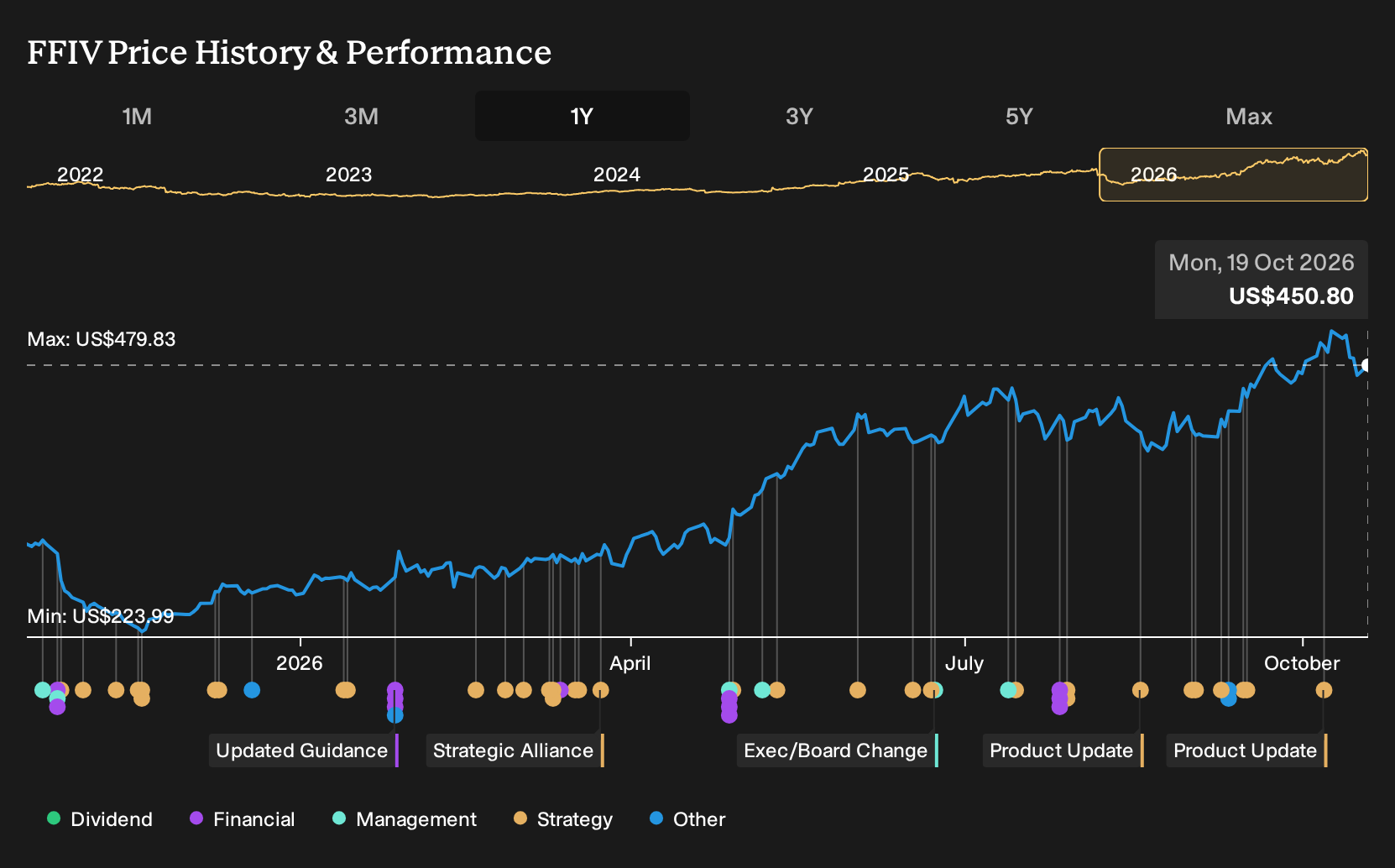
Uncover why F5's fair value indicates a 3% potential downside to its current price, leaving little room for error.
Exploring Other Perspectives
One alternate, more optimistic view leans on AI security as the big swing factor for F5. Those bullish analysts were already penciling in US$4.3b of revenue and US$1.2b of earnings by 2029 before this Kubernetes efficiency news landed. That crowd may see even more upside, while others stay cautious. Use these gaps as a prompt to compare several narratives before deciding what you think might change next.
Explore 2 other F5 fair value estimates, including one that suggests it could be worth as much as $437.80.
Form Your Own Verdict
Don't just follow the ticker; dig into the data and build a conviction that's truly your own.
- A great starting point for your F5 research is our analysis highlighting 2 key rewards and 1 important warning sign that could impact your investment decision.
- See our latest analysis for F5. The report includes a comprehensive fundamental analysis summarized in a single visual, the Snowflake, making it easy to evaluate F5's overall financial health at a glance.
Looking For More Investment Ideas Beyond F5?
If the F5 story has sharpened your thinking but you want a broader watchlist, the Simply Wall St Screener can help you line up other opportunities that match your risk and income goals.
- If capital preservation sits high on your list, scan a group of companies with steadier profiles through 32 resilient stocks with low risk scores that may suit a more cautious approach.
- For readers who want a stronger balance sheet foundation behind potential returns, filter for businesses with healthier leverage and liquidity using the list of solid balance sheet and fundamentals (25 results) to build a more durable shortlist.
- When you want growth potential without ignoring quality, run a search across 20 high quality undiscovered gems that pair solid fundamentals with lower market attention.
Have feedback on this article? Concerned about the content? Get in touch with us directly. Alternatively, email editorial-team@simplywallst.com