
SanDisk (SNDK.US) under the AI Spending Paradox: Credit Tightening Pressures Valuation, Reasoning Needs Underpins NAND, Can NBM Iron the Storage Cycle?
The Zhitong Finance App learned that in the past month, the wave of market sell-offs has continued to ferment, and the stock price of SanDisk (SNDK.US) has dropped by nearly 30% cumulatively. The core reason for this round of sharp stock price fluctuations is that the market is once again concerned about the sustainability of artificial intelligence (AI) infrastructure spending; in an environment where monetary policy is being tightened, the scale of industry debt continues to rise, further exacerbating investors' concerns.
By the close of trading on Friday, October 16, the Philadelphia Semiconductor Index had been falling for eight consecutive trading days, setting a record for the longest continuous decline since 2006.
However, recent developments in key links in the AI infrastructure value chain show that despite pressure from the recent valuation compression that dominates market sentiment, SanDisk fundamentals still have plenty of room to rise. TSM.US's latest earnings report exceeded expectations, and ASML.US (ASML.US) raised its full-year growth outlook, all confirm this, highlighting that demand for high-end chips remains resilient in an environment where capital is increasingly limited.
More importantly, the continued expansion of computing power infrastructure also highlights the accelerated transformation of the industry to large-scale inference; the continued rise in token (token) consumption and the continuous increase in complex agent (Agent) workflows are further driving the incremental demand for NAND flash memory.
Based on this, the analyst firm Summit Research will explore in depth the current NAND demand dynamics and price persistence, as well as SanDisk's progress in smoothing cyclical fluctuations below. These two major issues were also the focus of investors' biggest concerns before the company released its 2027 quarterly report on October 29, EST.
Specifically, the agency will discuss: In the context of resilient AI infrastructure demand, TSMC's latest earnings report may indicate that SanDisk still has room for further upward growth of nearly $94 billion in order reserves under its expanding new business model (NBM); as fundamentals rise definitively, SanDisk is expected to recover the market after this round of valuation pullbacks.
The AI spending paradox: high capital expenditure meets tight credit
Credit market volatility has intensified in recent weeks, and the market continues to question whether AI capital expenditure can be maintained for a long time, and this is the core driving force supporting SanDisk NAND demand.
Summit Research notes that continued AI transformation will inevitably lead to an increase in industry leverage, as recent infrastructure capital expenditure requirements increasingly exceed endogenous operating cash flow. Morgan Stanley estimates that global data center investment will be close to 3 trillion US dollars in the next two years, and the capital reserves of profitable hyperscale cloud vendors are expected to cover only about half through internal operating cash flow, leaving a huge gap that will need to be covered by external financing in the next few years.
Broadcom (AVGO.US) CEO Chen Fuyang also recently echoed the growing disconnect between impending capital expenditure requirements and expected operating cash flow. He warned that despite the accelerated revenue growth of cutting-edge AI model developers, there is still uncertainty about their profit prospects. CoreWeave (CRWV.US) also said it is working hard to obtain an investment grade rating and further improve its borrowing capacity, highlighting the industry's increasing reliance on the credit market to finance increasingly capital-intensive AI construction.
Meanwhile, the upcoming wave of AI-related debt supply coincides with rising financing costs.
Currently, the credit spread for AI-related debt “continues to be at a broad level of about 115 basis points,” which is significantly higher than the average spread of 78 basis points for comparable investment-grade bonds. Meanwhile, the Federal Reserve is expected to raise interest rates further next year to cope with a rebound in inflation — the inflation rate reached 3.7% in September, the highest since May, and the pressure on corporate financing will only increase further.
Although the tightening of the financial environment is not expected to substantially disrupt the current AI infrastructure construction cycle, it will raise the return on investment threshold for projects and make it harder for investors to examine whether future cash flow can prove reasonable to accelerate the spending trajectory.
Potential inflection point in the quarterly report: high computing power underpins storage demand
However, the latest financial reports from critical infrastructure vendors have proven that the AI industry's potential market size (TAM) still has the potential to improve because the underlying AI transformation is still in its early stages.
TSMC's third-quarter earnings report exceeded expectations, and the fourth quarter guidance was stronger than expected, highlighting that the company's product portfolio is rapidly migrating to the most advanced manufacturing processes, driven by resilient AI-related high-performance computing (HPC) demand. This higher-than-expected performance reinforces the sustainability of the industry's continued investment in next-generation AI infrastructure despite recent fluctuations in the credit environment.
Asma's increase in its 2026 growth outlook also confirms strong demand dynamics, as demand for advanced chip manufacturing equipment accelerates and continues to exceed supply. Taken together, the boom in upstream equipment and fabs ensures that AI capital expenditure will not cool down quickly, creating a favorable demand environment for SanDisk.
Summit Research said that as workloads shift from performance-intensive training to large-scale inference, next-generation AI data center architectures are increasingly prioritizing energy efficiency and scalability. This is consistent with recent estimates by MRVL.US (MRVL.US), that inference already accounts for about 60% of the total data center infrastructure; and as intelligent AI applications expand from enterprise scenarios to consumer scenarios, this proportion is likely to rise rapidly, especially after Meta Platforms (META.US) recently launched Muse.
The expansion of smart AI adoption is expected to further accelerate the growth in KV cache demand and increase memory capacity and bandwidth requirements, thereby supporting the incremental demand for NAND storage.
SanDisk's product roadmap is strategically aligned with grasping the inference storage needs of these emerging agents. This is reflected in the momentum of its rapidly rolling out BiCS8 technology; management sees this technology as a factor driving the company's recent inflection point.
Summit Research notes that BiCS8's advanced architecture design achieves higher bit density through vertical and horizontal scaling, supporting higher storage capacity and better energy efficiency without sacrificing response time and data integrity. BiCS8 currently supports SanDisk's “Carrera” three-layer unit (TLC) enterprise solid-state drive (eSSD) and “Stargate” high-capacity four-layer unit (QLC) products for the computing field, directly meeting the increasing performance and storage density requirements of the market.
Looking ahead, SanDisk's upcoming BiCS9 2Tb QLC architecture is expected to further improve performance gains and energy efficiency over BiCS8. Specifically, BiCS9 combines the storage unit array yield of BiCS8 with next-generation BiCS10 CMOS technology to achieve a 150% increase in write bandwidth and a 75% increase in read bandwidth. At the same time, the bandwidth per watt is increased by 85% and 30%, respectively, compared to the previous generation, highlighting the continuous increase in efficiency gains.
Meanwhile, SanDisk began sending samples of BiCS10 332 layer 1Tb TLC NAND flash memory to customers in August. Compared with BiCS8, the memory density was increased by 59%, the interface energy efficiency was increased by 38%, and the bandwidth was further improved. The recently released next generation BiCS10 332 layer 2Tb QLC technology will have a 60% increase in memory density, a 100% increase in write and read bandwidth, and a 75% improvement in write and read energy efficiency compared to the current generation.
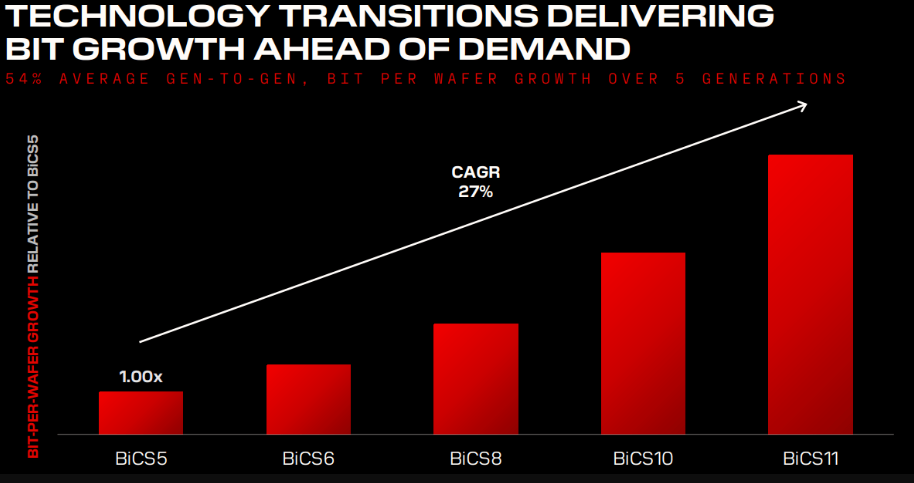
Taken together, these developments have strengthened visibility into SanDisk's growing share in continuously expanding NAND flash memory TAM. This is supported by management's expectations: as the SanDisk technology roadmap progresses, the number of bits per wafer will grow at a compound annual growth rate of 27%, supporting incremental cost efficiency and manufacturing scalability, which are critical to meeting end market demands. Currently, management expects NAND TAM to be 300 billion US dollars in 2026 and close to 500 billion US dollars in 2027. More than half of the emerging opportunities will be driven by data center demand, supported by accelerated inference, which increasingly requires high-performance and large-scale energy-efficient storage.
Can NBM solve the NAND periodicity problem?
The recent uncertainty about AI spending has also once again raised concerns about the cyclical issues in SanDisk's history.
Notably, management recently acknowledged that much of SanDisk's growth and profit expansion over the past year was still driven by supply-driven pricing. Specifically, two-thirds of the company's growth in the fourth quarter of the fiscal year was driven by supply-driven NAND pricing, while the remaining one-third was driven by bit-unit shipment growth.
Accordingly, the market is paying more attention to pricing sustainability ahead of SanDisk's first quarter results update and management's forward-looking expectations.
However, SanDisk's expanding NBM portfolio continues to reflect management's consistent ability to reduce the company's cyclical exposure. According to the latest Investor Day disclosure, SanDisk has received eight NBM customers so far. Long-term customer contracts currently last between one and five years, with an average duration of four years. NBM combines fixed and variable rates, and the contract reserve price alone supports a total contract value of US$93.9 billion and a remaining performance obligation (RPO) of US$91.1 billion.
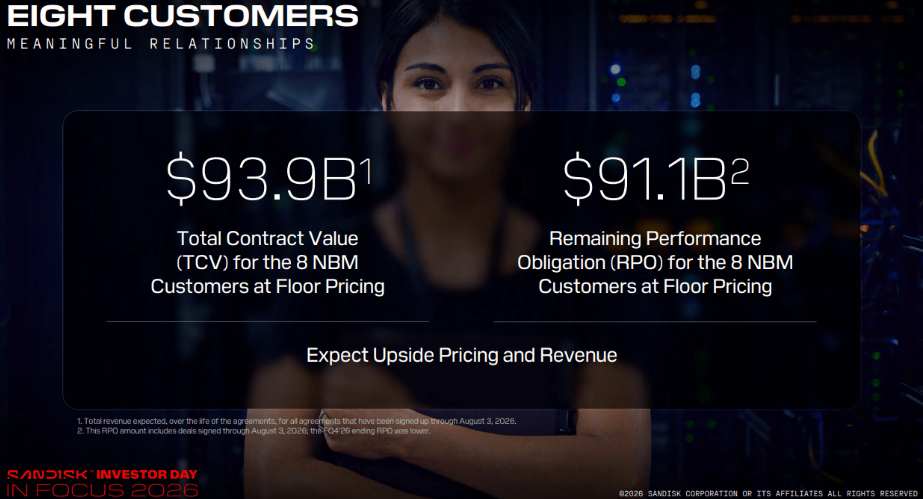
These agreements are expected to account for 50% of SanDisk's bitrate demand in FY2027, increasing to two-thirds by FY2028. This highlights significant revenue visibility and downward protection from longer-term NAND price fluctuations — when the current imbalance between supply and demand eases — and strengthens SanDisk's ability to maintain management's target high double-digit revenue compound annual growth rate.
More importantly, NBM currently supports a non-GAAP gross margin of 80% under the contract reserve price. This is expected to maintain SanDisk's current high profitability after the supply-driven upward cycle of NAND pricing, and extend profit visibility into 2030 as the average contract period exceeds four years.
The resilience of AI infrastructure demand, as reflected in TSMC's latest earnings report that exceeded expectations, and more importantly, continued capacity expansion efforts have further strengthened the extended visibility and incremental upward expectations of SanDisk's contract growth prospects. According to reports, TSMC increased Arizona's investment by 100 billion US dollars in July, bringing the cumulative commitment to 265 billion US dollars. The phased operation will continue until the end of this decade.
The multi-year delivery cycle for wafer capacity expansion is consistent with AMD (AMD.US) CEO Su Zifeng's recent disclosure that the company extended its manufacturing capacity plan from one to two years to three to five years, confirming the extension of the AI computing infrastructure demand runway. Asmat also echoed similar developments, stressing that customers are interested in “placing orders until 2030.”
Looking ahead, further NBM adoption and contract revenue growth will remain key areas of concern until SanDisk's upcoming performance update — especially given the fluctuating AI spending context, long-term agreements play a key role in measuring the company's ability to withstand the cyclical nature of NAND. Considering favorable terminal market demand dynamics indicating that the industry continues to prioritize securing long-term supply guarantees in order to seize emerging AI monetization opportunities, SanDisk is expected to achieve an upward trend in this area.
Finally, Micron Technology (MU.US)'s rapid expansion of its strategic customer agreement (SCA) also confirms this favorable trend — a long-term contract framework similar to the NBM that SanDisk launched earlier this year — reinforces the industry's increasing shift to multi-year procurement commitments, thereby supporting higher supply guarantees and pricing visibility after the current AI supercycle.
Potential risk: Weak demand for consumer-grade storage
Despite the long-term benefits driven by AI, SanDisk is still vulnerable to weakening consumer and mobile NAND demand under inflationary component pressure.
According to recent industry data, global smartphone shipments fell 22% in the September quarter, the worst on record, as rising memory and storage costs weakened OEM output and consumer demand. The consumer terminal market is expected to face continued pressure, which is also reflected in the expected decline in PC shipments in the short to medium term.
However, SanDisk's product portfolio, which is increasingly shifting to high-end edge storage opportunities, could potentially ease its exposure to recent headwinds in the consumer and mobile terminal markets. This is evidenced by the resilience of demand for high-end smartphones, such as Apple (AAPL.US)'s recently launched folding screen iPhone Duo, which is priced as high as $1999-3199 — more than some high performance MacBook Pro configurations — still attracted significant pre-order interest and extended delivery times.
Combined with ongoing AI-driven supply constraints, SanDisk deliberately focused on high-end SKUs to further reduce the risk of growth and profit prospects, even though the marginal and consumer end markets still dominate its sales mix.
Overall, the resilient expansion of AI infrastructure and industry trends indicating NBM's adoption of expansion have kept Summit Research's previous fundamental predictions of SanDisk unchanged. This is expected to support the agency's target price for SanDisk's benchmark scenario of 2,000 US dollars per share; the target price was lowered from the previous price of $2,200 per share to take into account the increase in the benchmark US Treasury yield, while keeping the revenue and profit forecasts in its previous research unchanged.
Summit Research concluded that despite the recent compression of valuation multiples against the backdrop of heightened uncertainty in AI spending, the improved visibility of SanDisk contract order reserve growth and the dynamic resilience of critical infrastructure vendor demand have highlighted that demand for NAND storage driven by reasoning is accelerating. Coupled with the strategic alignment between SanDisk's technology roadmap and the emerging demand for energy efficiency and scalability, the company has a competitive advantage that can transform favorable structural demand into continuous profit growth, supporting significant upside from current levels before the upcoming first-quarter results update.