
Lightspeed Commerce (TSX:LSPD) Stock Trades At A Discount Despite Its 87% Five Year Fall
Lightspeed Commerce has seen its share price move sharply over the past few years, and that kind of swing naturally raises a basic question for investors who care about valuation. Is the current price you see on the screen supported by what the company is generating through its sales today?
- Over the past 5 years the stock has fallen 87.4%, which puts a lot of focus on whether the revenue that remains can still justify the valuation that the market is assigning.
- Lightspeed's push into agentic AI tools for retailers may support expectations for higher payment volumes and software usage, which can influence how much investors are willing to pay for each dollar of sales.
- Your read on Lightspeed Commerce is one view; the desks covering it have another. See what analysts think Lightspeed Commerce's shares could be worth.
The stock's next move may depend on whether the current share price lines up with what Lightspeed Commerce is generating in sales right now.
If you are weighing Lightspeed Commerce against other ways to play this theme, a focused screen of 4 AI small caps can provide a clear starting list for further research.
Is Lightspeed Commerce a Bargain on Sales?
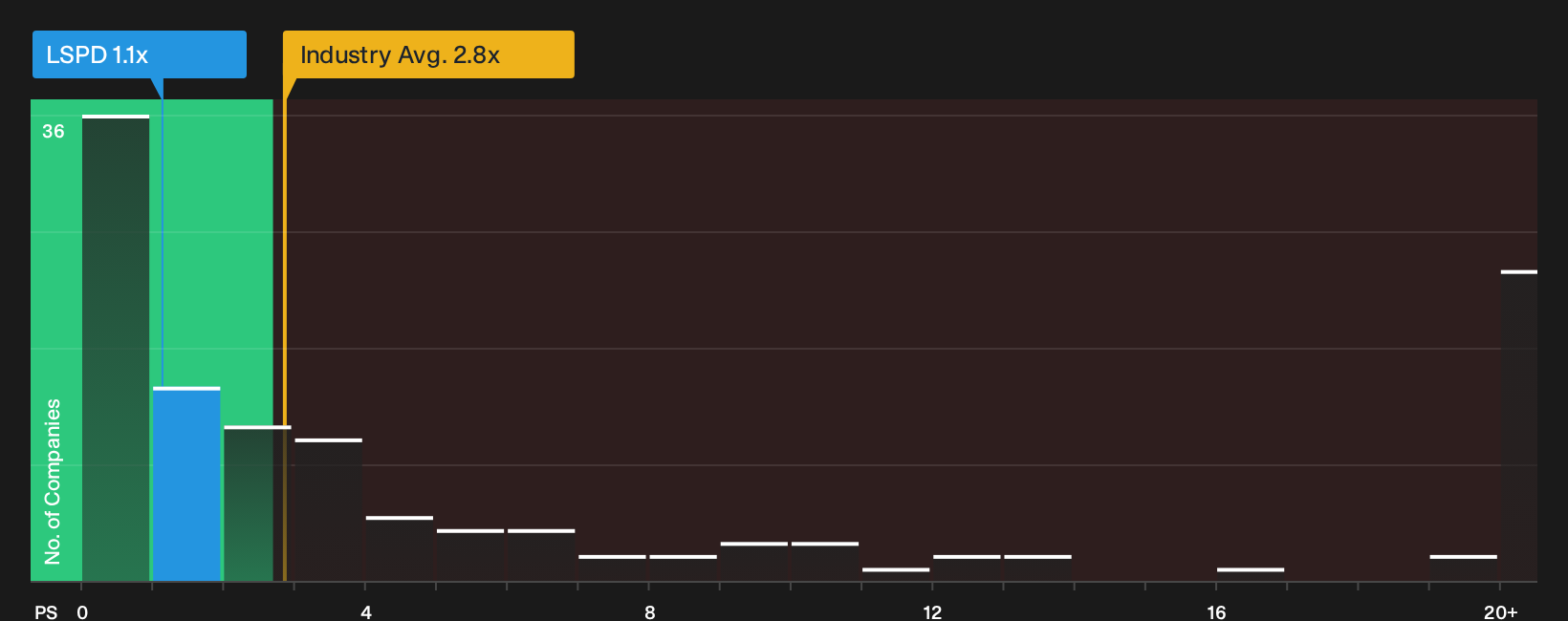
P/S is a useful lens for Lightspeed Commerce because investors are still keying off revenue and payment throughput rather than earnings. On this metric, the stock trades at about 1.1x sales, compared with a Software industry average of roughly 2.8x and a peer group closer to 4.0x.
The fair P/S level implied by Lightspeed Commerce’s own profile, including its margins, size and risk, sits above the current multiple, so the shares screen as undervalued on this framework. Because the recent launch of agentic AI tools has already lifted sentiment, the gap between a 1.1x P/S and richer peer valuations suggests the market is still cautious about paying a higher multiple for that product traction. For anyone comparing this ticker with other software and payments platforms, the current discount on sales raises the question of whether expectations for future execution are too low or simply more realistic than optimistic models imply. Explore the numbers behind Lightspeed Commerce's P/S valuation.
The Lightspeed Commerce Narrative: What Would Justify Today's Price?
Simply Wall St Narratives for Lightspeed Commerce pick up where the P/S puzzle leaves off by spelling out which future paths for growth, margins and earnings would need to occur for the stock to appear meaningfully cheaper or more expensive than today’s price. Each one treats fair value as a thesis about Lightspeed Commerce's business that can be tracked over time, rather than a static snapshot, and they are available on the platform’s Community page.
Bulls and bears on Lightspeed Commerce are looking at the same pivot toward higher margin software and payments, yet drawing opposite conclusions about what the current price reflects.
Bull case: 40% undervalued
"AI driven support and back office automation, already contributing to software gross margin of 83% as more than 80% of support tickets are resolved through AI, creates room for Lightspeed Commerce to redirect service spending toward product and sales while structurally raising software margin and operating leverage..."
Discover why this Narrative puts Lightspeed Commerce at 40% undervalued.
Bear case: 36% overvalued
"Although Lightspeed Commerce is targeting higher payments penetration with transaction revenue and Lightspeed Capital, the recent hardware gross margin turning negative due to heavy discounting and freight costs risks offsetting those gains..."
Explore why this Narrative puts Lightspeed Commerce at 36% overvalued.
The share price is only one piece of the Lightspeed Commerce puzzle
Before you rely too heavily on where Lightspeed Commerce trades on sales, it is worth knowing that Simply Wall St’s broader checks have highlighted specific concerns that could change how you weigh the opportunity. Take a closer look at 1 warning sign before settling on a valuation.
Have feedback on this article? Concerned about the content? Get in touch with us directly. Alternatively, email editorial-team@simplywallst.com