
Is Open Data Center Security Push Altering The Investment Case For Lattice Semiconductor (LSCC)?
- Lattice Semiconductor and AMI have launched SCMP, a new Open Compute Project workstream and architecture for secure, vendor neutral control and management of AI data center infrastructure, alongside the PQC enabled Lattice Sentry v5.0 platform and an Arm collaboration for secure AI server control.
- The grouping of post quantum ready firmware security, rack scale trust standards and Arm based control platforms signals an effort to position Lattice Semiconductor's low power FPGAs and AMI software as a default control layer across heterogeneous AI racks and future data center designs.
- This article will examine how Lattice Semiconductor's investment narrative relates to this focus on open, quantum resistant AI data center control.
Lattice Semiconductor Investment Narrative Recap
Lattice Semiconductor appeals to shareholders who buy into a simple idea. Low power FPGAs and AMI firmware aim to become the control fabric for AI racks, industrial systems and future physical AI platforms. The recent SCMP, Sentry v5.0 and Arm news mostly supports that thesis, but the near term story still hinges on converting design activity into volume deployments.
The shelf registration sits in the background as a tool that could fund more capacity or acquisitions, which may matter if demand scales quickly. The biggest immediate risk stays the same. Supply constraints, tariffs and a concentrated product focus could pressure margins and delay revenue conversion if conditions tighten.
The Lattice Sentry v5.0 launch is the clearest operational link to the SCMP story. It turns post quantum cryptography from a silicon feature into a full platform security stack aligned with CNSA 2.0 and NIST requirements. That directly targets AI data centers and critical infrastructure, where uptime, compliance and secure lifecycle management tend to drive purchasing decisions.
For catalysts, Sentry v5.0 deepens the pitch that Lattice Semiconductor and AMI together offer a ready made secure control platform. If customers standardize around this stack across AI racks and regulated markets, attach rates per system and software pull through could improve. Execution risk remains around integrating firmware, scaling support and managing higher supply chain complexity at rack scale.
What The Current Forecasts Assume For Lattice Semiconductor
Lattice Semiconductor's current analyst set up leans heavily on the idea that secure control inside AI racks turns into a much larger financial footprint over time. The published models sketch out a steep ramp in both revenue and profit, tied to higher content per rack, richer software attachment and a bigger share of system value as AMI and Lattice platforms spread through data center and industrial estates.
Those expectations rest on aggressive top line assumptions. Analysts are modeling revenue growth of 45.0% per year over the next 3 years, which is a demanding pace for any chip supplier, even one tied to AI infrastructure and physical AI systems. For Lattice Semiconductor, that level of compounding implies meaningful share gains in low power FPGAs and secure control, as well as a broad roll out of AMI firmware and management software into existing and new server fleets.
The earnings bridge is even steeper than the sales curve. Consensus points to profit rising from US$36.3 million today to US$537.9 million by 2029, which is roughly a 14x step up in absolute terms. That path depends on margins expanding from 5.6% to 27.1% over the next 3 years as the mix tilts toward higher value security platforms, AI centric control sockets and software heavy bundles, while cost of goods and operating expenses scale less quickly than volume.
Valuation assumptions are tightly linked to that profit story. To line up with the current analyst price targets, Lattice Semiconductor would need to reach US$2.0b of revenue and US$537.9 million of earnings in 2029, then trade on a P/E of 67.0x on those future earnings. That multiple sits above the 49.5x currently quoted for the broader US semiconductor group, so the models are baking in a premium for the combination of secure control focus, AI rack exposure and projected margin profile.
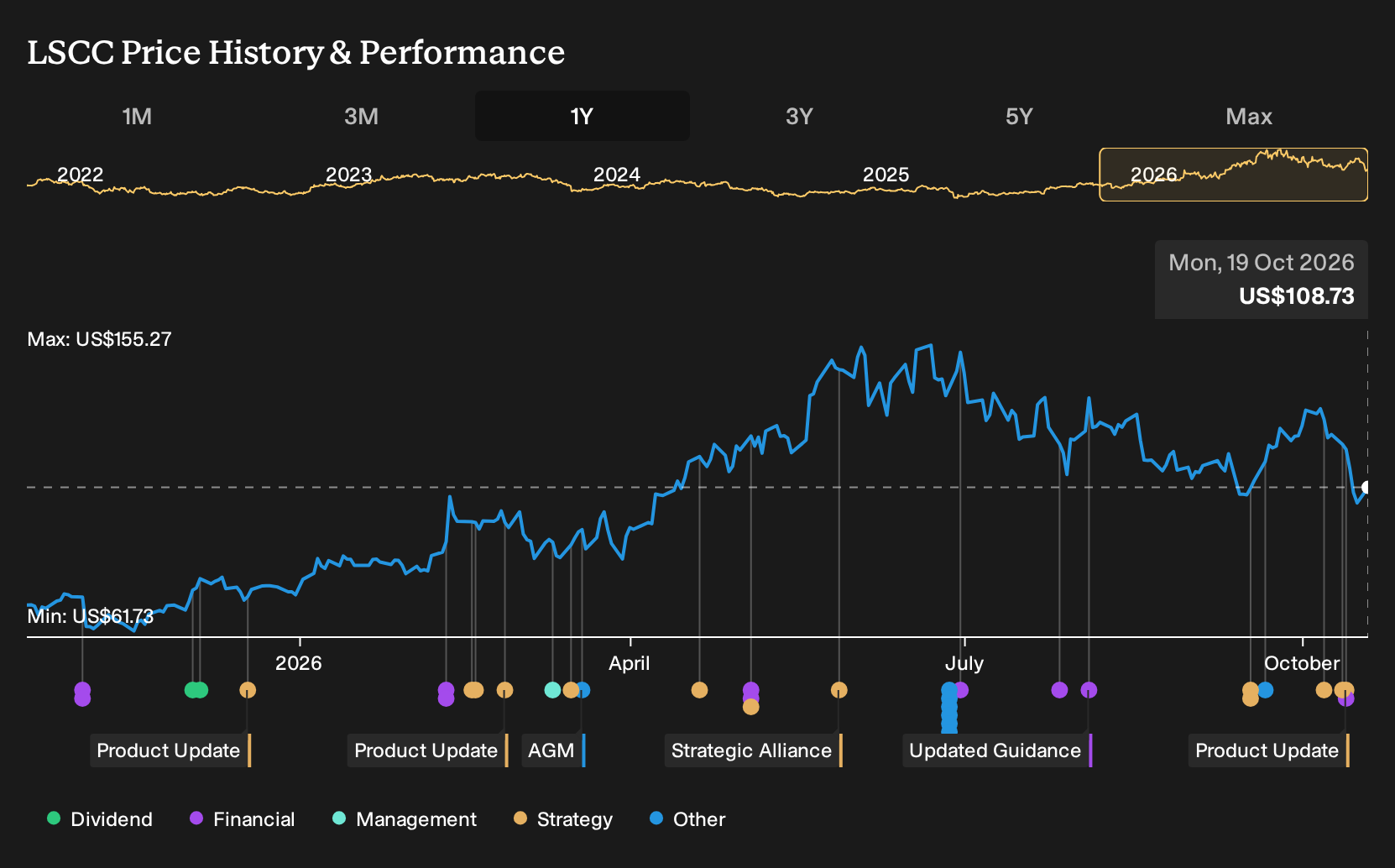
The present gap between the share price of US$128.86 and the consensus target of US$164.54, which is 21.7% higher, effectively reflects how much conviction the market has in that entire chain of assumptions. To bridge that spread, investors would need comfort with continued 45.0% annual revenue growth in the near term, a margin jump of more than 20 percentage points over 3 years and a 2029 earnings base that is multiples of what Lattice Semiconductor reports today. Any material deviation in AI rack deployments, AMI integration progress or supply chain costs could change how realistic that looks.
Lattice Semiconductor's narrative projects US$2.0b revenue and US$537.9 million earnings by 2029. This requires 45.0% yearly revenue growth and an earnings increase of about 14x from US$36.3 million today.
Uncover how Lattice Semiconductor's fair value indicates a 51% potential increase from its current price before the market closes that gap.
Exploring Other Perspectives
One alternate angle focuses less on tariffs and more on potential upside if Lattice Semiconductor executes the AMI software story. The most optimistic analysts were already penciling in US$2.3b of revenue and US$735.0 million of earnings by 2029, well above consensus. Those views were formed before the SCMP and Sentry v5.0 news, so forecasts may shift as different analyst camps revisit their assumptions.
Explore 4 other Lattice Semiconductor fair value estimates, including one that suggests as much as 66% potential upside from the current price.
The Verdict Is Yours
Disagree with existing narratives? Extraordinary investment returns rarely come from following the herd, so go with your instincts.
- A great starting point for your Lattice Semiconductor research is our analysis highlighting 2 key rewards and 1 important warning sign that could impact your investment decision.
- See our latest analysis for Lattice Semiconductor. The report includes a comprehensive fundamental analysis summarized in a single visual, the Snowflake, making it easy to evaluate Lattice Semiconductor's overall financial health at a glance.
Looking for more investment ideas beyond Lattice Semiconductor?
If the Lattice Semiconductor story has sharpened your view on secure AI infrastructure, it can be useful to compare it with other stocks that fit different risk and income profiles. The Simply Wall St Screener helps you quickly sort through a wide universe so you can focus on a short list that matches your own style and constraints.
- For investors who want income to do more of the heavy lifting, scan a curated group of 8 dividend fortresses that combine higher yields with resilient business profiles.
- If capital preservation and steadier fundamentals matter most to you, filter for 32 resilient stocks with low risk scores and see which businesses score well on financial strength and volatility.
- When you are hunting for potential mispriced opportunities off the beaten track, shortlist 20 high quality undiscovered gems that pair strong metrics with relatively low investor attention.
Have feedback on this article? Concerned about the content? Get in touch with us directly. Alternatively, email editorial-team@simplywallst.com