
How Investors May Respond To Jabil (JBL) India AI Partnership
- Adani Enterprises and Jabil signed a non binding MoU for a proposed 50:50 joint venture in India to manufacture and assemble AI racks, servers, storage, networking, power and liquid cooling equipment for multi gigawatt data center infrastructure, with installation and commissioning services included.
- The planned joint venture would connect Jabil directly to India’s expanding AI and data center build out and would create a local export hub for high value infrastructure hardware aligned with Adani’s 5 GW green energy powered hyperscale data center plans.
- We will now examine how Jabil's proposed AI and data center joint venture in India could reshape the existing investment narrative.
Scan the AI infrastructure ripple effects beyond Jabil by reviewing the hand picked 55 AI infrastructure stocks that is driving the build out of data center capacity and high performance computing hardware.
Jabil Investment Narrative Recap
To own Jabil, you need to believe the manufacturer can keep turning its engineering depth and asset light model into higher quality AI infrastructure and regulated industry work, without letting supply constraints or inventory bloat choke execution. The Adani MoU fits directly into this idea by directing more of that AI rack and data center demand toward an India centered build out.
The near term swing factor still sits in Intelligent Infrastructure. Large AI and cloud orders have to translate into clean shipments, stable component availability and improving working capital. The main operational risk remains the same. Tight components or sticky inventory days could crimp free cash flow and limit flexibility on capital returns, even with this new partnership.
The Adani joint venture outline aligns closely with one of the key existing catalysts for Jabil. Management has already highlighted India expansion, including photonics capable facilities, as an opportunity to win more infrastructure and electronics programs. This proposed MoU gives that theme a very tangible AI and data center angle, tied to multi gigawatt rack manufacturing capacity.
For you as an investor, the question is whether Jabil can translate this potential India hub into the guided AI revenue ramp while still managing component supply, debt and inventory discipline. Analyst commentary around earnings and asset use sits in the background, but the main focus is execution on large scale AI hardware programs without margin or cash flow slippage.
What The Current Jabil Forecasts Assume
For Jabil, the Adani joint venture concept lands on top of an already ambitious analyst framework for AI infrastructure and related programs. Consensus numbers point to a company that is expected to scale both revenue and profitability over the next few years while keeping capital intensity relatively contained.
Analysts currently assume Jabil's top line can expand by 16.9% a year over the next 3 years, with profit margins moving from 2.9% today to 4.0% over that same stretch. That margin shift matters more than it looks on paper. A couple of percentage points on multi tens of billions of dollars of sales can be the difference between routine cash generation and the type of earnings profile that supports large buybacks and potential new partnerships.
The earnings bridge is already mapped out. Consensus expects profit to reach about US$2.3b by around October 2029, compared with roughly US$1.0b today, based on the Simply Wall St report. That is an increase of about US$1.3b of annual earnings, tied to both margin expansion and the assumption that high value AI racks, data center hardware and regulated industry projects scale through the rest of the decade.
On the capital side, forecasts also bake in a shrinking share count, with the number of shares outstanding expected to decline by about 1.91% a year for the next 3 years. Buybacks then become a second leg of the story for Jabil alongside any incremental earnings from projects such as the proposed Adani venture. Fewer shares can support earnings per share even if revenue growth slows later in the cycle.
Analysts fold these ingredients into a discounted cash flow style view that uses a 9.15% discount rate in the Simply Wall St framework and references a future P/E of 24.1x on those projected 2029 earnings. The current P/E mentioned in the report is 30.1x, slightly above an indicated 30.3x for the broader US Electronic industry, so the view assumes some compression in the multiple as profits ramp.
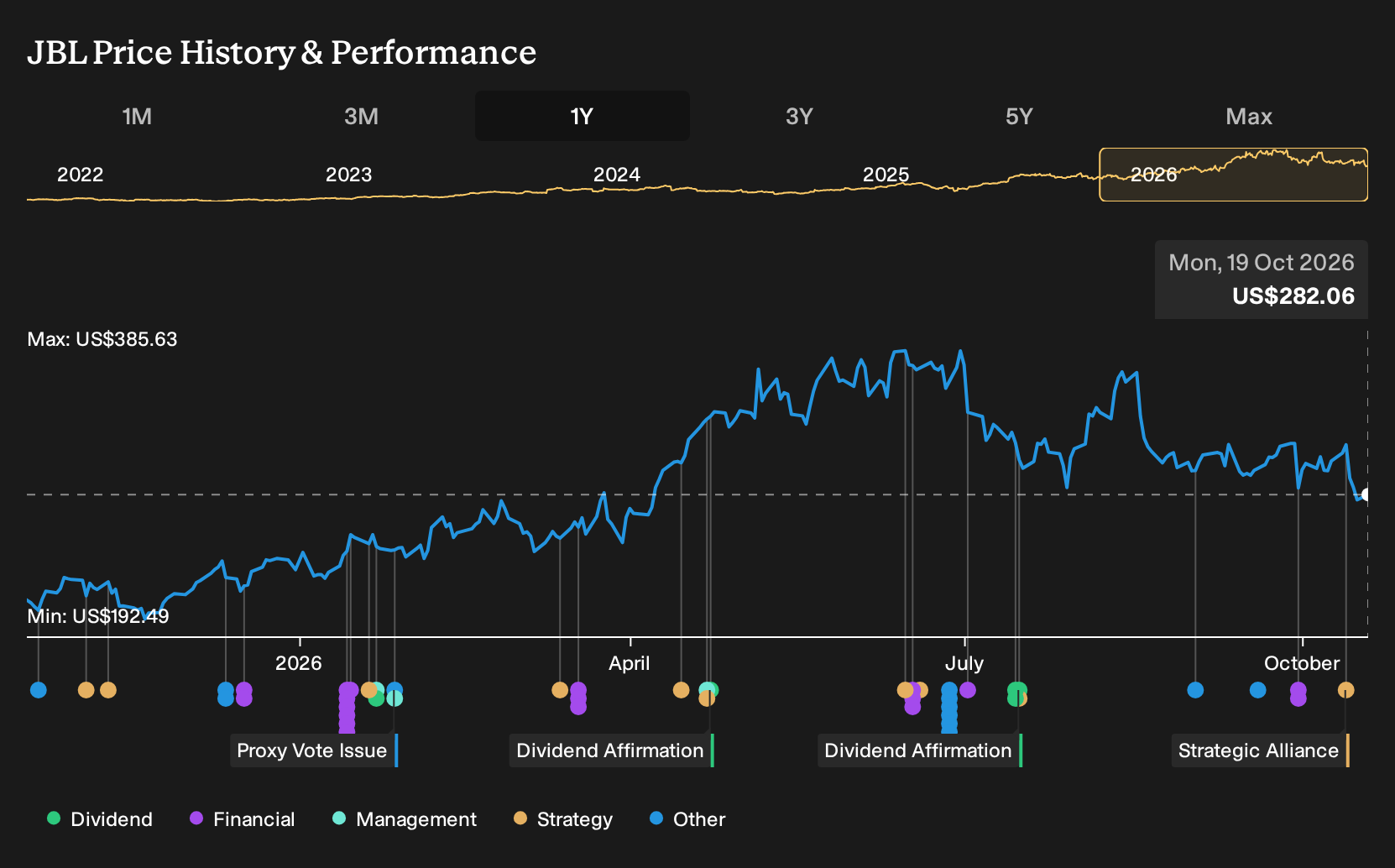
On the valuation side, the consensus price target sits at US$425.00 per share, with a current share price of US$299.47 and a range of US$365.00 on the low end to US$475.00 on the high end. That target implies a materially higher price than today if the forecast for roughly US$57.4b in revenue and US$2.3b in earnings by 2029 proves accurate and the stock trades near a 24.1x P/E on those numbers.
Jabil's narrative projects about US$57.4b in revenue and roughly US$2.3b in earnings by 2029. That path assumes 16.9% yearly revenue growth and an earnings increase of about US$1.3b from the current US$1.0b base.
Uncover why Jabil's fair value indicates a 51% potential upside to its current price that could narrow quickly.
Exploring Other Perspectives
One alternate view is that Jabil’s AI infrastructure push could prove more cyclical than consensus implies. The most bearish analysts were only penciling in about US$53.9b of revenue and US$2.1b of earnings by 2029 before this Adani MoU, and they tied that to a lower 22.0x P/E. This can serve as a reminder that opinions can differ widely and that this new India focused venture may eventually shift both the optimistic and cautious narratives.
Explore 2 other Jabil fair value estimates, including one that suggests it could be worth just $425.00!
Decide For Yourself
Don't just follow the ticker; dig into the data and build a conviction that's truly your own.
- A great starting point for your Jabil research is our analysis highlighting 4 key rewards and 1 important warning sign that could impact your investment decision.
- See our latest analysis for Jabil. The report includes a comprehensive fundamental analysis summarized in a single visual, the Snowflake, making it easy to evaluate Jabil's overall financial health at a glance.
Looking for more Jabil investment ideas?
If you want to broaden your watchlist beyond Jabil and still keep the focus on quality, the Simply Wall St Screener can help you quickly filter for businesses that match your risk tolerance and style.
- If capital preservation is a priority, start with companies that score well on resilience and balance sheet strength by scanning the 32 resilient stocks with low risk scores that may better fit a cautious approach.
- For investors hunting for quality at a reasonable price, use the screener to zero in on candidates with strong fundamentals and appealing valuations through the 35 high quality undervalued stocks that fit those tighter criteria.
- If you are looking for less crowded opportunities, broaden your search into underfollowed companies with solid metrics by reviewing the 20 high quality undiscovered gems that rarely feature on headline lists.
Have feedback on this article? Concerned about the content? Get in touch with us directly. Alternatively, email editorial-team@simplywallst.com