
After a 52-week low, Yingxi reversed Shanghai's Fudan (01385), what did it rely on to reprice?
From October 15 to 16, Shanghai Fudan (01385) broke out of the “reversal of expectations”: the intraday low hit HK$21.14 on the 15th, hitting a 52-week low. Just after the market on the same day, the company disclosed its earnings announcement for the first three quarters of 2026. Net profit for the first three quarters is expected to increase by 187.63% to 248.18% year-on-year; in early trading on the 16th, Hong Kong stocks rebounded in response, with an increase of more than 10% at one point. By the close, Fudan in Shanghai reported HK$2,484, up 13.11%, with a total turnover of HK$272 million.
Within a day, from a “52-week low” to an “intraday increase of more than 10%,” the focus of this round of market was not the absolute value of profit growth, but how the market repriced “excellent performance.”
The “trilogy” of breaking new lows, profitable returns, and capital return completed
By superimposing the price trajectory of the two trading days with the time of the announcement, you can fully see the process of switching capital expectations.
The trading session on the 15th is the last full trading day before the profit forecast is disclosed. Hong Kong stocks fell to a low of HK$21.14 on the same day, breaking a 52-week low, closing at HK$21.96, a decrease of 3.94%. The intraday low was still about 3.73% lower than the closing price. According to the closing decline, the previous trading day closed at around HK$22.86. That is, the stock price fluctuated in a low range throughout the day on the 15th and failed to recover at the end of the session. Market behavior at this stage is essentially an “uncertain discount.”
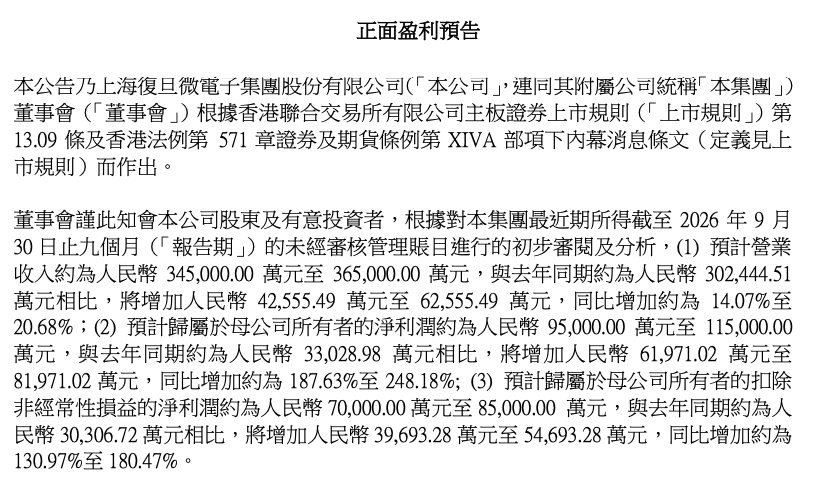
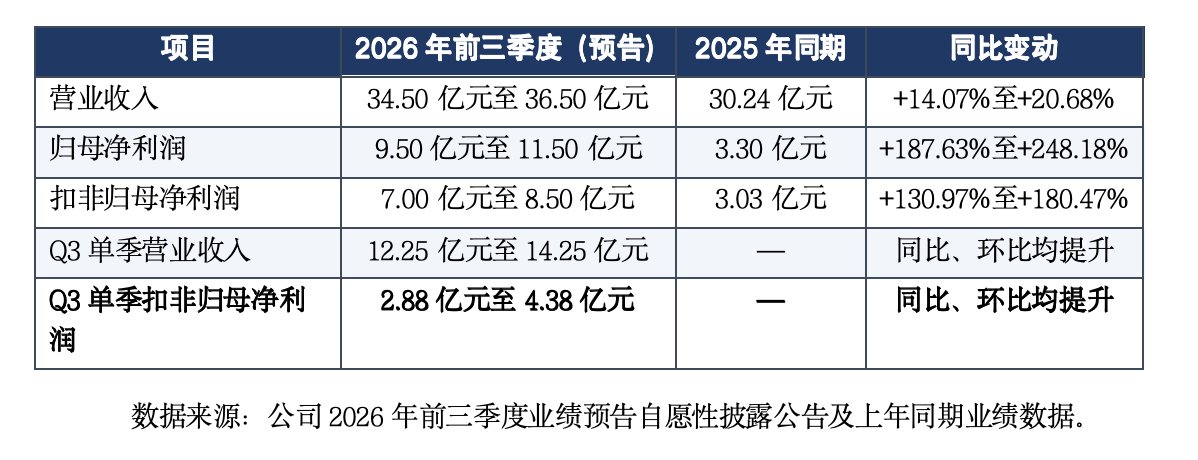
After the market on the 15th, the announcement came to fruition. According to public disclosure information, Shanghai Fudan issued the “Voluntary Disclosure Notice for the First Three Quarters of 2026” after the market: estimated operating income of about 3.45 billion yuan to 3.65 billion yuan, an increase of 14.07% to 20.68%; estimated net profit to mother is about 950 million yuan to 1150 million yuan, an increase of 620 million yuan to 820 million yuan, an increase of 187.63% to 248.18%; net profit without return to mother is estimated to be about 700 million yuan to 850 million yuan, an increase of 397 million yuan to 547 million yuan over the previous year, an increase of 397 million yuan to 547 million yuan, an increase of 397 million yuan to 547 million yuan, an increase of 397 million yuan to 547 million yuan over the previous year. 130.97% to 180.47%.
In early trading on the 16th, Hong Kong stocks undertook a rapid rebound. At one point, the increase was more than 10%, and the corresponding stock price returned above HK$24. At this point, the three steps of “first fall to a new low - profit after the market - return of capital” have been completed, and the price fluctuation range has spanned nearly 30% of market capitalization elasticity. This level of “landing and reversal” does not seem unusual in Hong Kong stocks.
“Two-wheel drive” for restoration of main business and changes in fair value
The expected success of this round of profits in Fudan, Shanghai needs to be dismantled from the two dimensions of main business restoration and investment flexibility. At the business level, benefiting from the recovery in the semiconductor industry, the revenue and comprehensive gross margin of the company's diversified product lines such as FPGAs, security and identification, and non-volatile memory all increased; combined with refined inventory management and dynamic optimization of preparation arrangements, inventory price drop losses declined sharply compared to the same period last year. This shows that the early strategy of actively removing inventory and restructuring has shown results, and the profit inflection point of the main business has been further confirmed.
At the same time, non-recurring profit and loss amplified profit elasticity. During the reporting period, the company confirmed the benefits of large-scale fair value changes through strategic placement of shares held by Shenghe Jingmicro Semiconductor Co., Ltd., and the dividends at the operating level of this capital were directly reflected in explosive growth in apparent profits. What needs to be distinguished, however, is that this type of income is more of a statement elastic, and is not a sustainable operating cash flow.
Judging from the quarterly data, the Q3 negative month-on-month positive growth further strengthened the signal for repair. According to the announcement, the third quarter is expected to achieve revenue of about 1,225 million yuan to 1,425 billion yuan in a single quarter, and net profit after deducting non-return to mother about 288 million yuan to 438 million yuan, an increase of both year-on-year and month-on-month. Structurally, Q3 single-quarter revenue accounted for 35.5% to 39.0% of the first three quarters, and Q3 single-quarter deductions accounted for 41.2% to 51.6% of the previous three quarters. The profit volume for the first quarter was close to the combined level of the two quarters in the first half of the year.
The company itself attributed the changes in the current period to several aspects: adhering to technological innovation and product iteration, continuously expanding product application boundaries, driving revenue growth and product structure optimization; boosting revenue and overall gross margin growth in various product lines; strengthening refined inventory management and dynamic optimization of stocking arrangements, which led to a sharp decrease in inventory price drop losses compared to the same period last year; and increased income from changes in the fair value of strategic placement shares. Among them, the first few items are improvements at the management level, and the last item is reporting income. Together, the two form a “two-wheel drive” that is profitable in this round.
Specifically, the FPGA and vehicle storage product lines form the core growth engine. In terms of FPGA, the company has completed the 28nm PSoC spectral layout, the promotion of FPAI's first 32TOPS computing power chip is progressing well, and is promoting the development of high-end FPGA products based on 1x nm FinFET advanced manufacturing process and 2.5D advanced packaging technology. In terms of vehicle specification storage, the company has mass-produced more than 60 AEC-Q100 grade1 vehicle grade EEPROMs and successfully introduced them into many Tier 1 and OEM supply chains. EEPROM products have broken through the bottlenecks of automotive-grade wide temperature, ultra-wide voltage, and low power consumption technology, and have reached the leading level in the industry in terms of key characteristics such as data erasing life and data retention time; medium- and high-capacity NOR Flash products above 64M have also achieved a sharp rise in sales volume and price. The increase in bicycle semiconductor usage brought about by the centralization of electronic and electrical architectures for new energy vehicles has created a double quantitative and structural dividend for storage and identification devices.
What was the price of the 1-day decline? What did the rebound on the 16th fix?
The stock price hit a new low on the 15th, and market concerns did not come out of nowhere.
On the one hand, domestic FPGA production expansion and price competition pressure. The number of domestic FPGA participants continues to increase. Peer manufacturers have an intensive layout in the middle and low end LUT segment, and the price band has declined markedly. Prices for popular vehicle specification devices have been reduced to a lower range. The market is concerned that general commercial FPGAs will slide from “scarce domestic alternatives” to “homogenized competition and price reduction.” At the same time, there is still an objective gap between the company and overseas leaders in the general commercial FPGA field in terms of manufacturing process, ecology, IP and operator richness, and wiring resource utilization. As a result, the pace of high-end product deployment forms a decisive variable in the gross margin ceiling — once the share of high-end revenue increases less than expected, the transmission of the decline in general product prices will first be reflected in the report.
Another aspect is the continuity of downstream demand. The company's slogan of this round of recovery is “a recovery in industry sentiment and an increase in downstream customer demand,” but the market needs to distinguish between “customer inventory replenishment” and “real terminal demand”: the former brings pre-order placement, and the latter only supports continuous volume and price improvements.
After Yingxi was implemented, the capital's evaluation focus changed from “whether profit multiples are sustainable” to “whether deductions and month-on-month improvements can be continued”. The statement “Q3 deductions did not increase year-on-year and month-on-month” coincided with the above sections 2 (demand continues during the quarter) and 3 (profit entities come from management), and section 1 (price competition) was also mitigated in stages under the statement that “revenue and comprehensive gross margin of each product line grew”. The essence of this round of reversal is that the market used a sharp price fluctuation to once again acknowledge the value of repairing the main domestic chip industry.