
Should Higher Interim Dividend Require Action From Tesco (LSE:TSCO) Investors?
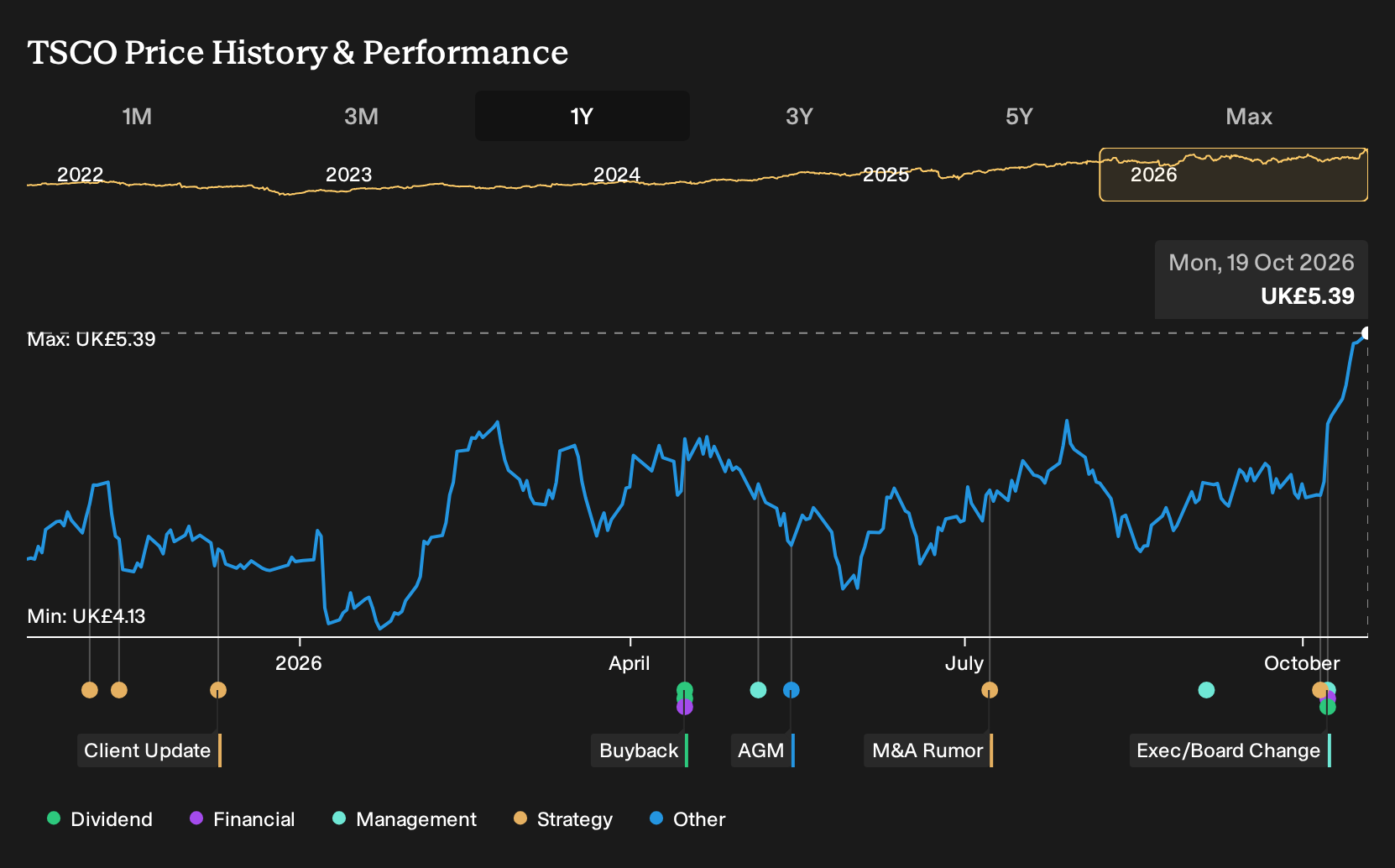
- Tesco reported half year 2026/27 results with revenue of £37,353m, net income of £1,060m and higher earnings per share versus a year earlier, alongside a £550m completed share buyback and an interim dividend of 5.05p per share.
- The higher interim payout, set at 35% of the prior full year dividend and paired with a sizeable repurchase of 117,880,753 shares, puts Tesco’s cash return policy and capital allocation choices firmly in focus for income focused investors.
- The focus now turns to how Tesco’s higher interim dividend shapes the existing investment narrative around cash generation, buybacks and capital discipline.
Tesco Investment Narrative Recap
To own Tesco, you need to be comfortable with a food first retailer that relies on steady U.K. grocery demand, tight cost control and disciplined cash returns rather than big swings in sales growth. The latest half year numbers, including £37,353m of revenue and £1,060m of net income, support that operating story without radically changing it.
In the short term, the main catalyst is whether Tesco can keep offsetting cost inflation and weak U.K. grocery volumes through its Save to Invest efficiencies and higher margin income streams. The biggest operational risk remains pressure on U.K. convenience and any need for heavier promotions, which could squeeze already thin net margins.
The most relevant announcement for that thesis is the £550m share buyback completion, covering 117,880,753 shares or 1.86% of the register. For income focused holders, that sits alongside the 5.05p interim dividend and gives a clearer view of how much cash Tesco is willing to return while still funding its store, digital and supply chain investments.
For catalysts, the repurchase matters because it amplifies any progress on earnings per share. However, it also raises the bar on execution. If competition or weak categories such as convenience and clothing pull on profitability, a large ongoing buyback could limit financial flexibility, which leaves investors watching how management balances further repurchases with operational resilience.
What Analysts Are Baking Into The Tesco Outlook
Consensus expectations for Tesco sketch out a measured growth story rather than a dramatic reset. Analysts are assuming revenue rises by 2.0% per year over the next three years, with profit margins edging from 2.5% today to 3.0% over that window as the Save to Invest program and higher margin income streams do more of the heavy lifting.
Earnings today are put at about £1.9b, with forecasts pointing to £2.4b of profit and earnings per share of £0.39 by 2029. That implies an increase of roughly £0.5b in earnings over the forecast period, which leans on both modest top line expansion and a higher slice of each pound of sales dropping through to the bottom line.
Valuation assumptions in these estimates also matter for income investors thinking about total return. The analyst models use a P/E of 15.7x on those 2029 forecast earnings, compared with 16.4x today and the wider GB Consumer Retailing group at 17.3x, and they apply a discount rate around 8% to bring those future cash flows back into today’s terms.
Tesco's narrative projects £79.6b revenue and £2.4b earnings by 2029. This requires 2.0% yearly revenue growth and an earnings increase of about £0.5b from £1.9b today.
Uncover why Tesco's fair value indicates a 3% potential downside to its current price, a premium that may not be sustained.
Exploring Other Perspectives
Three fair value views from the Simply Wall St Community span roughly £5.22 to £7.31 per share, so you see both punchy optimism and more cautious signals around Tesco. Set that against risks like tighter U.K. grocery competition and weaker convenience performance, and you quickly realise opinions can diverge sharply, so explore multiple viewpoints.
Explore 2 other Tesco fair value estimates, including one that suggests as much as 36% upside from the current price.
Form Your Own Verdict
Disagree with existing narratives? Extraordinary investment returns rarely come from following the herd, so consider taking an independent view.
- A great starting point for your Tesco research is our analysis highlighting 3 key rewards and 1 important warning sign that could impact your investment decision.
- See our latest analysis for Tesco. The report includes a comprehensive fundamental analysis summarized in a single visual, the Snowflake, making it easy to evaluate Tesco's overall financial health at a glance.
Looking For More Investment Ideas Beyond Tesco?
If Tesco’s mix of income, buybacks and measured forecasts appeals to you, it can be useful to line it up against other listed businesses with different strengths. The Simply Wall St Screener helps you quickly filter for specific traits so you can compare Tesco’s profile with a wider set of cash generative or resilient stocks.
- If you want to prioritise valuation and quality together, scan our curated 8 high quality undervalued stocks that combine solid fundamentals with appealing pricing.
- If resilience is higher on your checklist, focus on companies with steadier risk profiles by reviewing the 4 resilient stocks with low risk scores that pass our tougher risk filters.
- If you are hunting for businesses with healthier finances, start with the list of solid balance sheet and fundamentals (9 results) and compare their balance sheet strength with Tesco’s position.
Have feedback on this article? Concerned about the content? Get in touch with us directly. Alternatively, email editorial-team@simplywallst.com