
Should Senior Europe Hire Require Action From Lazard (LAZ) Investors?
- Lazard recently appointed David Krap as Managing Director and Co-Head of European Consumer, Retail & Leisure, adding more than two decades of consumer-focused M&A advisory experience to its London based European financial advisory practice.
- The hire deepens Lazard's sector coverage in food, beverage, home and personal care, and selected consumer health, which could influence how effectively the advisory franchise captures fee opportunities in those categories.
- Next, the focus will be on how Lazard's investment narrative could shift as it integrates Krap into its European advisory build out.
Lazard Investment Narrative Recap
To hold Lazard, you need to believe the firm can turn its retooled advisory and asset management platform into steadier fees and a lower compensation ratio over time. The big near term swing factor is execution on the private capital pivot and MD refresh, including integrating Campbell Lutyens and newer senior hires into a coherent deal engine.
The biggest risk remains cost discipline and earnings quality if compensation stays elevated while AUM or deal volumes soften. The Krap appointment looks incremental rather than transformational in the short run. It deepens consumer coverage but likely does not change the core near term catalyst or main risk on its own.
The most relevant recent move for this hiring story is Lazard’s decision for CFO Tracy Farr to also take on principal accounting officer duties after the planned departure of Chief Accounting Officer Michael Gathy in December 2026. You now have finance, accounting oversight and external messaging concentrated with one executive at a time when the firm is reshaping its advisory franchise.
For investors watching catalysts, that extra responsibility lands while Lazard is absorbing Campbell Lutyens, rolling out AI and expanding its senior banker bench with people like David Krap. Tight alignment between finance and accounting could help the group keep a close handle on compensation, capital allocation and reporting, which matters if revenue, margins or leverage come under pressure.
Lazard Consensus Forecast Check
Lazard's current analyst framework ties the hiring theme directly into the numbers that sit behind the stock. Consensus assumes revenue growth of 12.6% each year over the next three years, with profit margins rising from 6.8% today to 11.0% by 2029. On that view, earnings are expected to move from US$219.0 million today to US$501.8 million by 2029, which is an increase of about US$283 million. The same models also reference 2029 revenue of US$4.6b and a P/E of 11.8x on those forecast profits, compared with 15.4x today, while shares outstanding are assumed to expand by 2.71% a year.
Lazard's narrative projects US$4.6b revenue and US$501.8 million earnings by 2029. That path reflects 12.6% yearly revenue growth and an earnings increase of about US$283 million from US$219.0 million today.
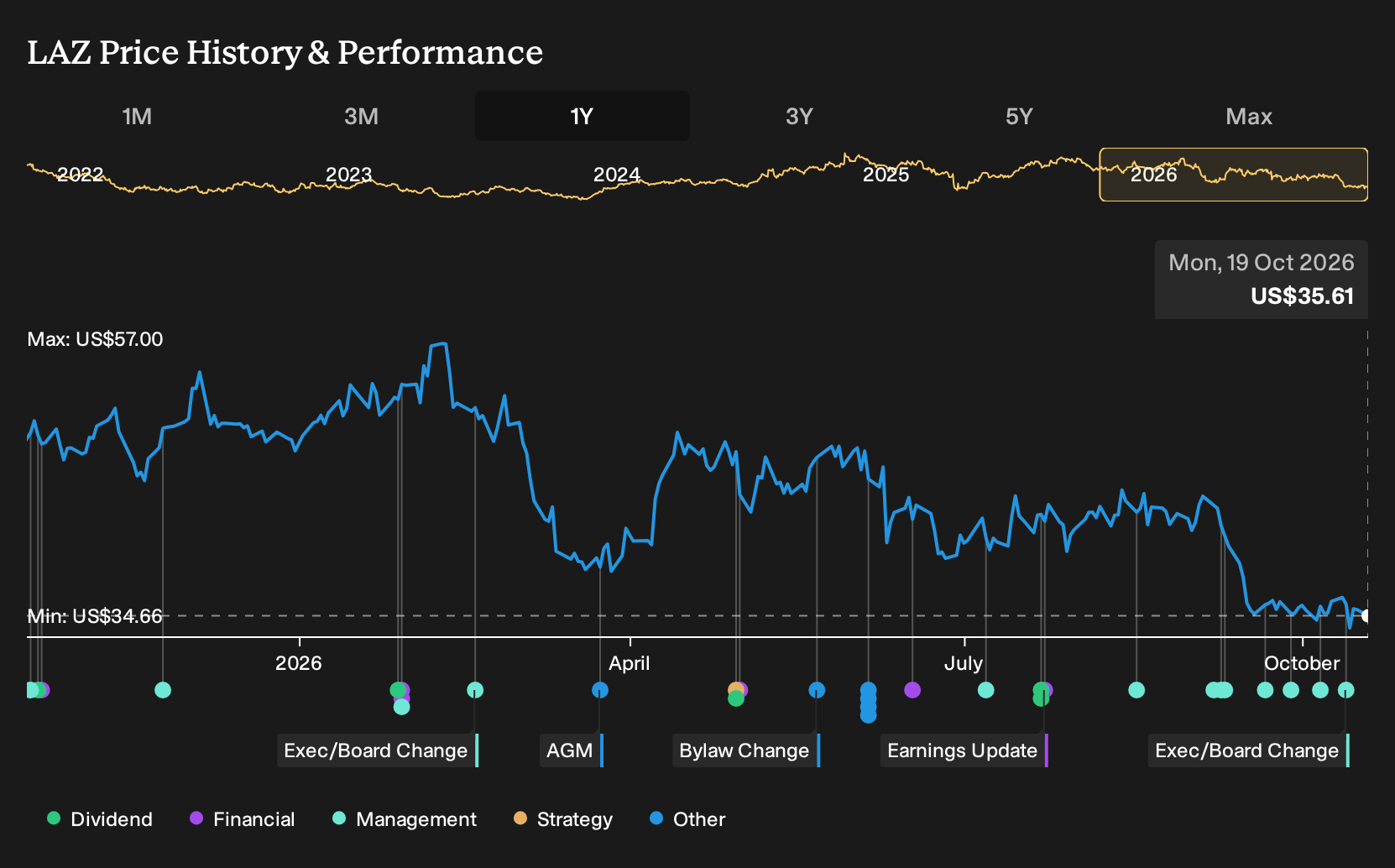
Uncover how Lazard's fair value indicates a potential 20% upside to its current price that may not last much longer.
Exploring Other Perspectives
One alternate view puts the compensation ratio front and center. The most bearish analysts already assumed Lazard would need an 8.3x P/E on 2029 earnings of about US$528.3 million and roughly US$4.4b revenue to justify a US$32.0 price target. Those figures came before this hiring news, so opinions and models may shift as the story evolves.
Explore 4 other Lazard fair value estimates, including one that suggests as much as 16% downside from the current price.
Reach Your Own Conclusion
Don't just follow the ticker; dig into the data and build a conviction that's truly your own.
- A great starting point for your Lazard research is our analysis highlighting 3 key rewards and 3 important warning signs that could impact your investment decision.
- See our latest analysis for Lazard. The report includes a comprehensive fundamental analysis summarized in a single visual, the Snowflake, making it easy to evaluate Lazard's overall financial health at a glance.
Looking for more Lazard style investment ideas?
If Lazard's story has you thinking about where else disciplined fee earners or resilient balance sheets might show up, it helps to scan a wider opportunity set with a consistent framework.
- For investors who want potential mispricing rather than headlines, start with companies that clear quality checks yet still trade at compressed valuations by reviewing 35 high quality undervalued stocks.
- If income is a priority and you care about cash reliability, focus on businesses built around steady payouts by scanning 8 dividend fortresses.
- When capital preservation ranks highest and you prefer fewer surprises in rough markets, concentrate on businesses with sturdier financial profiles using the 32 resilient stocks with low risk scores.
This article by Simply Wall St is general in nature. We provide commentary based on historical data and analyst forecasts only using an unbiased methodology and our articles are not intended to be financial advice. It does not constitute a recommendation to buy or sell any stock, and does not take account of your objectives, or your financial situation. We aim to bring you long-term focused analysis driven by fundamental data. Note that our analysis may not factor in the latest price-sensitive company announcements or qualitative material. Simply Wall St has no position in any stocks mentioned.
Have feedback on this article? Concerned about the content? Get in touch with us directly. Alternatively, email editorial-team@simplywallst.com