
Why December 3 Could Be a Critical Date for Tesla and SpaceX Stocks
Tesla (TSLA) and SpaceX (SPCX) could be moving toward a possible merger. Barclays analyst Dan Levy believes that the announcement could come before Tesla’s annual meeting, which has now been set for Dec. 3. Although the idea of a merger remains speculative, CEO Elon Musk has lent credence to the theory, highlighting the overlap between the two companies on an earnings call.
Levy considers the upcoming Terafab semiconductor manufacturing facility to be a “key driver” behind this possible combination. Moreover, Tesla’s robotaxis run on xAI’s fleet-management software, while its vehicles connect through Starlink and its Optimus robots use Grok.
With so much overlap, Levy sees the benefits of the vertical integration post-merger. However, combining these two trillion-dollar giants would face significant scrutiny, even if a merger were to gain approval from both Tesla and SpaceX's boards.
Ahead of the upcoming annual meeting and Tesla’s impending earnings on Oct. 21, let's take a closer look at both of these companies individually.
Stock #1: Tesla (TSLA)
Tesla designs, manufactures, and sells electric vehicles (EVs), energy storage systems, solar products, and charging infrastructure, operating factories and service networks around the world. Recent developments include the Cybercab robotaxi, Tesla's Robotaxi expansion, Optimus humanoid robots, Megapack growth, and the next-generation Roadster planned for production in 2028. Tesla currently has a market capitalization of $1.4 trillion.
TSLA stock has fallen 18% over the past 52 weeks on weaker margins, heavy artificial intelligence (AI) spending, EV competition, and doubts about its robotaxi valuation. Shares have also dropped 8% over the past six months. TSLA stock reached a 52-week low of $297.38 on July 29, but shares are now up 24% from that level.
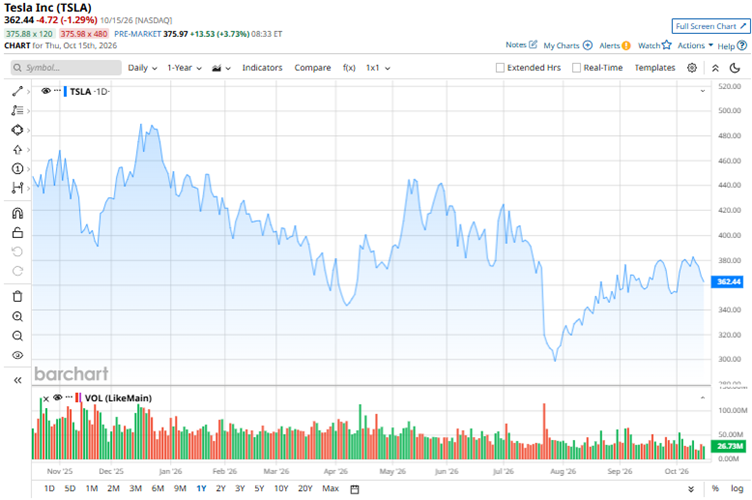
Despite the selloff, Tesla still trades at a lofty valuation. For example, its forward price-to-earnings (P/E) ratio of 523.6 times is significantly higher than the industry average of roughly 15 times.
Tesla’s second-quarter automotive revenue increased 23% year-over-year (YOY) to $20.52 billion, as vehicle deliveries increased 25% from the prior-year period. Total revenue climbed 26% YOY to $28.24 billion. However, non-GAAP EPS decreased 18% YOY to $0.33. In Q2, active Full Self-Driving (FSD) subscriptions also increased 56% YOY to 1.48 million.
Analysts are tepid on Tesla’s future bottom-line trajectory. For the current year, diluted EPS is expected to decline 35% YOY to $0.71, followed by a 65% increase to $1.17 in fiscal 2027. For Q3, analysts expect EPS to decline 41% YOY to $0.22.
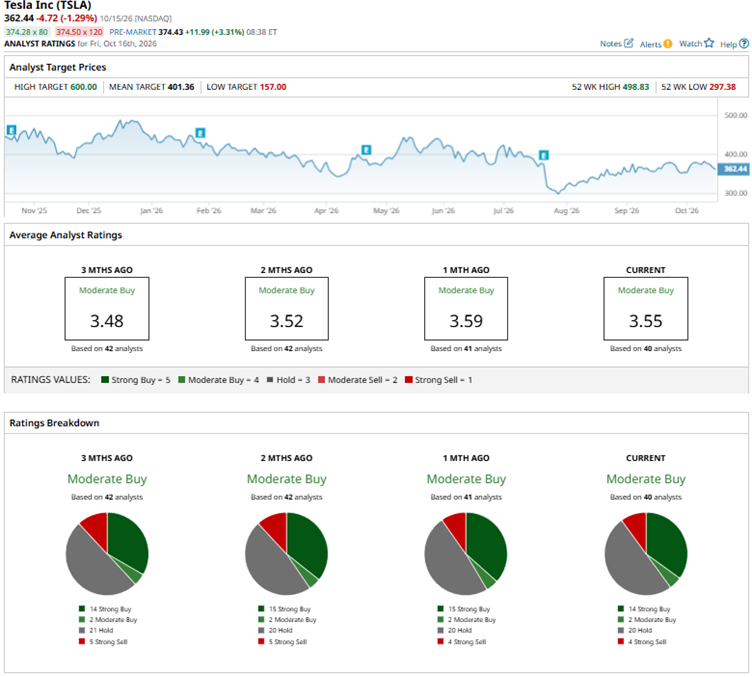
Still, Wall Street analysts remain bullish on Tesla stock with a consensus “Moderate Buy” rating. Of the 40 analysts rating the stock, 14 have a “Strong Buy” rating, two analysts have a “Moderate Buy,” 20 analysts have a “Hold” rating, and four suggest a “Strong Sell” rating. The average price target of $401.36 represents potential upside of 9% from current levels. Moreover, the Street-high price target of $600 reflects potential upside of 63% from here.
Stock #2: SpaceX (SPCX)
SpaceX designs and launches reusable rockets — including Falcon 9, Falcon Heavy, and Starship — operates the Starlink satellite-internet network, and provides launch services for commercial, government, and defense customers. Recent developments include Starship’s first orbital flight and Starlink V3 deployment on Sept. 28, continued Falcon 9 launches, and a proposal to expand Starship launches from Starbase, Texas. SpaceX has a market capitalization of $1.92 trillion.
SPCX stock is up 20% over the past three months as shares recover from a sharp selloff following SpaceX's initial public offering (IPO). However, the rebound has been capped by heavy insider-share unlocks and large AI spending concerns. SPCX stock is down 9% over the past five days. The stock reached a recent high of $176.42 on Oct. 6 but is currently down 17% from that level.
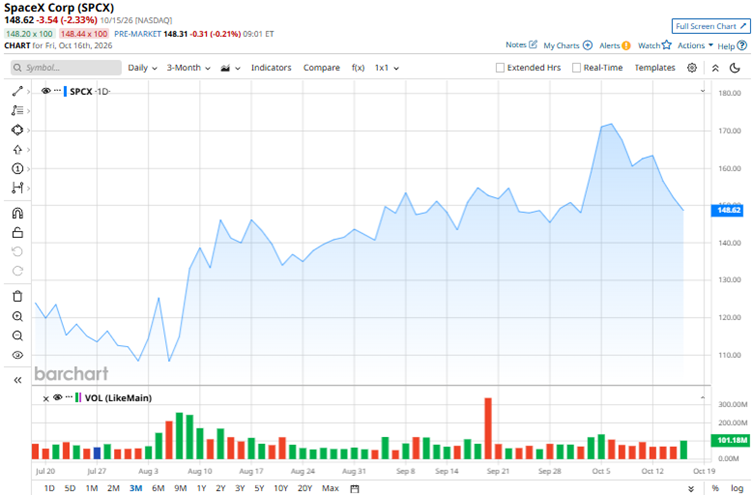
SpaceX has a very demanding valuation. For instance, the forward price-to-sales (P/S) ratio of 104.9 times is significantly higher than the industry average.
In the second quarter, revenue increased 92% YOY to $7.8 billion. This was mainly driven by the Connectivity segment, which generated $4.29 billion in revenue, up 66% YOY, fueled by strong Starlink subscriber growth.
For the current fiscal year, EPS is projected to reach $0.07, followed by a considerable improvement to $1.94 in fiscal 2027. For Q3, SpaceX is projected to earn $0.11 in EPS.
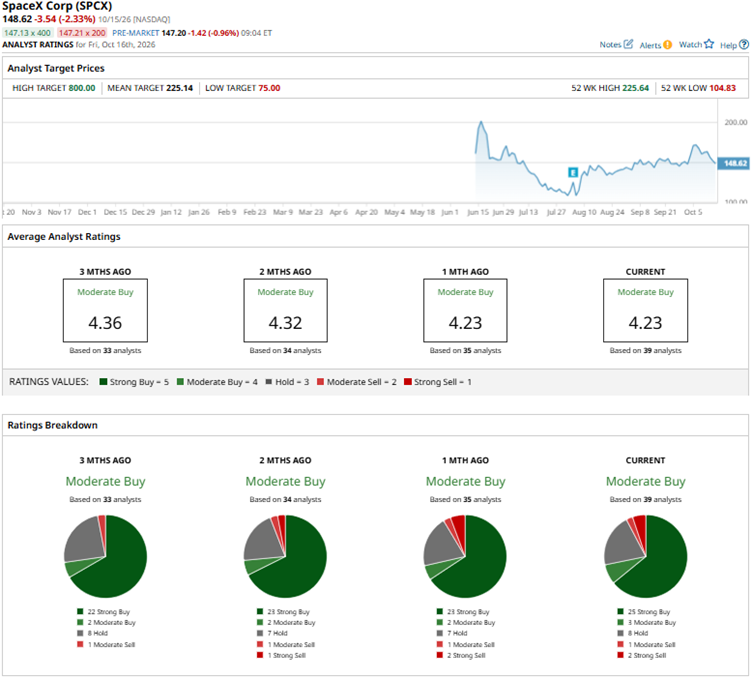
SpaceX has become popular on Wall Street, with analysts awarding SPCX stock a consensus “Moderate Buy” rating. Of the 40 analysts with coverage, 26 analysts have a “Strong Buy,” three analysts suggest a “Moderate Buy,” eight analysts have a “Hold” rating, one analyst suggests a “Moderate Sell,” and two analysts have a “Strong Sell” rating. The average price target of $225.14 represents potential upside of 52% from current levels, while the Street-high price target of $800 indicates a massive potential climb of 441% from here.
On the date of publication, Anushka Dutta did not have (either directly or indirectly) positions in any of the securities mentioned in this article. All information and data in this article is solely for informational purposes. For more information please view the Barchart Disclosure Policy here.