
McDonald's Stock And Labor Policy Why Margins Matter Now
The Supreme Court’s decision to leave expanded presidential power over independent agencies intact has quietly changed the rules of the game for labor intensive giants in consumer and hospitality. If future NLRB policy leans more employer friendly, wage and union pressures could shift and so could profit pools. This piece walks through three large cap U.S. stocks exposed to that story and explains why this regulatory twist may matter for your watchlist.
The stocks covered next are just a small sample of what this labor story touches. The full screen surfaced 51 more large cap consumer and hospitality companies with equally compelling narratives that are not addressed in the list below. To go straight to the source and analyze, compare, and identify potential high conviction ideas for your own watchlist, head into the U.S. Large-Cap Labor-Intensive Consumer & Hospitality Stocks screener.
McDonald's (MCD)
Overview: McDonald's runs a vast quick service restaurant network in the U.S. and abroad, where hourly staffing and wage rules directly shape profitability.
Operations: McDonald's generates about US$10.96b from the U.S., US$14.18b from International Operated Markets, and US$2.56b from International Developmental Licensed Markets & Corporate.
Market Cap: US$171.94b
For a labor intensive franchise system like McDonald's, any change in how regulators treat joint employer rules and staffing flexibility can quickly reshape the economics of each restaurant.
However, the weakness of the economy and consumer spending will put pressure in revenue growth during the next couple of years, coupling with the fact that a more health aware customer (resulting, or not, from new obesity drugs) will probably opt for other choices.
What ultimately matters is whether one quiet shift in labor policy lets McDonald's protect margins faster than customer habits and traffic patterns evolve.
That tug of war between margin protection and shifting customer habits is exactly what the full narrative for McDonald's unpacks, including how labor, pricing and traffic could be decoupling.

Starbucks (SBUX)
Overview: Starbucks is a large U.S. centered coffeehouse operator where thousands of baristas, schedules, and store level policies make labor rules especially important.
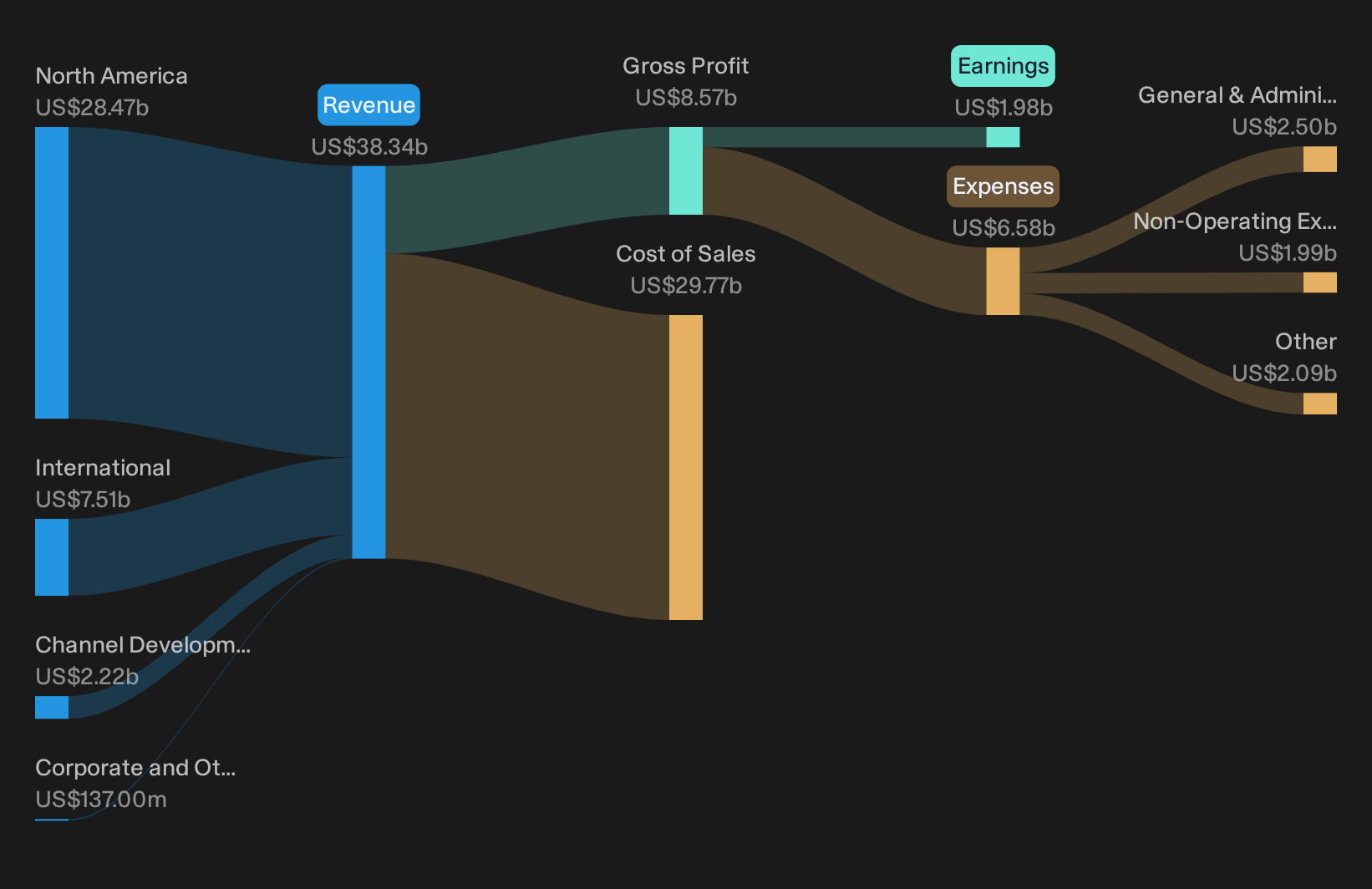
Operations: Starbucks generates about US$28.47b from North America, US$7.51b from International, US$2.22b from Channel Development, and US$137m from Corporate and Other.
Market Cap: US$111.15b
Starbucks sits close to the bullseye of this screener theme because every NLRB tilt feeds straight into how its cafes are staffed, paid, and managed day to day.
The Back to Starbucks plan, including Green Apron Service, standardized store scorecards, and a $2b cost-savings program through fiscal 2028, is still in progress and is expected to continue affecting operating margins and earnings as more of the targeted savings and process changes flow through the P&L.
What ultimately matters for Starbucks is how one unresolved labor pressure point interacts with this efficiency push to shape future margins.
That margin puzzle is exactly what the full narrative for Starbucks unpacks. It reveals how labor shifts, traffic patterns, and efficiency gains could be quietly accelerating Starbucks earnings power.
Kroger (KR)
Overview: Kroger is a major U.S. grocery and drug retailer with unionized, hourly staff across supermarkets, multi department stores, marketplaces and warehouses.
Operations: Kroger generates about US$149.33b from Retail Operations in the United States, reflecting a heavily labor intensive domestic grocery footprint.
Market Cap: US$37.58b
Kroger brings the screener theme into everyday life, where union contracts, scheduling rules and store staffing choices directly shape what is left after a low margin grocery dollar.
The rapid growth in Kroger's e-commerce business, highlighted by adjusted online sales rising around 19% to 20% and the shift of this operation including media into profitability for two consecutive quarters, has been noted by management as an important development for the business as more grocery demand moves online.
What happens to those thin grocery margins if one quiet cost lever in this labor heavy model pulls harder than most investors expect?
If that cost lever has your attention, the full narrative for Kroger maps how Kroger’s labor, e-commerce and union mix could be quietly accelerating long term earnings power.

Seeking Alternatives Before The Crowd
Fresh ideas move first. Breakout trends, shifting momentum, and under the radar stories get priced fast. Use these curated lists while it matters and get in early.
- Spot potential income workhorses and scan a curated pool of high yield payers using the 8 dividend fortresses before the best entry points get caught by others.
- Track early movers in automation and hunt for operators powering the next productivity wave with the 92 robotics and automation stocks while many investors are still looking the other way.
- Zero in on resilient balance sheets and sift through a hand picked list of solid balance sheet and fundamentals (25 results) list before sentiment swings and these sturdier profiles start attracting fast money.
This article by Simply Wall St is general in nature. We provide commentary based on historical data and analyst forecasts only using an unbiased methodology and our articles are not intended to be financial advice. It does not constitute a recommendation to buy or sell any stock, and does not take account of your objectives, or your financial situation. We aim to bring you long-term focused analysis driven by fundamental data. Note that our analysis may not factor in the latest price-sensitive company announcements or qualitative material. Simply Wall St has no position in any stocks mentioned.
Have feedback on this article? Concerned about the content? Get in touch with us directly. Alternatively, email editorial-team@simplywallst.com