
Over $1 trillion lease, 24GW construction site, +50GW in 2027: the theory of excess AI is being falsified by ground data
The Zhitong Finance App learned that recently, the “new cloud vendor” CoreWeave (CRWV.US) fell more than 30% in just eight trading days. In particular, on October 14, the stock fell 15.46% in a single day. The yield on its unsecured bond due in 2032 once approached 15%. The five-year credit default swap spread soared to a record high of 1194.5 basis points, and the probability of default over the next five years as set by the credit market is over 60%. Nebius (NBIS.US) fell by more than 30% during the same period, SK Hynix (SKHY.US) US stocks have fallen by more than 30% since October 6, and the NASDAQ 100 index has accumulated a cumulative pullback of more than 4% over the past three days.
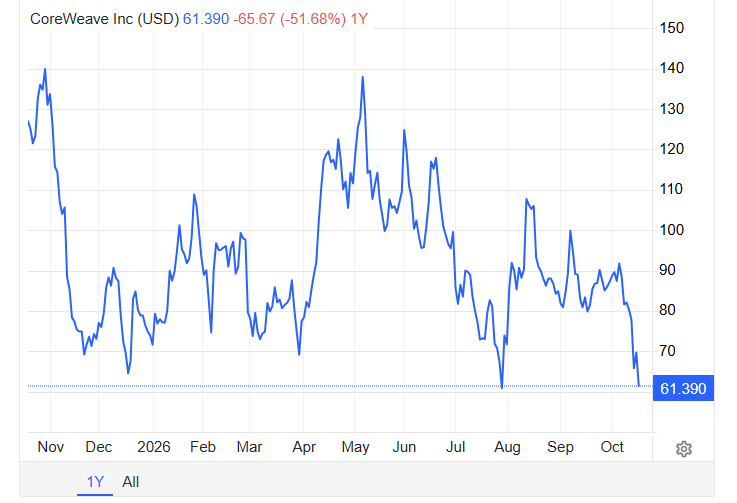
On the face of it, this is a sell-off panic about “AI overcapacity”: Gartner released a forecast in October saying that by 2030, more than 80% of new cloud vendors may close due to cost pressure and lack of differentiation in business models, and estimates that AI infrastructure spending over $3.5 trillion is at risk of depreciation.
However, interpreting Coreweave's credit problem as a global oversupply of AI computing power may be a category-level mistake. CoreWeave's problem is first and foremost a question of a specific financing structure, not an issue of total supply and demand; and the leading indicator that actually points to the 2027 computing power trend is describing a narrative that is diametrically opposed to “excess.”
Misunderstood Selling: New Cloud Venders' Financing Vulnerability ≠ Total Excess Computing Power
CoreWeave's decline has its own clear chain of cause and effect. The three co-founders have cashed out a total of $3.3 billion since their IPO in March 2025, and sold $2.4 billion in shares in 2026 alone.
The company's consolidated debt and lease obligations had reached about US$52 billion by the end of June. The annual capital expenditure forecast was raised by US$4 billion to a maximum of US$39 billion in August, while Visible Alpha's market consensus forecast shows that its cumulative negative free cash flow from 2026 to 2028 will reach US$71 billion.
Notably, the credit ratings of CoreWeave's entities are all speculative — Moody's BA3, S&P B+, Fitch BB-. Although CoreWeave delivered a loan of 8.5 billion US dollars in March of this year, using chip assets and Meta (META.US) long-term computing power procurement contracts as collateral, and obtained complete investment grade ratings from Moody's A3, DBRS A (low), and Fitch a-SF, anchored by Blackstone Credit & Insurance. The participants included a group of global financial institutions and insurance investors, and there was a “meaningful” excess in the subscription.
But this investment grade rating is for its specific deal, not the company CoreWeave. The borrower is a bankrupt and isolated special purpose company. The loan is secured by all of its assets, and there is no recourse against the parent company. The rating agency targeted the cash flow from Meta's contract, plus the residual value of Nvidia (NVDA.US) chips, not CoreWeave's balance sheet.
In other words, the market prices CoreWeave the refinancing risk of a single counterparty with high leverage, negative cash flow, and rolling financing in the short-term capital market, rather than the macro-judgment that “AI computing power is so high that no one needs it.”
Gartner's warning also points to the fate of the integration of new cloud vendors as a specific business format. The core argument is that “enterprise and consumer AI revenue alone is not enough for many AI companies to reap profit returns.” This is a reasonable review of computing power resellers with weak financing structures and lack of differentiated moats, but shifting it to being bearish on overall data center production capacity is tantamount to mistaking the balance sheet of a highly leveraged participant as the supply and demand curve for the entire industry.
First-line signals from the industry: limited production capacity, not overcapacity
In stark contrast to the financial market narrative, business executives directly involved in the operation of computing power infrastructure are describing a situation where supply catches up with demand.
Pat Gelsinger, former CEO of Intel (INTC.US) and current general partner of Playground Global, made it clear in an interview that AI demand is “almost limitless,” and that the real constraint is energy supply, not the demand for computing power itself. Marc Boroditsky, Chief Revenue Officer of Nebius, also stated: “Demand far exceeds our ability to fulfill contracts, and this has been the norm for some time now.”
Andrew Feldman, CEO of Cerebras Systems (CBRS.US), characterized the previous move by Meta and XAI to sell idle computing power as an “individual case” and emphasized that “as far as the industry is concerned, demand for computing power far exceeds existing production capacity.” Michael Hurlston, CEO of photonics and optical connectivity supplier Lumentum (LITE.US), revealed that orders for optical components have been filled until early 2029.
The financial disclosures of hyperscale cloud vendors provide supporting evidence in the same direction. Microsoft (MSFT.US) made it clear during the conference call for the fourth quarter of fiscal year 2026 that Azure demand continues to exceed usable capacity, “this pattern of imbalance between supply and demand has not been mitigated in the short term,” and plans to invest about 190 billion US dollars in capital expenditure in the 2026 natural year, adding 1 gigawatt of computing power capacity and opening 31 new data centers during the quarter. Amazon (AMZN.US) AWS Chief Financial Officer also recently publicly refuted the bubble theory, saying that the current spending boom in AI infrastructure and related services is sustainable in the long term. The core reason is that such investment is spawning various innovative results with real value.
If computing power actually becomes excessive, a cloud platform based on enterprise-level contracts and multi-year commitments as revenue will not repeatedly confirm “insufficient supply” for many consecutive quarters.
An overlooked leading indicator: Acceleration in 2027 is not a “wish”, but concrete that is already being poured
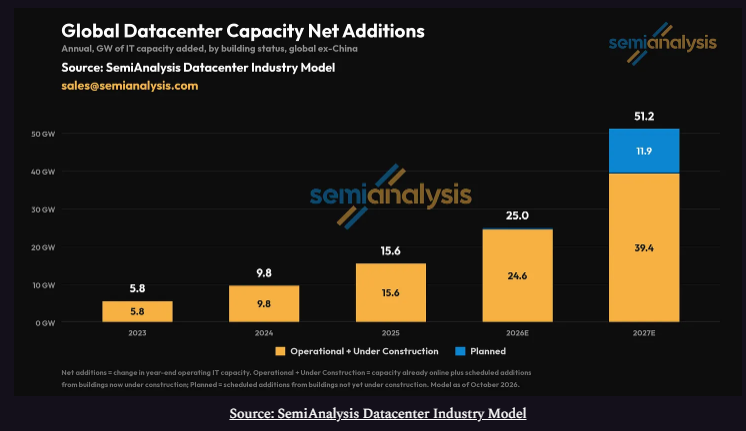
In a report released on Monday, SemiAnalysis gave a far more aggressive judgment than “adding 43 GW”: the global IT capacity of new data centers will reach about 50 GW in 2027, which is equivalent to replicating the cumulative global data center market built up to 2024 within one year. This prediction is not based on a linear extrapolation of AI narratives, but is based on two observable leading indicators.
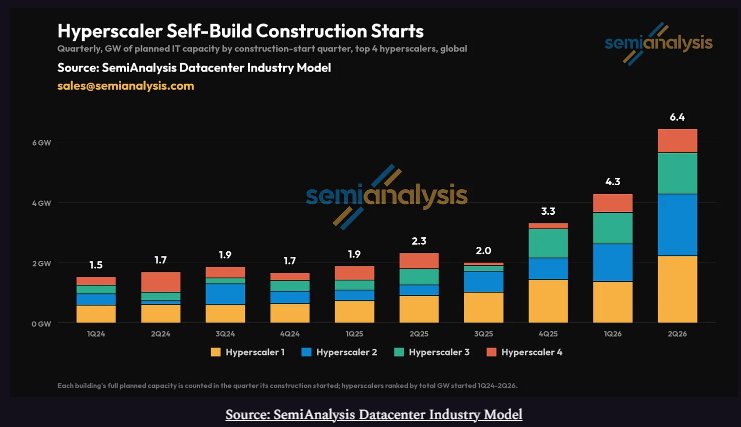
The first indicator is the quarterly self-construction commencement volume. SemiAnalysis tracks the construction progress of each data center of US hyperscale manufacturers, building by building. The conclusion is that “US hyperscale manufacturers have never started so many data center construction”, and the number of megawatts starting quarterly is rising in a parabolic manner.
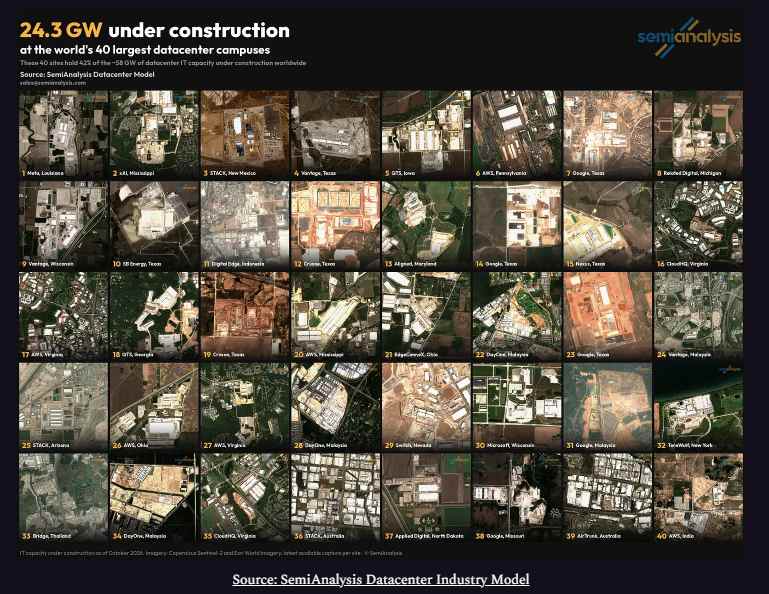
Only 40 parks — a very small share of hundreds of late-stage construction projects — correspond to more than 24 GW of capacity, most of which are halfway through construction, and external cooling and electrical equipment has already been installed.
The second indicator is the locking of rental contracts. Data center developers usually invest only 5% to 10% of the project capital without customers, and must rely on 15 to 20 year pre-lease contracts to leverage debt financing. The total contract value is between 30 billion and 50 billion US dollars per gigawatt. In the first three quarters of 2026, the total value of signed and completed data center lease contracts tracked by SemiAnalysis was over $1 trillion, of which binding and irrevocable contracts from the beginning of 2026 alone are close to $1 trillion.
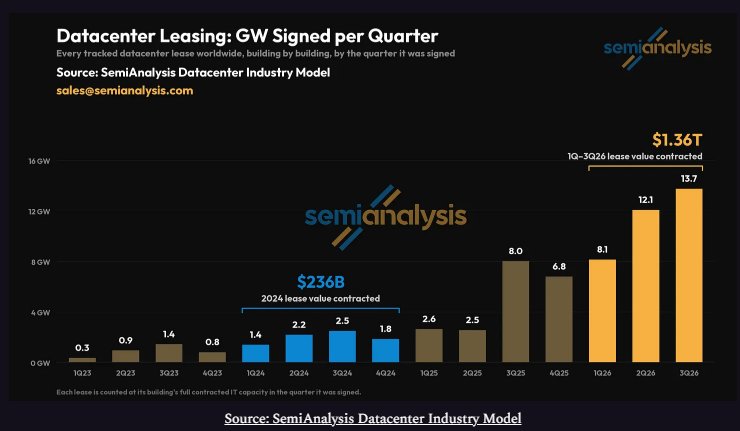
According to SemiAnalysis, Oracle (ORCL.US) completed a data center IT capacity lease of about 4.5GW between August and October 2025, which drove the beginning of the giant lease era. Since then, Meta, AWS, Microsoft, Google (GOOGL.US), Nvidia, AMD (AMD.US), Anthropic, and OpenAI have all entered the gigawatt rental market, and a number of new cloud vendors have also signed hundreds of megawatt agreements.
Lease contracts are ahead of debt issuance, and debt issuance is ahead of actual construction — the starting point of this transmission chain is at its highest level of activity in history, yet the market is drawing conclusions that the entire chain is about to break down amid concerns about a link at the end of the chain (CoreWeave's balance sheet).
The true meaning of supply constraints: the bottleneck is delivery speed, not demand
An implicit premise of the “excess theory” is that the supply of computing power is expanding faster than demand. But the real constraints for the acceleration of construction in 2027 point in the opposite direction: tight electricity, labor, and supply chains limit the speed at which supply is released, rather than the extent to which demand is being met.
SemiAnalysis has previously pointed out that the remaining capacity of the US grid to carry large new loads will fall to a negative value as soon as 2027. This forces AI laboratories and hyperscale manufacturers to self-generate electricity after switching to meters. From fuel cells to refurbished turbines, the solution to the power generation problem itself confirms one thing: the demand side is willing to pay a high premium to bypass the grid interconnection line of 5 to 10 years.
Furthermore, SemiAnalysis said in the report that in order to solve the challenge of shifting from order to delivery, the industry has responded quickly with innovation to reduce the construction cycle to less than 10 months through modular design and prefabricated data centers, which can reduce MEP labor investment (7-11 months workload) by up to 63%. This also shows that the supply side is catching up with demand rather than dealing with idle production capacity after demand ebbs.