
Bank of America is betting on storing profits to destroy everything! Are retail investors flocking to semiconductor leveraged ETF AI computing power and technology topics about to stage a counterattack?
The Zhitong Finance App learned that in the global stock market, the semiconductor sector, which is closely linked to AI computing power, continues to decline, especially as the stock price of the memory chip sector, which has been fully benefiting from the unprecedented AI infrastructure frenzy in the recent past, Wall Street financial giant Bank of America can be described as sending a dose of “bullish strength” that many followers of AI and technology stocks urgently need to the memory chip sector and even the global AI computing power theme. After experiencing deep adjustments to memory chips, the market has experienced a significant slowdown in early price discounting in the future, supply expansion, and AI financing pressure. However, Bank of America believes that the demand for tiered storage brought about by spot price resilience, HBM updates and iterations, and the AI intelligent reasoning frenzy can still support strong profit expansion over a long period of time.
Just as some cautious investment institutions began to price real money “the AI bubble burst” and the “memory chip supercycle” became disillusioned, Bank of America's in-depth research report called “Global Storage Technology - Price-Earnings Ratio and Net Market Ratio fell to a low level in the cycle, investor opinions were divided, focusing on the fourth quarter guidance and stable spot prices”, the most important contrarian bullish judgment on global memory chip stocks such as SK Hynix and Samsung Electronics and the broader AI computing power investment theme targets were already “booming and declining”, but the price of storage chips is already “booming and declining”, orders, and profit trends Other fundamental indicators have yet to show any corresponding degree of deterioration.
Bank of America's research report shows that after about three and a half months of adjustments, the valuations of some memory chip superleaders are close to historical cycle lows, and profits are expected to remain high from 2027 to 2028. Recently, however, the market has concentrated trading on some extremely pessimistic logic — the NASDAQ 100 fell by about 5.5% last week, and Korea's KOSPI Index, which has the title of “memory chip and AI computing power weather vane,” fell sharply by about 14.5% in a single week. The two have fallen by about 4% and 17% respectively since October 16; as of the 16th, the increase during the year was still about 16% and 35% respectively, which is enough to indicate that the huge profits accumulated previously were experiencing a rapid backlash under negative pessimistic pricing trajectories such as “rising financing costs associated with AI infrastructure” and the “bursting of the AI bubble.”
The Philadelphia Semiconductor Index, which covers the world's top chip giants such as Nvidia, AMD, Intel, and Micron, rarely fell sharply by about 11.4% last week. US bond yields climbed and continued to rank at the highest level in history for more than 20 years, driving a sharp increase in AI financing pressure, further amplifying market concerns about the rapid balance between pricing, supply and demand, and long-term profit expectations after the drastic expansion of production of memory chips. Overall, the memory chip sector's continued undervaluation, spot price resilience, and contrarian buying are a positive signal, but what can really drive a continued counterattack is that the earnings season and future prospects of chip giants can positively prove that high profits can be converted into cash, and credit pressure will no longer continue to erode customer purchasing capabilities.
It is worth noting that at a time when the global semiconductor sector has plummeted, institutions have drastically reduced their directional allocation exposure, but retail investors' long-term favorite semiconductor leveraged ETF (that is, a leveraged ETF that tracks three times the Philadelphia Semiconductor Index — US stock code “SOXL”) has ushered in huge inflows. Potential recovery demand and leveraged capital can be said to have amplified the market's sensitivity to the strong catalytic fundamentals of the earnings season.
Positive financial reports and the potential to exceed expectations disclosed by management and strong shareholder return trends are expected to be a catalyst for lower-tier institutions to re-increase their positions — if large cloud computing companies' orders, cash flow, storage factory sales prices, and profit margins continue to exceed expectations, the agency's previous positions depressed due to financing pressure and cycle concerns may turn into potential purchases. At the same time, retail investors' overall capital continues to pour into semiconductor leveraged ETFs, indicating that some investors have begun to bet on a rebound ahead of time; when improved profit expectations resonate with institutional allocations, the AI computing power sector, including memory chips, is expected to shift from reduced valuations to a strong recovery supported by profit.
Stock prices were the first to fall into a “cyclical winter,” but storage profits did not enter the winter at the same time
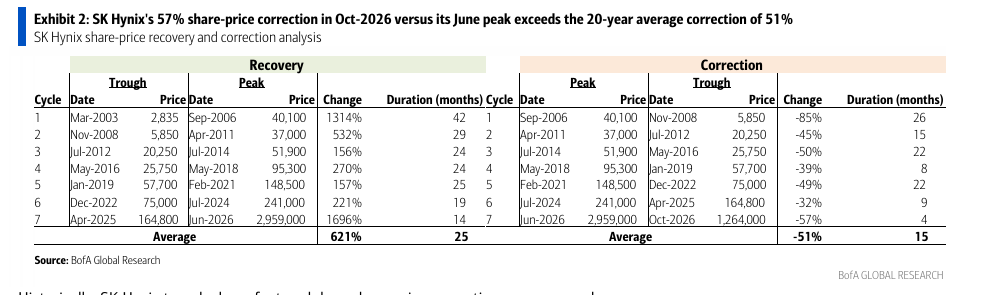
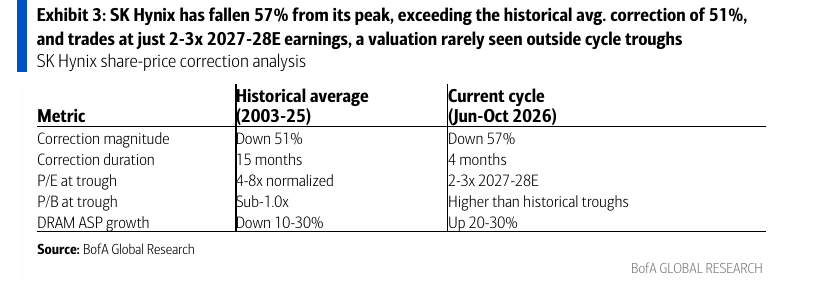
In this research report, Bank of America defines the current adjustment as valuation compression first, rather than a confirmed storage decline. According to the report statistics, SK Hynix retracted by about 57% from its June high, exceeding the average decline of 51% during the main adjustment period in history. According to Bloomberg's consistent expectations, the price-earnings ratio of Samsung and Hynix in 2027 was about 3.0 times and 2.7 times, respectively, and fell further to 2.8 times and 2.3 times in 2028; based on the 2028 forecast net assets, the net price-earnings ratio of both was only about 0.9 times.
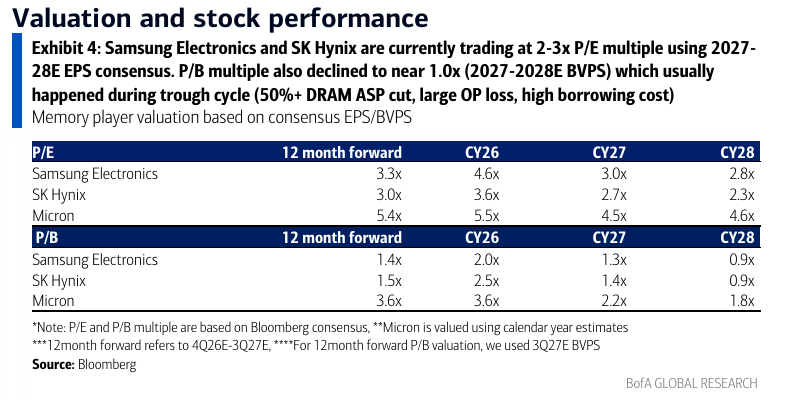
Bank of America's own quantitative model appears to be relatively conservative. The price-earnings ratio of the two companies from 2027 to 2028 is estimated to be about 3.5 to 3.7 times. It is worth noting that the extremely cheap net market ratio here is based on future profit and net asset redemption, and cannot be directly equivalent to “breaking” according to current book value. Bank of America admits that quarterly growth in 2027 will slow, and earnings per share may decline slightly year-on-year in 2028, but it is expected that the absolute scale of revenue, operating profit, and earnings per share will continue to be close to record highs. The core of its bullish outlook is the duration of the high profit level, not that the rate of price increase will continue to accelerate forever.
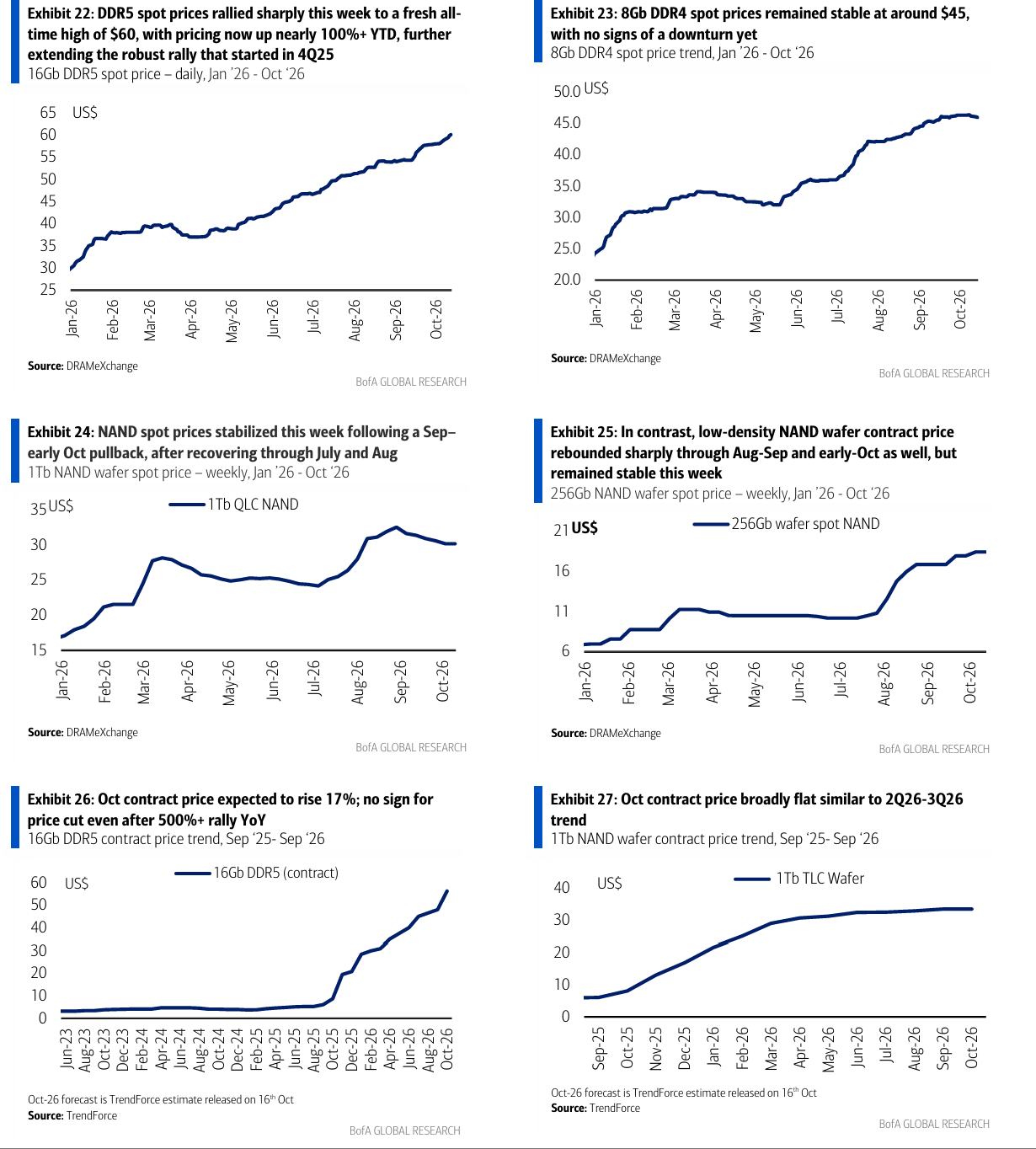
The price data does not support the judgment of an overall recession: the 16Gb DDR5 spot price listed in the report is about 60.6 US dollars, up 3% weekly and 107% during the year; DDR5 contract prices are expected to rise by about 17% month-on-month in October, and DDR4 is also expected to increase by more than 15%. At the same time, some DDR4 specifications have stabilized after falling back from a high point. Prices for the main NAND specifications remained flat during the week, and the average monthly price of some products dropped; the price of server memory modules remained high after the previous rise. The recovery in consumer SSD prices and the general stability of panel prices also indicate that demand for terminals is not booming at the same time.
According to recent Asian research data from another Wall Street giant, KeyBanc, the agency predicts that the HBM hybrid price is expected to rise sharply by 80% to 100% in the first quarter of 2027. At the DRAM memory price level, KeyBanc predicts a 15% to 20% month-on-month increase in the fourth quarter of 2026 under a strong price increase base in the third quarter, and 10% to 15% in the first quarter of 2027; in terms of future NAND pricing, it is predicted that the fourth quarter of 2026 will rise by about 20% month-on-month under a strong base in the third quarter, and 10% to 15% in the first quarter of 2027 .
The current more accurate description is “fragmentation and a slowdown in growth on high-price platforms” rather than the complete collapse of storage prices. Bank of America's top semiconductor stock analyst team is betting that even if the price increase of HBM/DRAM/NAND memory chips narrows, higher selling prices and product structure improvements can maintain impressive profit margins and return on capital near record levels.
What really suppresses stock valuations is that the market is beginning to reverse future demand along the financing chain. The yield of a CoreWeave 2031 bond surpassed 16% last week, and the market implied a cumulative default probability of close to 63% for the five-year CDS quote; however, it is important to note that the latter includes assumptions such as risk premiums and recovery rates, and cannot be used as an actual default probability. For new cloud enterprises, computer room, electricity, and GPU purchases first form cash expenses, and customer acceptance, revenue recognition, and repayment; rising financing costs will reduce tolerable delays and low utilization space for projects, and GPU iteration also increases uncertainty about the value of collateral assets.
However, recent market concerns and pessimism about the “bursting of the AI bubble” are that even if extremely strong order demand linked to AI computing power infrastructure actually exists, the financing gap may force customers to slow down their expansion. Furthermore, in the opinion of investors who are cautious about the topic of AI computing power, it should also be noted that long-term US bond yields have experienced a safe-haven driven decline after the previous rise. The 10-year yield on October 19 was about 5.05%; credit spreads did not necessarily narrow at the same time, so the decline in risk-free interest rates did not automatically relieve the financing pressure for AI projects.
From a single GPU to an entire AI computing power supercluster, AI storage requirements are being reallocated
Bank of America's investor exchanges in Singapore showed that hedge funds are generally pessimistic, while most representatives of long-term asset management and retail investors still prefer long-term positive bullishness. The differences focus on new cloud financing, the decline in China's 4F² DRAM technology, single GPU storage allocation, and the slowdown in AI capital expenditure and storage price growth.
Looking at the technical mechanism, multiple rounds of intelligent reasoning, tool calls, and long contexts will simultaneously increase model weight reading, KV caching, and state storage requirements; these loads are distributed across HBM, host DRAM, LPDDR5/SOCAMM, and enterprise-grade SSDs. Cache tiering and sharing can reduce duplicate storage while also shifting demand to higher capacity and lower cost tiers. Therefore, the decrease in the HBM configuration of a single GPU cannot be directly deduced from the drop in storage requirements for the entire cluster. The key is cluster size, concurrency, and context length. Similarly, 4F² means an improvement in storage unit area efficiency, and its supply impact still needs to be realized through yield, mass production, and customer certification; therefore, the Bank of America analyst team judged that the recent impact was limited, and emphasized storage replacement requirements brought about by GPU and ASIC upgrades.
Meta's opening of Muse Spark Open can be described as providing a new technological impetus for application proliferation and growth in inference demand. With Meta Muse and OpenAI's GPT-6 Astra fully detonating a wave of AI agents, and as shown in the latest news, the Muse Spark Open, which also focuses on cutting-edge AI intelligence workloads, the “AI FOMO transaction” (meaning investors are worried about missing out on rising opportunities in AI-related assets, so buying up or making up for previously lowered positions) is likely to make a comeback in the near future.
Looking at the underlying architecture of AI computing power infrastructure, Muse, Astra, and Meta's latest open source Muse Spark Open are expected to jointly further expand the scope of use of AI agents. The massive expansion of AI inference workloads brought by them will also increase the demand for model inference, tool execution, and state management, while deepening the competitive pressure on some software companies. Accelerators such as GPUs and TPUs undertake model computation; high-performance server CPUs run browsers, virtual machines, product search, database queries, and transaction orchestration; HBM and server DRAM carry model data, context, and concurrent working environments; enterprise-grade SSDs store product indexes, task records, and persistent states, and high-speed networks and optical interconnections support distributed data exchange.
Another Wall Street financial giant, J.P. Morgan Chase recently released a research report showing that the cooling of the early-trading memory chip cycle at the stock price level can occur at the same time as the profit supercycle of the global AI computing power industry chain, which includes memory chip components, for a long period of time. Based on this, the J.P. Morgan Asia Pacific analyst team led by Jay Kwon is optimistic about Samsung Electronics, SK Hynix, Kioxia, and Samsung Electric, ISU, and ISC over the next six months, and is betting that the storage upward cycle will continue for a longer period of time and the continuation of related substrates, PCBs, and testing requirements.
J.P. Morgan explains why storage pullbacks may create opportunities from the strong profit trajectory on the industrial side: market concerns about the sustainability of AI capital spending have not necessarily translated into an equal amount of deterioration in storage orders and profits. AI inference requires continuous reading of model weights, saving context and KV caches, and taking on data requirements at different levels through server memory and SSD; HBM upgrades also take up wafer, packaging, and yield climbing resources, making it difficult for effective supply to keep up with demand quickly.
According to J.P. Morgan's semiconductor research report on the Korean stock market, concerns about the sustainability of AI investment at the macro level are clearly disconnected from the storage industry's bottom-up supply and demand data, so the third quarter is viewed as an “expected reset season”. The next six months will be overequipped with Samsung Electronics, SK Hynix, and Kioxia, and extended to Samsung Electric, as well as ISU and ISC companies — leading manufacturers of AI PCBs and test sockets, respectively. The “long-term deal” here is betting that the upward cycle will last longer and that high profits will last longer: even if the DRAM/NAND price slope slows down, as long as demand for HBM, server DRAM, and enterprise-grade SSDs continues to absorb new production capacity and achieve a significant growth trajectory, the rapid decline in profits previously included in the market may need to be revised again. This also explains why storage stocks can peak and fall before profit, but they may rebound early after the profit duration is verified; what determines trading opportunities is the gap that continues to evolve between actual profit paths and implied stock price expectations.
According to the Bank of America research report, global trade and equipment data provided cross-verification of the resilience of demand for memory chips and even global semiconductors driven by the AI computing infrastructure frenzy, but also revealed a growth structure: South Korea's semiconductor exports were about US$12.2 billion in the first ten days of October, up 171% year on year; China's integrated circuit imports in September increased 75% year on year, and the volume increased by only 2%, which means that the price and product portfolio contributed far more than quantitative expansion.
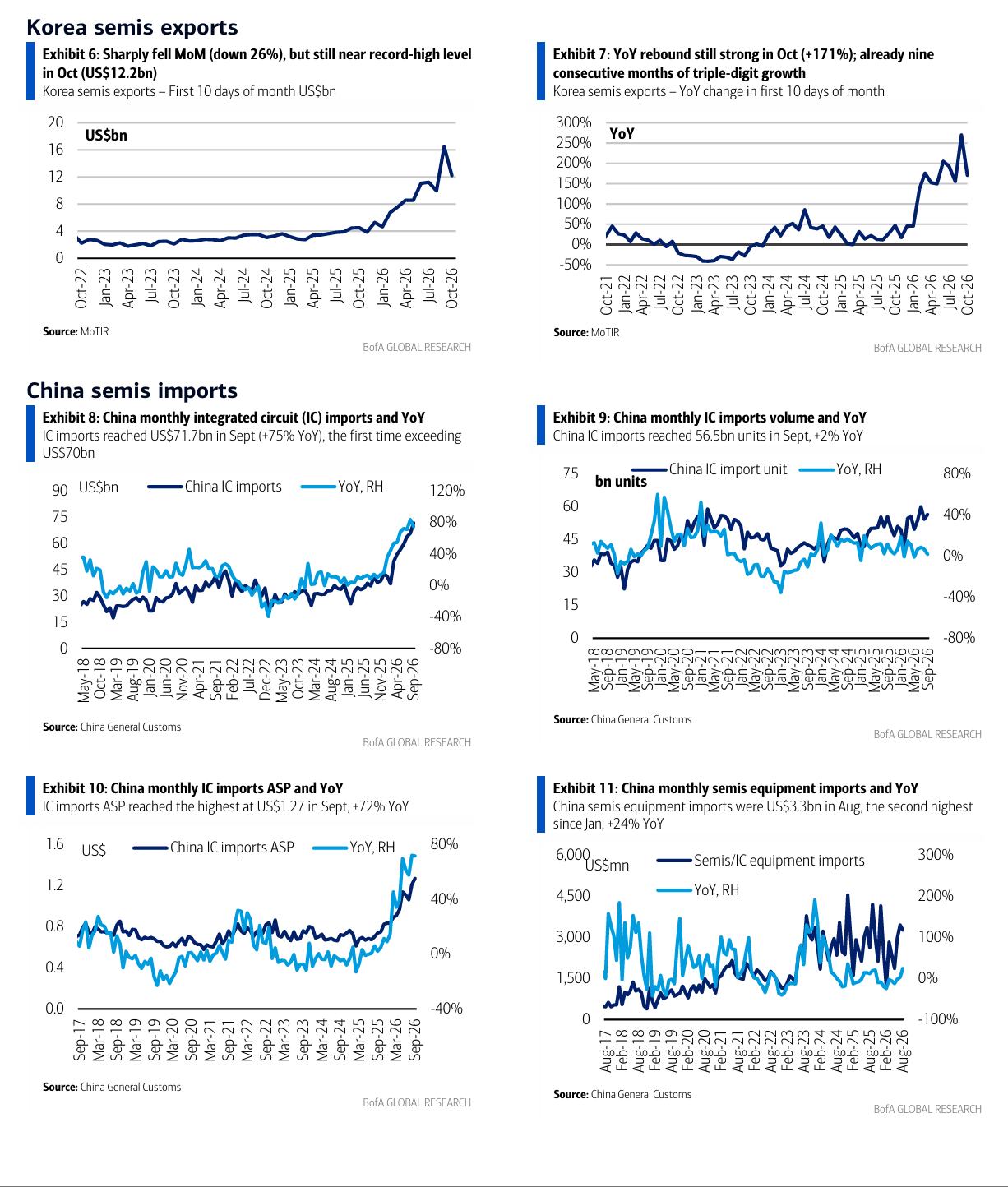
Meanwhile, TSMC's third-quarter revenue surpassed expectations by about 51%, with annual capital expenditure plans reaching 60 billion to 64 billion US dollars; ASML (i.e., lithography giant Asmack)'s third-quarter revenue was about 11.7 billion euros, and is expected to reach 14.2 billion to 15.2 billion euros in the fourth quarter. This also explains why equipment orders may continue to be strong when storage stocks are adjusted: stocks are discounted ahead of schedule, future supply increases and prices decelerate, while equipment companies are fulfilling production expansions and process upgrades previously initiated by customers. However, the two are not permanently decoupled; if customers eventually cut capital expenses, equipment orders will also be transmitted.
The recent verification window focuses on the fourth quarter guidance. South Asia Technology has released a positive outlook. Bank of America expects Hynix to disclose stronger sales prices and profit margins, a rise in mass production of the 12-story HBM4, and an increase in 8-tier product output in response to new orders, and may announce a special cash dividend in addition to the recent 40 trillion won repurchase. According to the report, dividends and repurchases from 2027 to 2028 have the potential to be equivalent to more than 10% of the current market value, but this is a potential shareholder return, not a promised cash dividend rate. In the longer term, Bank of America proposed that the global storage market could expand from about 1 trillion US dollars in 2026 to more than 2 trillion US dollars in 2030, and discussed the scenario where the industry's operating profit reached 1 trillion US dollars and market capitalization reached 10 trillion US dollars. The above positive outlook is the long-term positive upward scenario given by the Bank of America analyst team. According to the Bank of America analyst team, whether the recent stock price can be recovered still depends first and foremost on active implementation of DRAM/NAND price increases, HBM delivery data, and cash allocation.
Institutional sell-off and leverage clash: AI computing power super counterattack conditions are being accumulated, and financial reports and performance forecasts determine the final outcome
The latest judgment of Howard Max, a legendary Wall Street investor and co-chairman of Oak Capital, provides a reverse perspective on the current pessimism: a really dangerous bubble is usually accompanied by a loss of awareness about risk, and continuing discussions about the bubble mean that investors have not completely relinquished their restraints. Currently, the forward price-earnings ratio of leading technology companies is significantly lower than during the Internet bubble period, which is also related to the fact that enterprises have already formed large-scale profits.
This intersects with Bank of America's storage judgment: whether a low price-earnings ratio can constitute an opportunity depends on whether profits can be maintained; if the market underestimates the duration of high profits, the valuation may be repaired; if the profit forecast is too high, the low multiple may just be a cyclical trap.
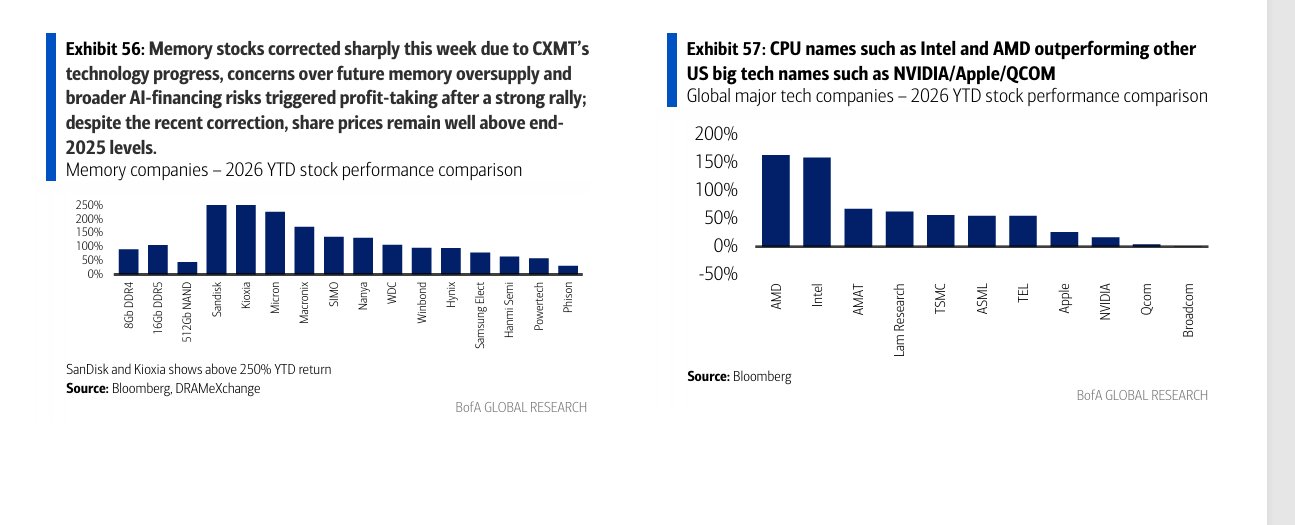
The financial side, on the other hand, seems to show strong two-way strength. According to Goldman Sachs's latest statistics, from October 12 to 16, about 9.5 billion US dollars of the popular leveraged ETFs flowed into the US stock market, of which about 7 billion US dollars went into the semiconductor triple-long ETF SOXL; at the same time, net sales of institutional technology stocks set a record. The net exposure of US fundamental long and short funds fell to the lowest percentile in history, yet the total exposure still reached 213.9%, which is at a high level.
What is particularly noteworthy is that these highly leveraged ETF investment products, which are three times longer, pursue daily leverage targets. Rebalancing during a continuous decline will reduce risk exposure, and may increase exposure when rising, thereby amplifying the market. Furthermore, for some institutional investors with optimized position institutions, financial reports that exceed expectations may increase their willingness to drastically increase their positions again and increase the pressure to catch up with benchmark earnings.
Positive financial reports are expected to be a catalyst for lower-allotted institutions to re-increase their positions: if cloud factory orders and cash flow, storage factory sales prices and profit margins continue to be fulfilled, institutional positions previously depressed due to financing pressure and cycle concerns may turn into potential purchases. At the same time, capital continues to pour into semiconductor leveraged ETFs, indicating that some investors have begun to bet on a rebound ahead of time; when improved profit expectations resonate with institutional allocations, the AI computing power sector is expected to shift from reduced valuations to a recovery supported by profit.
According to Bank of America analysts, a contrarian bullish logic for investing in memory chips and the broader AI computing power investment theme is being formed. The strongest fundamental basis it cites is that valuations have been drastically compressed, yet prices, delivery, and profit have yet to fall at the same time. Another financial report emphasized by Wall Street giant Goldman Sachs confirms that it is necessary to observe along the entire industry chain: whether large cloud computing giants and Xinyun can turn orders into utilization, repayments, and sustainable cash flow; whether memory chip supergiants can maintain profit margins, control production expansion, and deliver shareholder returns after price growth slows; and whether the credit market can stop further raising the financing threshold. If these three pieces of evidence improve simultaneously, low allocation compensation and profit revaluation can jointly drive a counterattack; if only leveraged purchases increase and cash flow and financing conditions continue to deteriorate, the rebound will still be easily interrupted by further deleveraging.