
How Chiefs Partnership At H&R Block (HRB) Has Changed Its Investment Story
- H&R Block announced a multiyear partnership with the Kansas City Chiefs, becoming the team’s Exclusive Tax Preparation Partner through the 2030 season, with prominent in-stadium, digital and community activation, including a Chiefs Small Business Spotlight Contest across Kansas, Missouri and Nebraska.
- The collaboration gives H&R Block a direct channel to small business owners and higher-income fans through cash awards, a year of small business services and ongoing game day features, tying its tax expertise to a loyal regional audience that closely matches its core focus.
- The focus now turns to how this long-term Chiefs partnership, especially the Small Business Spotlight program, could influence H&R Block's investment narrative.
H&R Block Investment Narrative Recap
To own H&R Block, you need to believe the tax expert plus AI model can keep pulling in more complex filers, especially higher income households and small businesses, while holding pricing power. The Chiefs deal mostly supports that story by sharpening brand visibility with exactly that audience. The more pressing near term swing factor remains tax season execution and mix between assisted, DIY and small business services, not this single marketing partnership.
The key risk stays the same. Market share losses and pressure from low cost digital and AI rivals could erode volumes or push clients toward cheaper products, especially if tax filing growth slows. High leverage also limits room for error if revenue disappoints. The Chiefs alliance helps with awareness and funnel building, but it does not remove those structural questions.
The new Chiefs partnership is the announcement that matters most here because it plugs directly into H&R Block’s focus on higher value clients and entrepreneurs. The Small Business Spotlight contest, with US$5,000 awards and a year of small business services for four winners, gives the firm a concrete way to put its small business offering in front of local owners.
For catalysts, the interesting link is how this outreach could intersect with areas analysts already watch closely, such as Wave’s paid Pro subscriptions and the broader small business services line. If community programs convert contest nominees and voters into paying clients, that would support revenue mix, cross sell opportunities and the case that marketing partnerships can feed into tax, payments and advisory volumes rather than just brand exposure.
H&R Block Consensus Forecast Check
H&R Block's consensus story leans on analysts expecting revenue to reach US$4.5b and earnings of US$751.3m by 2029, anchored to an annual revenue growth rate of 4.6% and an earnings increase of about US$18.7m from current earnings of US$732.6m.
Those projections sit on a specific earnings framework. The current profit pool of US$732.6m and P/E of 7.1x is paired with an assumption that net margins edge down from 18.6% to 16.6% over roughly three years. Analysts still model earnings of US$751.3m and US$7.08 per share by 2029, which implies that margin pressure is offset by modest revenue expansion and share count decline.
The revenue line is built on a 4.6% yearly increase over the next three years, combined with a gradual reduction in shares outstanding of 2.5% a year. That combination matters for you because even if total profit grows slowly, fewer shares can still support earnings per share. It also ties directly to management's recent focus on buybacks and capital returns.
For readers weighing valuation, the consensus set up effectively asks you to judge whether a future P/E of 9.8x on those 2029 earnings feels reasonable. Analysts link that multiple to the US$4.5b revenue and US$751.3m earnings mark in 2029. The implied discount rate used in the Simply Wall St framework is 7.6% to 7.63%, which gives a structure for thinking about risk and required return without needing to build a full model from scratch.
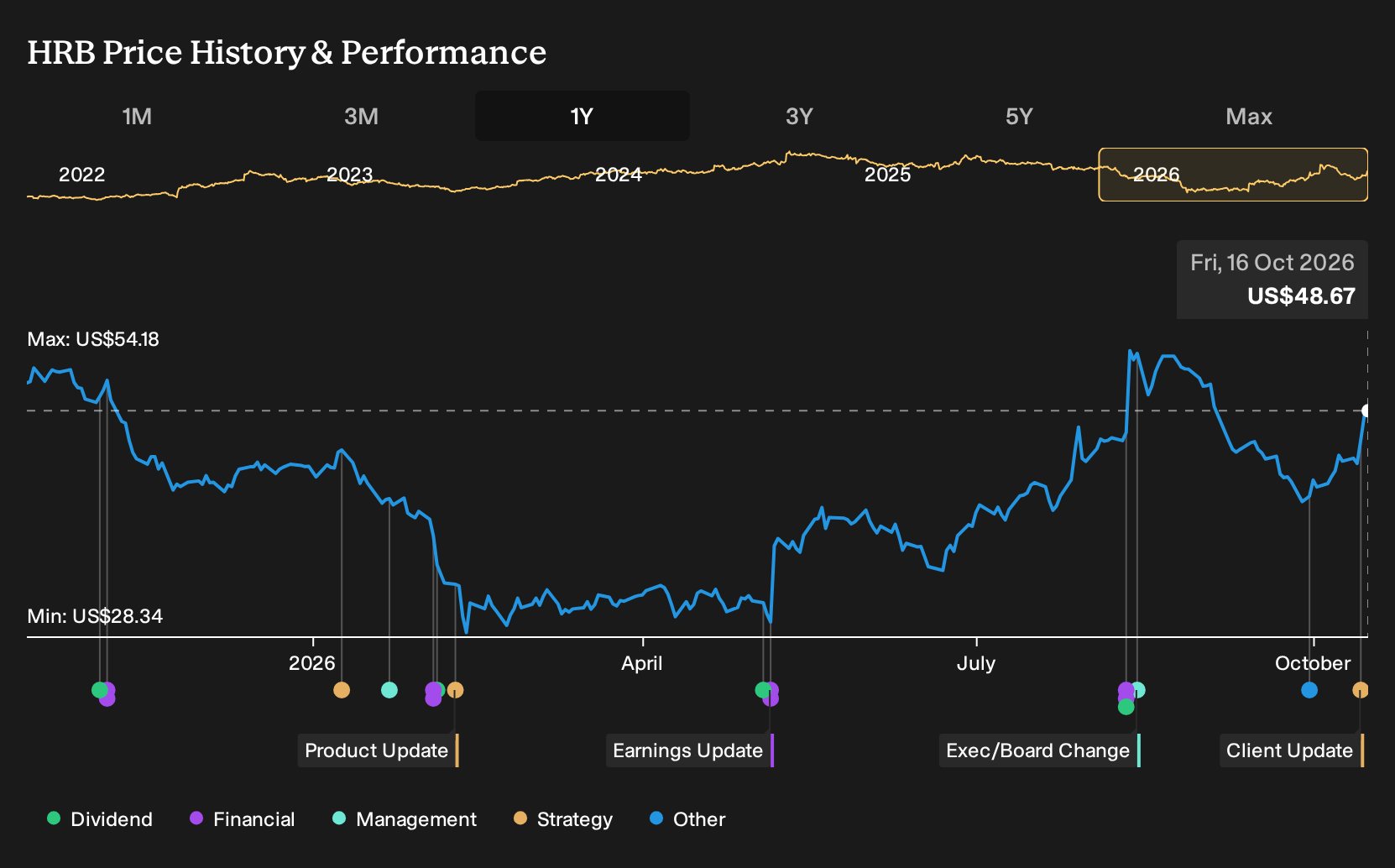
Uncover why H&R Block's fair value indicates a 6% potential upside to its current price before the market closes that discount.
Exploring Other Perspectives
One alternative angle on H&R Block focuses on margins rather than revenue. The most bearish analysts already assumed net margins slipping toward 16.3% and a low P/E of 6.9x, even while penciling in 2029 revenue of about US$4.6b and earnings near US$741.9m. You can read that as a much harsher narrative on profitability. Those forecasts came before the Chiefs partnership, so this small business focused outreach could eventually nudge expectations in either direction as analysts reassess how marketing spend translates into future earnings.
Explore 3 other H&R Block fair value estimates, including one that suggests as much as 26% downside from the current price.
Form Your Own Verdict
Disagree with existing narratives? Extraordinary investment returns rarely come from following the herd, so consider forming your own view.
- A great starting point for your H&R Block research is our analysis highlighting 4 key rewards and 1 important warning sign that could impact your investment decision.
- See our latest analysis for H&R Block. The report includes a comprehensive fundamental analysis summarized in a single visual, the Snowflake, making it easy to evaluate H&R Block's overall financial health at a glance.
Looking for more H&R Block style investment ideas?
If the H&R Block story has you thinking about where else disciplined execution and clear financial profiles might show up, the Simply Wall St Screener can help you cast a wider net without losing focus on quality.
- For investors who care most about valuation strength and balance sheet resilience, review a list of solid balance sheet and fundamentals (25 results) that already stack up well on debt and liquidity.
- If income is your priority, focus on reliable cash returns and let a curated group of 8 dividend fortresses guide where you spend your time first.
- When you want potential mispricings with quality traits still intact, start with a targeted pool of 20 high quality undiscovered gems that many investors may not yet be watching closely.
This article by Simply Wall St is general in nature. We provide commentary based on historical data and analyst forecasts only using an unbiased methodology and our articles are not intended to be financial advice. It does not constitute a recommendation to buy or sell any stock, and does not take account of your objectives, or your financial situation. We aim to bring you long-term focused analysis driven by fundamental data. Note that our analysis may not factor in the latest price-sensitive company announcements or qualitative material. Simply Wall St has no position in any stocks mentioned.
Have feedback on this article? Concerned about the content? Get in touch with us directly. Alternatively, email editorial-team@simplywallst.com