
Did Employee Built AI Agents Just Shift ServiceNow (NOW) Investment Narrative?
- ServiceNow rolled out major upgrades to its EmployeeWorks platform and AI governance tools, including employee-built AI agents, ToolSmith for rapid automation creation, and AI Passport for runtime control of enterprise AI workflows.
- The new tools shift automation design closer to frontline staff while keeping governance inside ServiceNow’s unified AI platform. This could influence how customers weigh productivity gains against risk controls when deciding where to consolidate workflow spend.
- We will now look at how ServiceNow's AI Passport and EmployeeWorks upgrades interact with the existing investment narrative around AI ACV.
Compare ServiceNow’s push into employee-built AI agents with other automation initiatives by reviewing the hand-picked 55 AI infrastructure stocks shaping this phase of enterprise AI workflows.
ServiceNow Investment Narrative Recap
To own ServiceNow, you need to believe its workflow platform keeps winning a larger share of IT, security, CRM, and employee experience budgets as AI agent usage grows. The near term focus stays on scaling AI ACV, absorbing Armis and Veza, and translating that into subscription growth while keeping AI incidents contained after prior security flaws.
The key short term catalyst is proof that customers are actually running production AI agents at scale and paying more for them. The biggest risk remains that AI driven usage patterns or security issues reduce high margin workflow adoption. The latest EmployeeWorks and AI Passport releases look directionally helpful rather than thesis changing.
The AI Passport launch is the announcement that ties closest to the EmployeeWorks upgrades. ServiceNow is not just pitching more AI agents. It is selling a control layer that discovers those agents, sets what they can do at runtime, and ties that back to CMDB data, GRC policies, and workflow approvals. This matters for large enterprises.
For you as an investor, that links directly to the AI ACV catalyst. Enterprises that worry about shadow AI, costs, and compliance might be more willing to standardize on ServiceNow for both automation and oversight. Execution risk sits in proving that AI Passport and Super Intelligence Control Tower really manage third party agents cleanly across hundreds of connectors.
ServiceNow AI ACV Assumptions Behind EmployeeWorks
ServiceNow investors are being asked to plug the EmployeeWorks and AI Passport releases into a much bigger earnings arc than a single product cycle. Analysts are assuming revenue will grow by 19.4% a year for the next 3 years, with profit margins rising from 11.3% today to 16.6% over the same stretch. That backdrop shapes how much credit you might give to employee built AI agents and the new governance tools when you think about what is already embedded in expectations.
On earnings, the current consensus points to profit of US$1.7b today and US$4.2b by about 2029, with forecasts spread between US$2.7b and US$5.9b. Getting from US$1.7b to US$4.2b implies earnings need to climb by roughly US$2.5b, which is a big move even before factoring in the extra security and compliance work required as more AI agents touch sensitive workflows. EmployeeWorks and AI Passport sit right in that gap between current profitability and the future earnings path the market is already modeling.
ServiceNow's narrative projects US$25.1b revenue and US$4.2b earnings by 2029. This assumes 19.4% yearly revenue growth and an earnings increase of about US$2.5b from US$1.7b today.
Those same estimates rely on the business trading on a P/E of 47.4x 2029 earnings, down from 85.8x today but still above the 30.6x used for the broader US software group. That kind of multiple usually needs investors to feel comfortable that AI driven workflows like EmployeeWorks will produce more subscription scale than security incidents. The fresh governance stack, including AI Passport and the Super Intelligence Control Tower, speaks directly to that trade off because it tries to keep experiments close to employees while keeping policy, approvals, and incident response tied back to the core platform.
Forecasts also bake in a 0.38% yearly decline in the share count for the next 3 years, so the bar for per share earnings is a touch higher than the headline profit figures alone. For you as a holder or prospective buyer of ServiceNow, the question is whether the new AI tooling helps justify both the absolute earnings jump and the premium P/E the consensus is using. Evidence that AI ACV tied to governed, production grade agents is scaling within those risk parameters would point to the story tracking the current script rather than drifting off course.
Uncover why ServiceNow's fair value indicates a 6% potential upside to its current price that could narrow quickly.
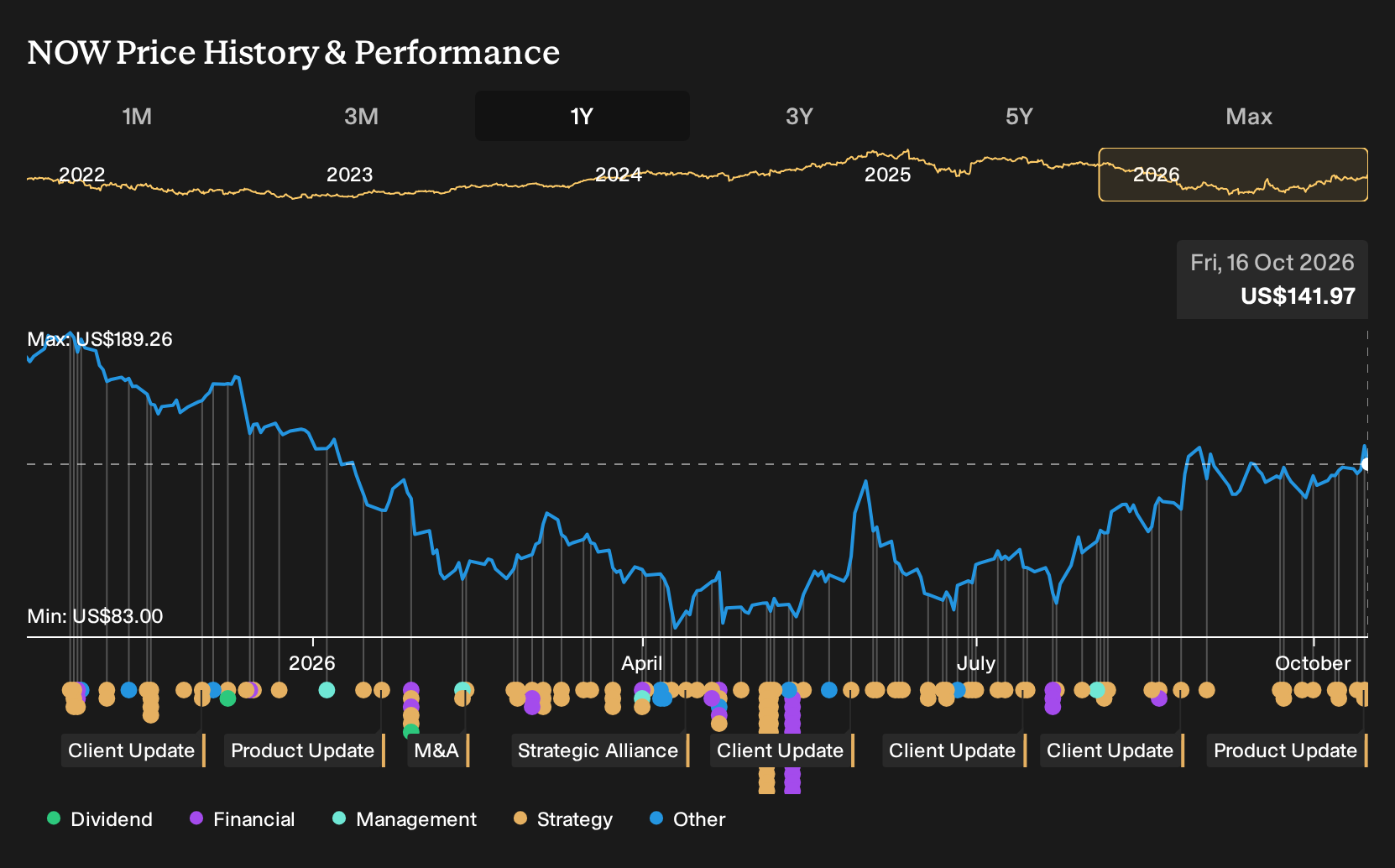
Exploring Other Perspectives
One alternate view worries less about AI security incidents and more about pricing friction. In that narrative, ServiceNow’s hybrid AI packages could keep contracts messy, which helps explain why the most cautious analysts were only modeling about US$24.6b revenue and US$2.4b earnings by 2029. Those estimates and today’s EmployeeWorks and AI Passport news were set on different timelines, so you may see forecasts shift as analysts reassess adoption, monetisation, and risk after these launches.
Explore 21 other ServiceNow fair value estimates, including one that suggests as much as 30% downside from the current price.
The Verdict Is Yours
Disagree with existing narratives? Extraordinary investment returns rarely come from following the herd, so go with your instincts.
- A great starting point for your ServiceNow research is our analysis highlighting 3 key rewards that could impact your investment decision.
- See our latest analysis for ServiceNow. The report includes a comprehensive fundamental analysis summarized in a single visual, the Snowflake, making it easy to evaluate ServiceNow's overall financial health at a glance.
Looking For More Ideas Beyond ServiceNow?
If the ServiceNow story has sharpened your thinking on AI workflows and governance, it can be useful to compare it with other businesses that meet very different criteria. The Simply Wall St Screener lets you quickly filter for traits that matter to you so you can build a watchlist that actually matches your risk tolerance and income needs.
- If resilience matters most, filter for companies that score well on financial strength and low leverage by reviewing a list of solid balance sheet and fundamentals (25 results) that keeps balance sheet risk in focus.
- If steady income is a priority, look for businesses with higher yields and more established payout histories through our set of 8 dividend fortresses that might suit an income focused approach.
- If you want potential mispricing opportunities, scan a 20 high quality undiscovered gems that combine quality fundamentals with less crowded investor attention.
This article by Simply Wall St is general in nature. We provide commentary based on historical data and analyst forecasts only using an unbiased methodology and our articles are not intended to be financial advice. It does not constitute a recommendation to buy or sell any stock, and does not take account of your objectives, or your financial situation. We aim to bring you long-term focused analysis driven by fundamental data. Note that our analysis may not factor in the latest price-sensitive company announcements or qualitative material. Simply Wall St has no position in any stocks mentioned.
Have feedback on this article? Concerned about the content? Get in touch with us directly. Alternatively, email editorial-team@simplywallst.com