
How Investors Are Reacting To General Mills (GIS) Debt Paydown Focus
- General Mills completed cash tender offers for seven series of long dated notes, accepting several hundred million dollars of bonds for purchase, while returning any securities not taken up under the Offer to Purchase terms.
- The decision to buy back specific portions of its debt aligns with General Mills' stated plan to prioritize deleveraging at a time when earnings and operating margins face pressure from softer demand and declining unit volumes.
- This development raises questions about how General Mills' investment narrative may evolve as debt reduction takes precedence over dividend growth and expansion plans.
Compare General Mills' deleveraging pivot with other balance-sheet focused opportunities by scanning our list of solid balance sheet and fundamentals (25 results) that could better fit your approach to risk and income.
General Mills Investment Narrative Recap
To stay invested in General Mills, you need to be comfortable with a consumer staples group that is working through softer demand, pressured operating margins and guidance that points to a potential earnings decline in fiscal 2027. The core belief is that cost savings, product refreshes and pet food platforms can eventually support more stable cash generation.
Right now, the key short term catalyst is whether volume trends and execution in challenged pockets like Totino’s and Wilderness improve while cost savings begin to show up. The biggest risk is that weaker volumes and margin pressure persist longer than expected, keeping earnings and cash flow under strain.
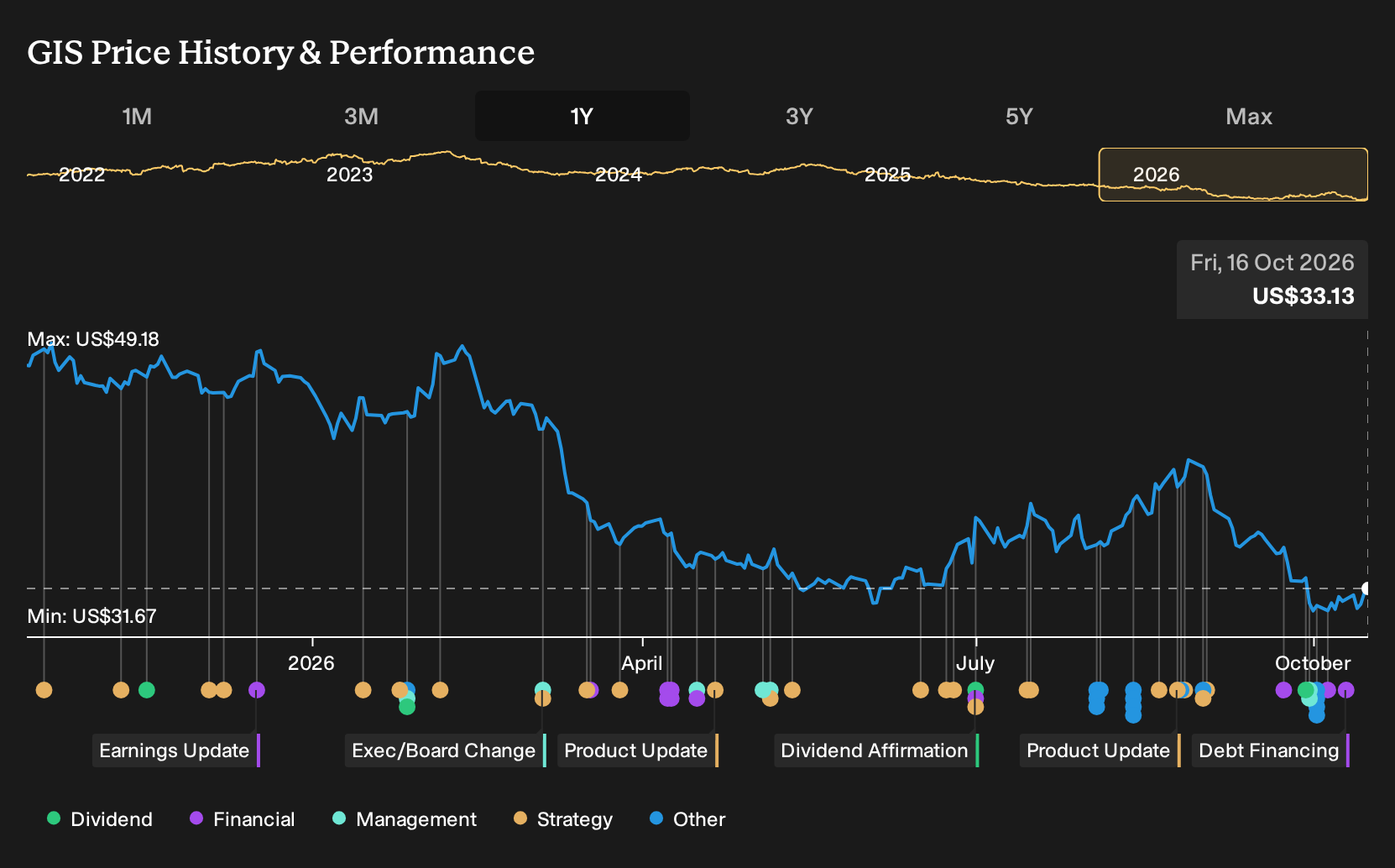
The recent decision to complete cash tender offers for seven long dated note series is the clearest confirmation of General Mills leaning into deleveraging. Several hundred million dollars of bonds were accepted, with some issues fully taken up and others partly tendered but not all accepted under the Offer to Purchase terms.
This announcement matters for the current thesis because management is already signaling a flat dividend in the near term while it pays down borrowings. If operating pressure on margins and earnings continues, the pivot to debt reduction over dividend growth and expansion spending becomes the central tension for investors who rely on income from this stock.
What The Current General Mills Forecasts Assume
General Mills' narrative projects US$18.1b revenue and US$1.8b earnings by 2029. This assumes fairly flat yearly revenue trends and an earnings increase of about US$1.9b from a current loss of US$87.6m.
Uncover how General Mills' fair value indicates a 14% potential upside to its current price that could narrow quickly as expectations reset.
Exploring Other Perspectives
One contrasting angle on General Mills focuses on remarkability spending as a risk. The lowest analysts worry that heavier media and SG&A outlays lock in higher costs, so their pre tender offer models assumed revenue easing to about US$17.5b by 2029 and an earnings recovery from a US$894.8m loss to US$1.8b. These views were formed before the latest debt buyback, so you may want to see how they evolve and compare several perspectives before deciding how this deleveraging push fits your own income and risk preferences.
Explore 7 other General Mills fair value estimates, including one that suggests there may be as much as 9% downside from the current price.
Decide For Yourself
Don't just follow the ticker; dig into the data and build a conviction that's truly your own.
- A great starting point for your General Mills research is our analysis highlighting 2 key rewards and 2 important warning signs that could impact your investment decision.
- See our latest analysis for General Mills. The report includes a comprehensive fundamental analysis summarized in a single visual, the Snowflake, making it easy to evaluate General Mills' overall financial health at a glance.
Looking For More Ideas Beyond General Mills?
If General Mills' deleveraging story has you rethinking where you want income, stability or upside potential to come from, it can help to line it up against a wider universe of businesses with balance sheets and cash profiles that better match your comfort level.
- If capital preservation matters most to you, start with a basket of companies that our tools flag as more resilient by risk score via the 32 resilient stocks with low risk scores.
- For investors who want income to do more of the heavy lifting, scan a curated universe of higher yielding payers through the 8 dividend fortresses.
- If the goal is to pair quality with a price that still looks reasonable on fundamentals, check out a hand picked group of potential bargains using the 33 high quality undervalued stocks.
This article by Simply Wall St is general in nature. We provide commentary based on historical data and analyst forecasts only using an unbiased methodology and our articles are not intended to be financial advice. It does not constitute a recommendation to buy or sell any stock, and does not take account of your objectives, or your financial situation. We aim to bring you long-term focused analysis driven by fundamental data. Note that our analysis may not factor in the latest price-sensitive company announcements or qualitative material. Simply Wall St has no position in any stocks mentioned.
Have feedback on this article? Concerned about the content? Get in touch with us directly. Alternatively, email editorial-team@simplywallst.com