
Did Securities Lawsuit Just Shift Baidu (BIDU) Stock Investment Narrative?
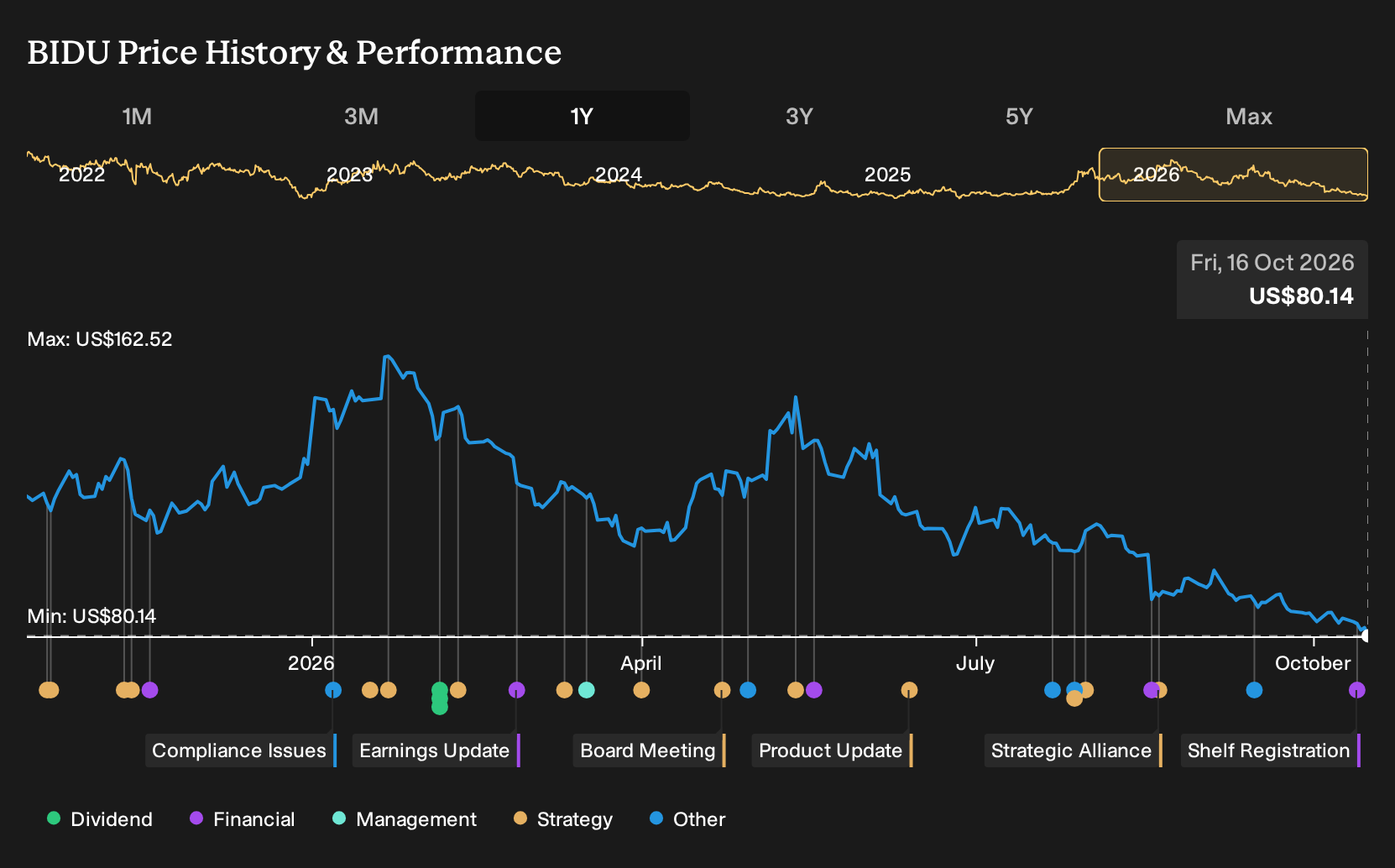
- Baidu filed a shelf registration for up to US$2.88 billion of American Depositary Shares tied to its employee share ownership plan, while facing a securities class action alleging investors were misled about AI performance relative to a weaker legacy advertising unit.
- The combination of ESOP-related issuance plans and legal scrutiny on AI disclosures highlights how Baidu is balancing talent retention, capital structure, and confidence in its newer businesses as its traditional advertising operation remains under pressure.
- We will examine how Baidu's investment narrative is being tested by the new securities lawsuit focused on AI business performance.
Baidu Investment Narrative Recap
To own Baidu, you need to believe its AI cloud, autonomous driving and AI powered search can become the economic engine that outweighs the drag from a weaker legacy advertising operation. Recent Q3 2026 numbers show that tension clearly. AI cloud infrastructure revenue grew 50%, while core online advertising fell 19% year on year, so mix shift remains the key near term catalyst to watch.
The biggest operational risk right now sits in execution. Traditional online marketing already faces pressure, AI monetisation is taking time, and Baidu recently recorded a large impairment on older infrastructure that did not meet AI efficiency needs. The new securities lawsuit over AI disclosures adds headline and legal risk, but does not directly change how the underlying businesses perform in the short term.
The shelf registration for up to US$2.88b of American Depositary Shares tied to the employee share ownership plan is the announcement that matters most here. It intersects with the same AI story investors are focused on, because the ESOP offering links staff incentives to Baidu’s long term transition toward AI cloud, foundation models and Apollo Go.
For investors, the practical angle is about dilution, capital structure and execution. ESOP related issuance can modestly increase the share count, at a time when Baidu is still loss making and reporting pressure on earnings. The plan sits alongside earlier moves such as share repurchases and the Hong Kong dual primary listing. The main catalyst to track is whether AI driven segments continue to scale enough to absorb higher investment, potential write downs and any impact from the securities class action.
Baidu's narrative projects CN¥154.3b revenue and CN¥16.0b earnings by 2029. This assumes 6.6% yearly revenue growth and an earnings swing of roughly CN¥20.7b from a current loss of CN¥4.7b to the forecast CN¥16.0b profit.
Uncover how Baidu's fair value indicates a potential 81% upside to its current price before the market closes that gap.
Exploring Other Perspectives
One alternate view says the real swing factor for Baidu is not AI execution but legal and regulatory drag. The most cautious analysts were penciling in CN¥143.8b revenue and CN¥14.5b earnings by 2029 before this ESOP shelf and lawsuit news. That camp already saw the stock as roughly fully valued, so this kind of development may prompt them to revisit assumptions.
Explore 6 other Baidu fair value estimates, including one that suggests it could be worth just $80.31.
Decide For Yourself
Don't just follow the ticker. Dig into the data and build a conviction that's truly your own.
- A great starting point for your Baidu research is our analysis highlighting 2 key rewards that could impact your investment decision.
- See our latest analysis for Baidu. The report includes a comprehensive fundamental analysis summarized in a single visual, the Snowflake, making it easy to evaluate Baidu's overall financial health at a glance.
Looking for more Baidu-like investment ideas?
If you want to balance your Baidu view with fresh ideas, use the Simply Wall St Screener to build a shortlist that fits your risk, income and quality preferences instead of relying on headlines alone.
- For investors who care about quality at a reasonable price, scan a curated 33 high quality undervalued stocks that combine stronger fundamentals with more appealing valuations.
- If capital preservation sits higher on your checklist, start with a 32 resilient stocks with low risk scores that score well on financial strength and business stability.
- When income is the priority, focus on steady cash generators through a set of 8 dividend fortresses that pair higher yields with more resilient balance sheets.
This article by Simply Wall St is general in nature. We provide commentary based on historical data and analyst forecasts only using an unbiased methodology and our articles are not intended to be financial advice. It does not constitute a recommendation to buy or sell any stock, and does not take account of your objectives, or your financial situation. We aim to bring you long-term focused analysis driven by fundamental data. Note that our analysis may not factor in the latest price-sensitive company announcements or qualitative material. Simply Wall St has no position in any stocks mentioned.
Have feedback on this article? Concerned about the content? Get in touch with us directly. Alternatively, email editorial-team@simplywallst.com