
Progressive Stock And Commercial Auto Insurers After The $604 Million Texas Verdict
A single Texas court decision has put commercial auto liability under a harsh spotlight, with C.H. Robinson facing a US$604m judgment plus roughly US$107m in pre judgment interest and a 6.75% accrual rate that keeps the meter running. That kind of legal shock can reshape risk pricing, pressure freight brokers and rewrite how insurers think about trucking exposure. This article explains how three U.S. Commercial Auto and Excess Casualty insurers could be positioned in light of that verdict, and where investors may want to look more closely.
The stocks that follow are just a first cut, and the full screen surfaced 14 more insurers and reinsurers with equally compelling commercial auto and excess liability stories that are not covered below. To see the rest of the field, head straight to the U.S. Commercial Auto & Excess-Casualty Liability Insurers screener and use it to identify, filter, and analyze your highest conviction ideas.
Progressive (PGR)
Progressive sits at the front of this commercial auto and excess liability screen because its large U.S. property and casualty franchise reaches deep into trucking, small business cover, and higher limit risk that could be reshaped by shifting jury awards and broker liability trends.
Progressive is a large U.S. insurer writing personal auto, commercial auto for trucks and fleets, small business liability and property, and workers’ compensation. All of its US$91.7b revenue is generated in the United States, and it has an equity value of about US$123.9b.
"Progressive's scale, data analytics, and rapid pricing response mechanisms continue to support share gains in personal auto as it now holds 18.6% market share and has become the largest U.S. personal auto writer by direct premiums written, which can influence net premiums written and earnings."
The key question is what happens if a single unseen pressure on commercial liability severity shifts the balance between that pricing edge and future margins.
If that pressure on severity is what you are watching, the full narrative for Progressive shows how Progressive's scale, pricing engine, and legal risk could be decoupling.

Global Indemnity Group (GBLI)
Global Indemnity Group is a smaller specialty insurer that fits this commercial auto and excess liability screen because it focuses on niche property and casualty and reinsurance lines where high severity claims matter most for pricing power and capital use.
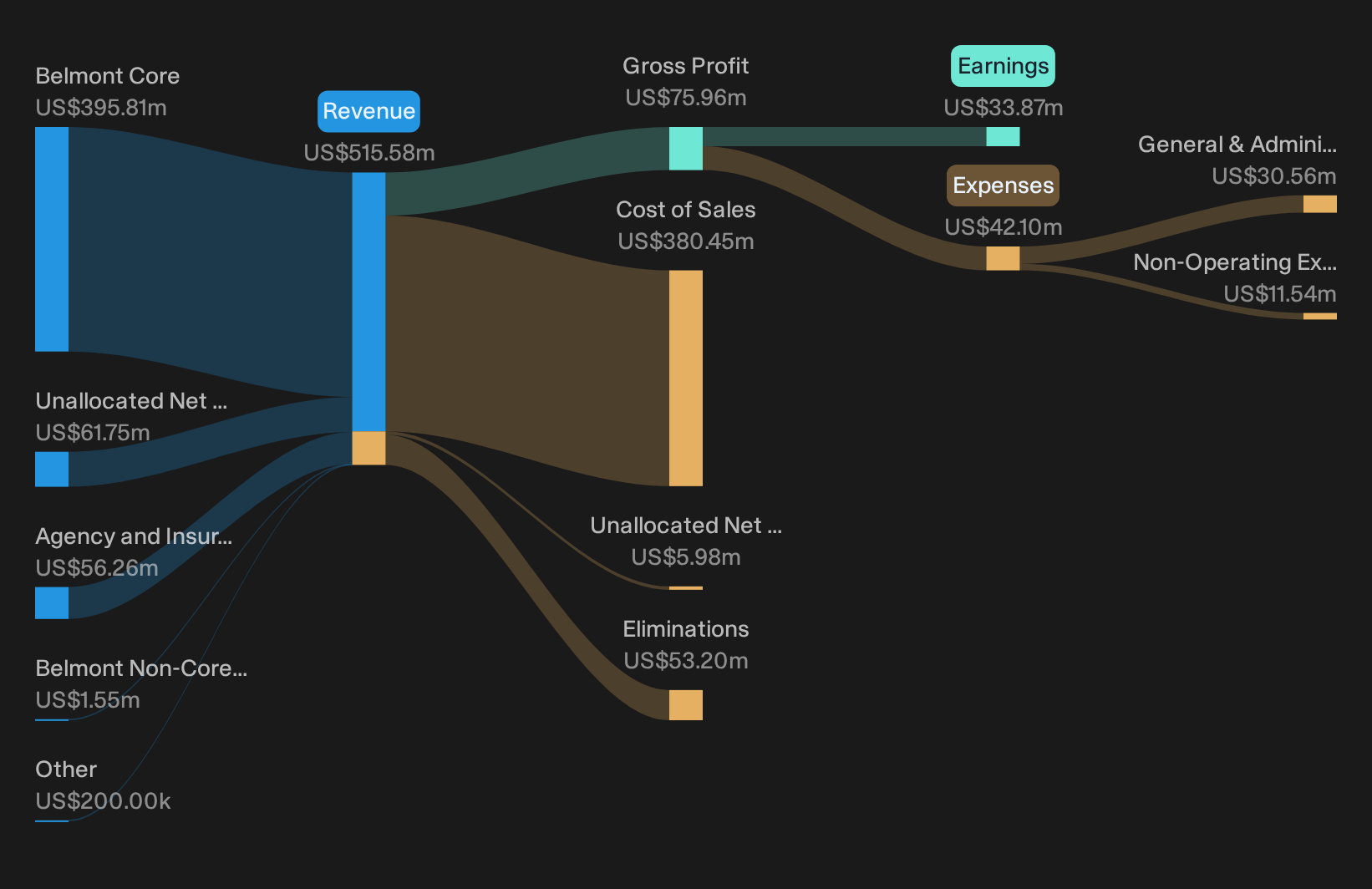
Global Indemnity Group writes specialty property and casualty cover and reinsurance for small commercial clients and niche risks, with most of its US$395.8 million revenue coming from the Belmont Core segment, supported by Agency and Insurance Services on US$56.3 million and investment income of about US$61.8 million on top of a market value near US$374 million.
"The accelerated adoption of data analytics and artificial intelligence at Global Indemnity Group through the Kaleidoscope platform and related tools is progressing toward full integration of key product groups by 2026."
What happens if one unresolved piece of that plan shifts the path of expense ratios just as jury awards keep pushing severity higher?
If that unresolved piece has your attention, the full narrative for Global Indemnity Group explains how Global Indemnity Group’s plan could turn rising severity into accelerating pricing power and capital efficiency.
James River Group Holdings (JRVR)
James River Group Holdings fits this commercial auto and excess-casualty theme as a specialist in higher-risk surplus lines, with most of its US$653 million book tied to Excess and Surplus Lines and Specialty Admitted Insurance. Its market value of around US$172 million anchors the investment debate.
James River Group focuses on specialty excess and surplus lines that often absorb the spillover from standard carriers when jury awards and trucking liability start to bite. This positioning puts its underwriting choices squarely in the path of today’s commercial auto repricing story.
"Ongoing strategic repositioning toward smaller and more profitable specialty E&S accounts, combined with disciplined underwriting and improved data-driven processes, is resulting in a lower combined ratio and higher net margins, supporting more consistent and sustainable future earnings."
The key issue for James River Group is what happens if a single unseen pressure in excess commercial auto severity tests how firmly that underwriting reset holds margins.
If that pressure is what you are testing, the full narrative for James River Group Holdings explores whether James River Group Holdings is undergoing an accelerating reset or whether risks are still masking fragility.

Seeking Alternatives Before The Crowd?
Fresh ideas move first. Breakout stories gain momentum, weak ones start dropping, and under the radar opportunities will not stay quiet for long. Consider acting sooner rather than later.
- Spot stable income candidates early by scanning a curated pool of reliable payers with the 8 dividend fortresses before yields get compressed by inflows.
- Track the next wave of infrastructure momentum and shortlist potential long term compounders using the 41 power grid technology and infrastructure stocks while they are still flying under most radars.
- Target resilient balance sheets and disciplined capital allocation with the list of solid balance sheet and fundamentals (25 results) before fresh buying interest tightens valuations.
This article by Simply Wall St is general in nature. We provide commentary based on historical data and analyst forecasts only using an unbiased methodology and our articles are not intended to be financial advice. It does not constitute a recommendation to buy or sell any stock, and does not take account of your objectives, or your financial situation. We aim to bring you long-term focused analysis driven by fundamental data. Note that our analysis may not factor in the latest price-sensitive company announcements or qualitative material. Simply Wall St has no position in any stocks mentioned.
Have feedback on this article? Concerned about the content? Get in touch with us directly. Alternatively, email editorial-team@simplywallst.com