
Will Earnings Beat Change Wells Fargo (WFC) Stock Narrative
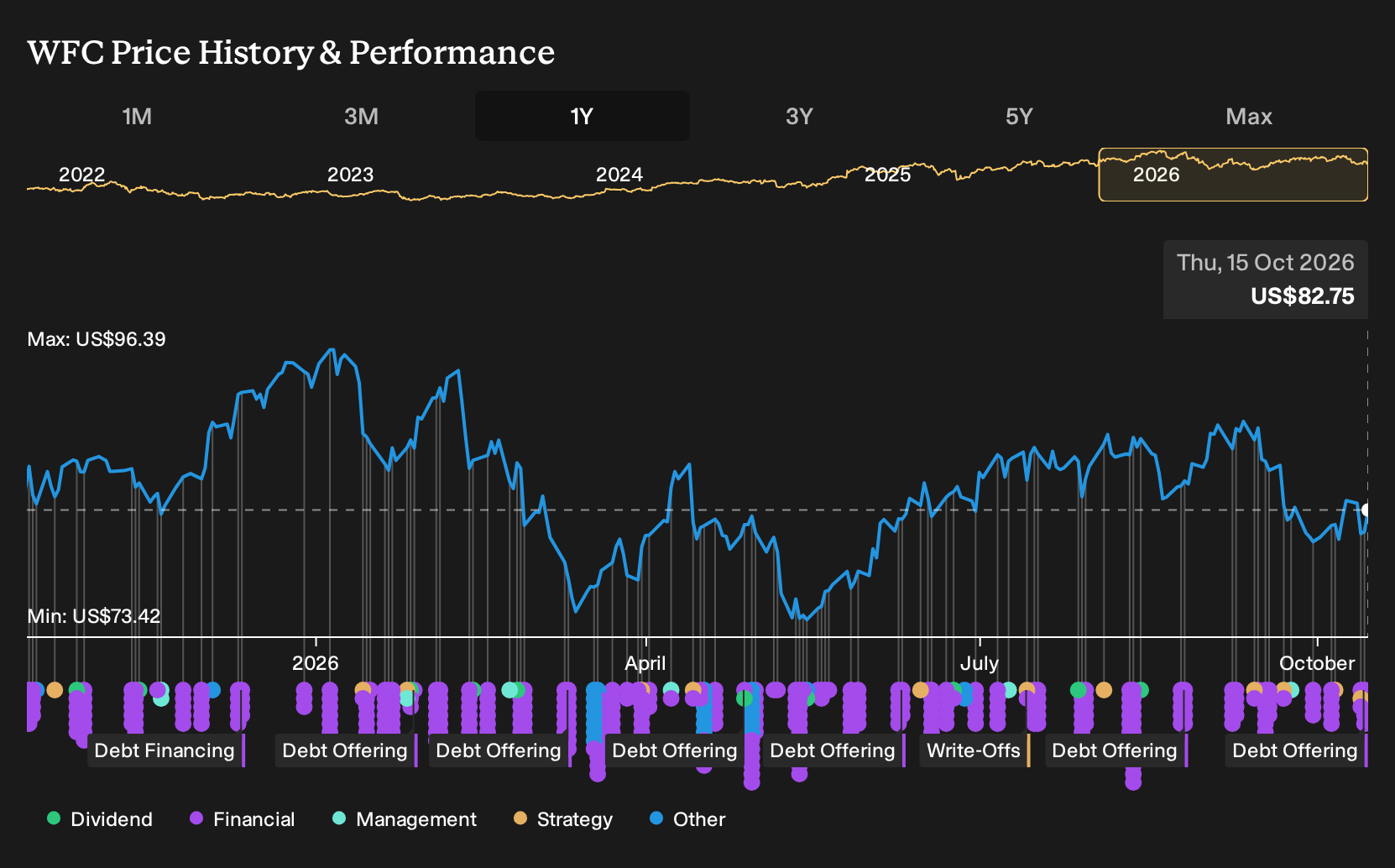
- Wells Fargo reported third quarter 2026 earnings with net income of US$5.95b and EPS of US$1.87, beating profit estimates. Revenue of US$21.87b and weaker late quarter trading activity weighed on top line performance, while management kept full year 2026 net interest income and expense guidance unchanged.
- The bank is leaning on loan and deposit growth, technology and AI investments, and disciplined expenses to support returns. At the same time, higher net loan charge offs of US$983m and sector wide concern about future trading revenue highlight the operational balancing act behind its Consumer, Corporate and Markets franchises.
- We will look at how Wells Fargo's investment narrative holds up as guidance stays flat while trading and credit pressure build.
Wells Fargo Investment Narrative Recap
To own Wells Fargo, you need to be comfortable with a big bank that is leaning on loan and deposit growth, tighter costs, and heavier use of technology and AI, while net interest margin and trading remain swing factors. The short term story still hinges on whether net interest income around US$13b in Q4 and roughly US$50b for 2026 can hold steady as funding costs evolve.
The biggest near term risk sits in margin compression and credit, reflected in net loan charge offs of US$983m and softer late quarter Markets revenue. The recent AI leadership hire and steady guidance do not radically change that equation. They mostly reinforce the existing plan rather than creating a new catalyst or threat.
The clearest link to the current Wells Fargo earnings debate is the appointment of Cayetano Gea Carrasco as head of AI and Data for Consumer Banking and Lending. His remit spans the full lifecycle of AI use cases, data simplification, and partnership with the Enterprise AI group, which directly connects to management’s focus on technology and expense control.
For you as a shareholder, the relevance is execution. If Wells Fargo can apply AI across cards, servicing, credit decisions, and fraud in a controlled way, it could support the efficiency and fee income catalysts already in motion while helping manage credit risk as card vintages season. Any missteps in responsible AI rollout or risk controls would cut against that and could add to regulatory and operational risk rather than easing it.
Wells Fargo's narrative projects US$103.9b in revenue and US$24.0b in earnings by 2029. Analysts are assuming 7.7% yearly revenue growth and an earnings increase of US$2.0b, from US$22.0b today to reach that 2029 consensus.
Uncover why Wells Fargo's fair value indicates an 18% potential upside to its current price that could narrow quickly.
Exploring Other Perspectives
The Simply Wall St Community contributes two fair value views for Wells Fargo that cluster between about US$98 and US$125, so even a tiny sample already shows a wide span in what private investors think the shares are worth. You then have rising net loan charge offs, higher coupon bond issuance and fresh AI leadership, all of which could reshape future earnings power. Opinions clearly differ, so explore several viewpoints before deciding how this fits in your own portfolio.
Explore another Wells Fargo fair value estimate, including one that suggests it could be worth just $97.90.
Decide For Yourself
Disagree with existing narratives? Extraordinary investment returns rarely come from following the herd, so go with your instincts.
- A great starting point for your Wells Fargo research is our analysis highlighting 4 key rewards and 1 important warning sign that could impact your investment decision.
- See our latest analysis for Wells Fargo. The report includes a comprehensive fundamental analysis summarized in a single visual, the Snowflake. This makes it easy to evaluate Wells Fargo's overall financial health at a glance.
Looking For More Ideas Beyond Wells Fargo?
If Wells Fargo sits at the center of your watchlist, it can still pay to compare it with other opportunities that share similar themes in balance sheet strength, income potential and valuation quality. The Simply Wall St Screener helps you quickly narrow the universe to a handful of candidates that actually fit what you want to own, rather than just what grabs headlines.
- For investors who want income that works harder than cash in the bank, scan a focused set of 8 dividend fortresses that combine yield with supporting fundamentals.
- If capital preservation matters most to you right now, filter for 32 resilient stocks with low risk scores and see which businesses pair steadier risk profiles with cleaner balance sheets.
- When you want to get ahead of the crowd, look through a curated 20 high quality undiscovered gems that may not be widely followed but still show solid financial underpinnings.
This article by Simply Wall St is general in nature. We provide commentary based on historical data and analyst forecasts only using an unbiased methodology and our articles are not intended to be financial advice. It does not constitute a recommendation to buy or sell any stock, and does not take account of your objectives, or your financial situation. We aim to bring you long-term focused analysis driven by fundamental data. Note that our analysis may not factor in the latest price-sensitive company announcements or qualitative material. Simply Wall St has no position in any stocks mentioned.
Have feedback on this article? Concerned about the content? Get in touch with us directly. Alternatively, email editorial-team@simplywallst.com