
How Sluggish Demand Will Impact Gap Stock Investors
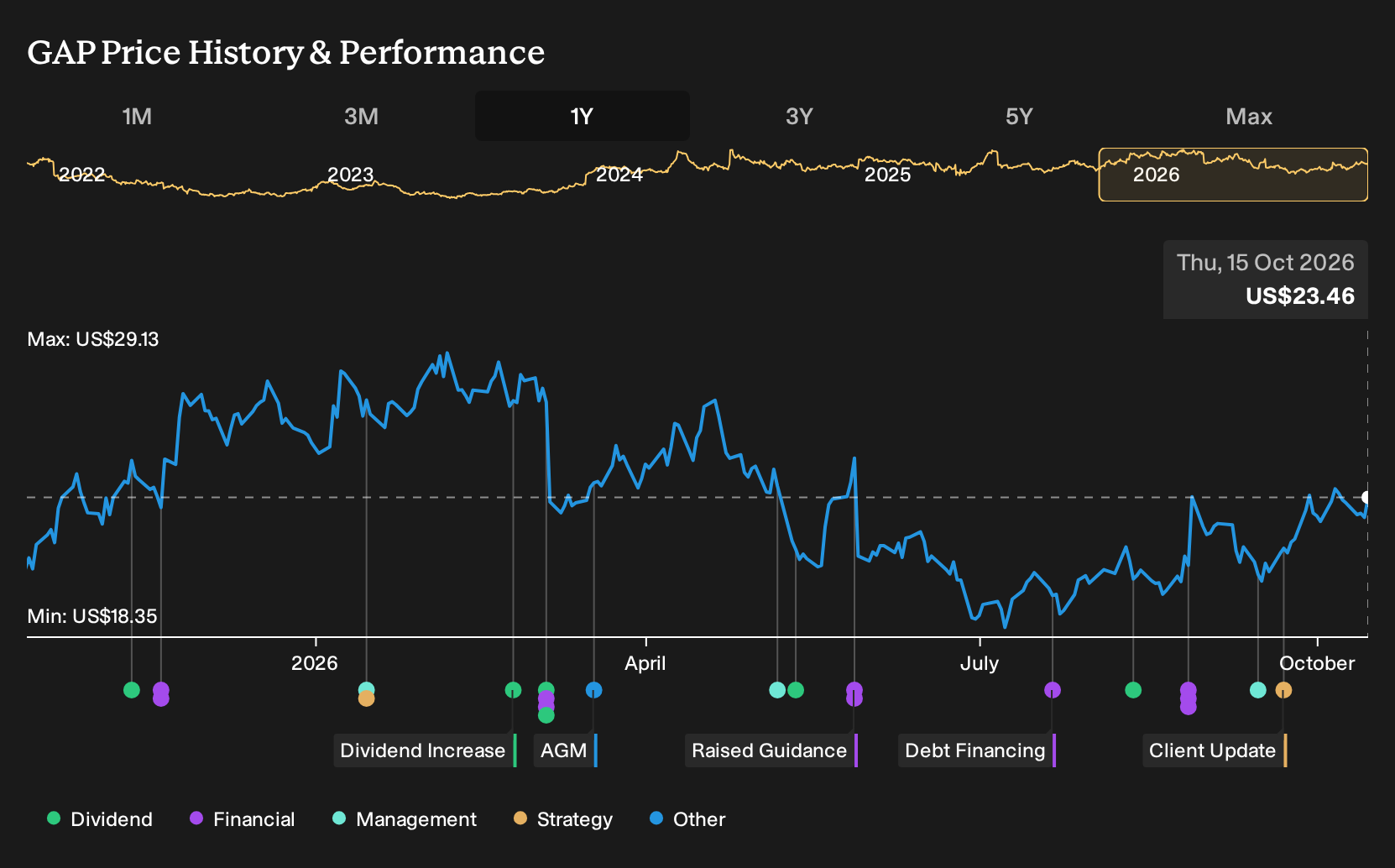
- Gap is contending with sluggish demand, underwhelming same store sales and ongoing store closures, which together highlight how hard it is for the retailer to find consistently profitable growth opportunities across its Old Navy, Banana Republic and other banners.
- The weak return on capital signals that Gap’s footprint and merchandising choices are not yet converting its brand reach into attractive economic performance, keeping execution quality at the center of the story for long term investors.
- We will now look at how this weaker demand backdrop at Gap could reshape the longer term investment narrative around its brands.
Gap Investment Narrative Recap
To own Gap, you need to believe the retailer can turn a wide brand portfolio into steadier, less promotional demand across Old Navy, Gap, Banana Republic and Athleta. The recent news on sluggish traffic and same store sales keeps that thesis under pressure. The near term swing factor remains basic execution, getting assortments and inventory closer to what core customers actually buy at full price.
The biggest risk right now is that Old Navy and Athleta stay stuck in reset mode, which could force heavier discounting and keep returns on capital soft. If demand stabilises, existing efforts in beauty, accessories and higher margin categories could matter more, but the latest trading update points to a slower path to that scenario rather than a clear break in the story.
Among the earlier announcements, the shift toward higher adjusted gross margin of 41.4% in Q2 2026, supported by tariff relief and cost discipline, looks most relevant against this weaker demand news. That margin base gives Gap some room to absorb softer same store sales without an immediate hit of the same scale to profitability, as long as discounting does not escalate too far.
Cash of about US$2.5b and more than US$600m of share repurchases year to date show that the balance sheet and capital return framework were positioned for a steadier demand backdrop. In light of the current slowdown, investors now have to weigh whether that cash and margin strength can offset execution risk at Old Navy and Athleta, or whether further pressure on promotions erodes those earlier gains.
Gap’s current analyst narrative points to revenues of US$16.5b and earnings of US$970.5m by 2029, based on an assumed 2.4% yearly revenue growth rate and an earnings decline of about US$229.5m from US$1.2b today.
Uncover why Gap's fair value indicates that Gap has a 13% potential upside to its current price, which could narrow quickly.
Exploring Other Perspectives
One alternate view on Gap leans hard into digital risk. The most pessimistic analysts already saw online rivals squeezing profitability, with revenue projected at about US$16.4b and earnings near US$878.0m by 2029. The latest demand shock could push those expectations lower, so you may want to compare both narratives before deciding your stance.
Explore 5 other Gap fair value estimates, including one that suggests as much as 10% downside from the current price.
Reach Your Own Conclusion
Don't just follow the ticker. Dig into the data and build a conviction that's truly your own.
- A great starting point for your Gap research is our analysis highlighting 3 key rewards and 4 important warning signs that could impact your investment decision.
- See our latest analysis for Gap. The report includes a comprehensive fundamental analysis summarized in a single visual, the Snowflake, making it easy to evaluate Gap's overall financial health at a glance.
Looking For More Investment Ideas Beyond Gap?
If the Gap story leaves you wanting a broader watchlist, it can help to line it up against other companies with different risk and return profiles. The Simply Wall St Screener offers a quick way to scan for stocks that better match your preference for quality, volatility, or income.
- If capital preservation matters most to you, start with a basket of companies that have stronger balance sheets and accounting fundamentals using the list of solid balance sheet and fundamentals (25 results).
- If you are searching for value opportunities, compare Gap against a curated group of stocks that look attractively priced relative to their quality with the 33 high quality undervalued stocks.
- If reliable income is the priority, line up Gap next to companies offering robust yields and more resilient cash flows through the 8 dividend fortresses.
This article by Simply Wall St is general in nature. We provide commentary based on historical data and analyst forecasts only using an unbiased methodology and our articles are not intended to be financial advice. It does not constitute a recommendation to buy or sell any stock, and does not take account of your objectives, or your financial situation. We aim to bring you long-term focused analysis driven by fundamental data. Note that our analysis may not factor in the latest price-sensitive company announcements or qualitative material. Simply Wall St has no position in any stocks mentioned.
Have feedback on this article? Concerned about the content? Get in touch with us directly. Alternatively, email editorial-team@simplywallst.com