
Wall Street fixed income transactions took the lead in “entering winter”, and major European banks “took over” the pressure
The Zhitong Finance App learned that Wall Street banks' fixed income business was weak in the third quarter, which did not bode well for European banks because they were also dealing with rising interest rates.
Analyst Philip Richards said, “I can't see how the European banking situation would be any different. Interest rates are rising, uncertainty is soaring, the US and European banking sector are in exactly the same situation, and in fact, given the current situation in France, I think the European banking sector is worse.”
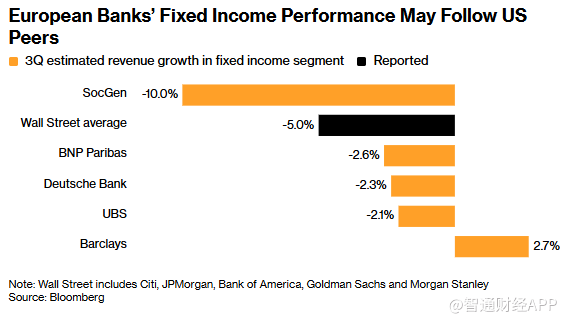
The market anticipates that Societe Generale Bank's fixed income and foreign exchange revenue plummeted 10% in the third quarter, the biggest decline among European investment banks. Deutsche Bank, BNP Paribas, and UBS Group will all also report a decline in fixed income, with Barclays being the only exception.
Wall Street fixed income transactions took the lead in “entering winter”
This will echo its American counterpart. Revenue from fixed income transactions in the US banking sector fell by an average of 5%, and Goldman Sachs (GS.US) mentioned “a significant drop in net income from mortgage loans and credit products.” J.P. Morgan Chase (JPM.US) saw a year-on-year decline in fixed income, foreign exchange, and commodity revenue for the first time in more than two years, while Morgan Stanley (MS.US) recorded the second worst quarterly performance in three years.
According to the data, Bank of America (BAC.US) fixed income transaction revenue in the third quarter fell 17% year on year, more than three times the average decline of its US peers. Only Citigroup (C.US) bucked the trend.
European banks' fixed income performance may follow US peers
As high interest rates curtail bond issuance, the bond trading sector is facing an even more serious situation. In the US, uncertainty about the Federal Reserve's next move has also made some clients reluctant to establish large-scale positions. Renewed concerns about inflation have further exacerbated the uncertain outlook for interest rates.
French risks are compounded, and the outlook for the bond market is still bleak
As concerns about France's fiscal situation grow, the volatility in the bond market will only worsen. The French debt crisis brought several of France's major banks — Société Générale, BNP Paribas, and Crédit Agricole — into the spotlight because they are the main holders of French government bonds.
Although the US banking industry can rely on equity business to offset the weakness in fixed income business, European banks are less capable in this regard. Barclays and Societe Generale failed to replicate the brilliance of Wall Street's second-quarter stock trading, increasing the possibility that the European Investment Bank would weaken across the board in the third quarter.
KBW analysts Thomas Hallett and Andrew Stimpson wrote in a report that UBS appears to be “in a relatively favorable position” because of its limited credit exposure and focus more on foreign exchange transactions, which have become a highlight in FICC's business. Analyst Richards believes that Barclays may have performed well, but there is little room to significantly exceed expectations.
Barclays will release earnings on October 22, UBS, Deutsche Bank and BNP Paribas will release financial reports on October 28, and Société Générale on October 29.
Looking ahead, the outlook for the region's largest lenders is becoming bleak, with global bond sell-offs evoking memories of the 2012 sovereign debt crisis, while high oil prices have fueled concerns about inflation.
“As far as we can see, there are risks everywhere: exposure to sovereignty, financial collapse across Europe,” Richards said. “Of course I wouldn't assert that the plight of the fixed income market has bottomed out, because it looks like this is likely to continue.”