
3 British Energy Stocks With Revenue Up To US$175b
Energy shocks linked to the Iran war have pushed US inflation to 3.7%, putting crude supply back in the spotlight and reminding investors how central fuel costs are to everything from transport to data centres. That kind of pressure keeps global attention on leading oil and gas producers. In this article, you will see three large oil and gas stocks that headline this global opportunity.
The three stocks below are just a starting sample, and the full screen surfaced 12 more oil and gas companies with equally compelling narratives that are not covered here.
To identify and analyze those additional opportunities directly, head into the Oil and Gas screener
Seplat Energy (LSE:SEPL)
Seplat Energy is a Nigeria focused upstream producer, with onshore oilfields and gas processing plants that plug directly into the Oil and Gas theme through its core exploration, production, and gas processing operations.
Seplat Energy generates most of its income from crude, with about $2.8b from oil, $192 million from gas, and $127 million from natural gas liquids, and the business is valued at about £5b in the market.
For Oil and Gas investors, Seplat Energy is interesting because its onshore fields and gas plants tie directly into real barrels and molecules, not just financial engineering. This makes the next piece of its story worth paying attention to.
"Substantial ramp-up in gas production due to the imminent commissioning of the ANOH gas plant and Sapele Gas Integrated Project will allow Seplat to capture rising demand for domestic gas as a cleaner energy source in Nigeria, supporting long-term revenue growth and improved net margins."
What really matters now is how one unresolved pressure around future mix and pricing feeds through to those margins investors are watching.
Those margin pressures are only half the story, and the real context sits in the full narrative for Seplat Energy that connects Seplat Energy's gas ramp, capital choices and risk trade offs.

Shell (LSE:SHEL)
Shell is a global energy giant with deep roots in oil and gas, where upstream production of crude and natural gas, plus LNG, still anchors a broad mix that also spans refining, marketing, chemicals, and growing low carbon solutions.
Shell generated about US$134.6b from Marketing, US$131.8b from Chemicals and Products, US$48.9b from Integrated Gas, US$44.2b from Upstream and US$41.8b from Renewables and Energy Solutions, and the group is valued at roughly £223.7b in the market.
For an Oil and Gas themed portfolio, Shell offers scale and diversification, with its LNG platform and global trading arm giving the business leverage to how global fuel flows and price gaps evolve.
"Economic growth in Asia and energy security concerns in Europe will increase LNG demand by over 50% by 2040."
What shapes Shell’s long term appeal is how one shift in LNG project timing and policy could feed through to unit margins and cash returns.
That mix of timing risk and LNG clout only really comes into focus when you read the full narrative for Shell, which maps where Shell’s next phase could accelerate.

BP (LSE:BP.)
BP is one of the big integrated energy groups in this Oil and Gas screener, with upstream crude production, refining and oil trading still doing much of the heavy lifting alongside its gas and low carbon units.
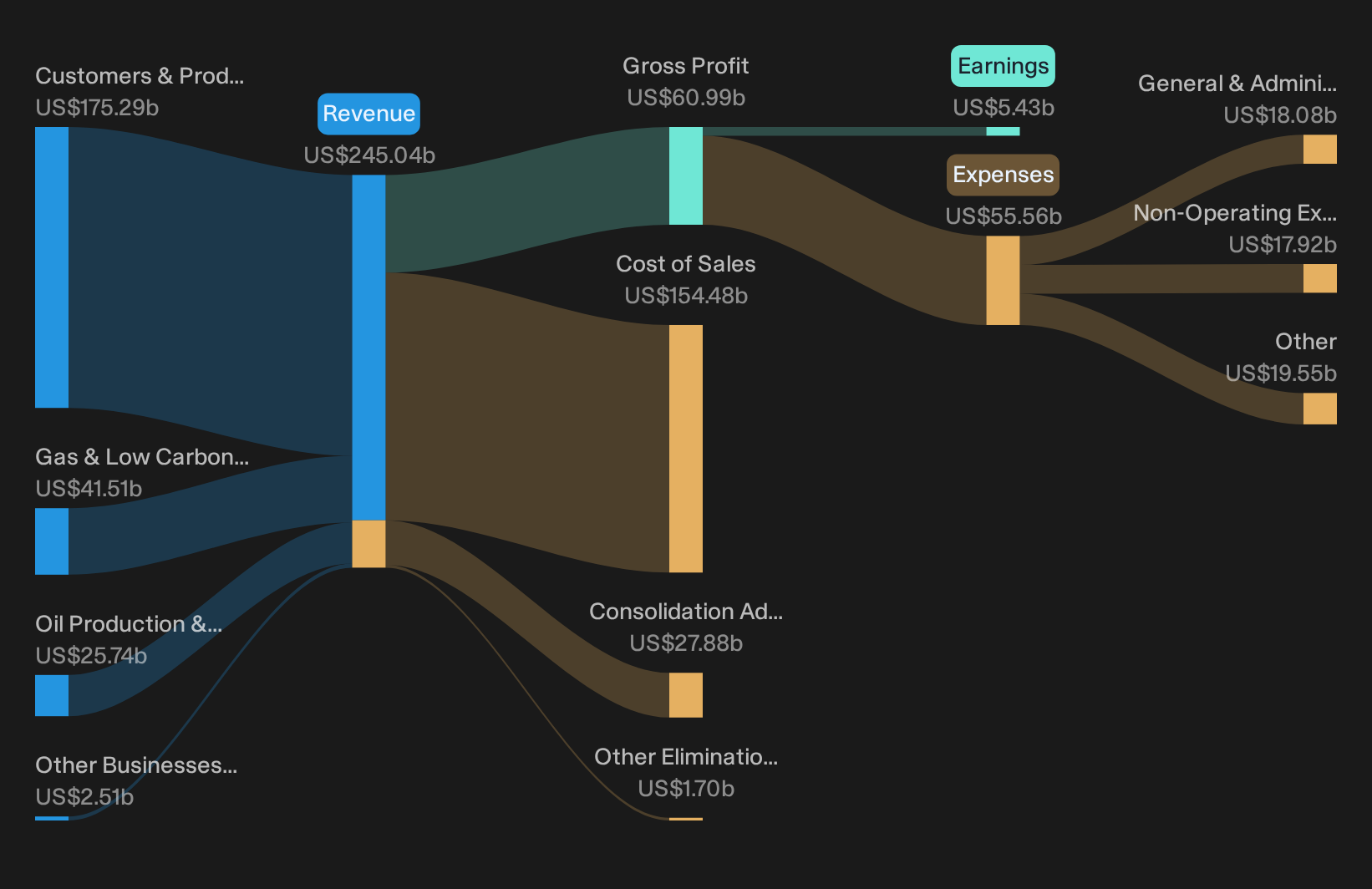
BP runs a broad energy operation that spans oil production, gas, refining, trading, retail fuel and EV charging, with Customers & Products contributing about US$175.3b, Gas & Low Carbon Energy around US$41.5b, and Oil Production & Operations roughly US$25.7b in annual revenue, and the group is valued at about £94.9b in the market.
For investors focused on top Oil and Gas producers, BP offers a mix of upstream barrels, trading muscle and refining exposure, all wrapped inside a balance sheet that management is actively reshaping.
"An accelerated and data-driven structural cost reduction program, enhanced by the use of AI, digitization, and supply chain optimization, is expected to materially improve BP's operating margins and free cash flow, positioning the company to benefit from technological advancements that reward scaled, efficient industry players."
What happens when one quiet shift in how BP funds and prioritises those core oil and gas projects starts to ripple through future cash returns.
That quiet shift is exactly what sits at the centre of the full narrative for BP, where BP's cost cuts, project choices and cash ambitions start to look like an accelerating reset.
Seeking Fresh Alternatives Beyond Oil?
New themes can gather momentum quickly. By the time the crowd notices, the most attractive entry points may no longer be available. Review these fresh stock ideas while it matters and consider them early.
- Look for early movers in small caps before momentum headlines appear by scanning the 13 elite penny stocks with strong financials that filters for financial strength instead of hype.
- Track businesses developing AI products now, not just pitching slide decks, through the curated 39 profitable AI stocks that aren't just burning cash focused on companies already generating revenue from their technology.
- Evaluate opportunities around potential infrastructure upgrade cycles by checking the 43 power grid technology and infrastructure stocks featuring firms involved in grid reliability, transmission projects and electrification efforts.
This article by Simply Wall St is general in nature. We provide commentary based on historical data and analyst forecasts only using an unbiased methodology and our articles are not intended to be financial advice. It does not constitute a recommendation to buy or sell any stock, and does not take account of your objectives, or your financial situation. We aim to bring you long-term focused analysis driven by fundamental data. Note that our analysis may not factor in the latest price-sensitive company announcements or qualitative material. Simply Wall St has no position in any stocks mentioned.
Have feedback on this article? Concerned about the content? Get in touch with us directly. Alternatively, email editorial-team@simplywallst.com