
How Strike Action At BHP Group (ASX:BHP) Has Changed Its Investment Story
- Supervisors and unionized workers at BHP Group's Escondida copper mine in Chile have already commenced strike action after government mediated wage talks and contract negotiations collapsed, raising the prospect of disrupted output at the world's largest copper operation.
- The strike dispute over pay, bonuses, duties and shift patterns highlights rising labor and cost pressures across BHP Group's copper portfolio at a time when Chilean production is already constrained and global demand for the metal remains closely watched.
- This section now examines how BHP Group's investment narrative is affected by labor driven disruption risk at the Escondida copper mine.
BHP Group Investment Narrative Recap
BHP Group appeals to shareholders who focus on long life, low cost resource assets with significant exposure to copper, iron ore and steelmaking coal. The short term story now depends on how quickly Escondida can return to stable operations. Prolonged labor action would add to inflation and labor cost pressures already identified as key issues.
The biggest near term positive swing factor remains reliable volumes from core hubs, particularly Western Australian iron ore and Chilean copper, contributing to margin quality rather than rapid revenue growth. The strike directly affects the largest copper asset, so operational execution and labor relations are central to the current risk profile.
With no new company announcements disclosed alongside this labor dispute, the most relevant context comes from earlier commentary on cost inflation, labor expenses and project execution risk. Management has previously noted that higher wage bills and productivity challenges can reduce the benefits of efficiency gains, even when output remains steady.
This Escondida strike effectively tests that message in real time. Any extended disruption would not only affect near term copper shipments, it could also influence how BHP Group phases future copper and potash spending, how it manages labor terms across other sites and how much flexibility remains for disciplined capital allocation if operating cash flow is temporarily weaker.
BHP Group's current analyst narrative points to revenues of $58.6b and earnings of $13.9b by 2029, based on forecasts that imply broadly flat top line performance and a rise in profit from $9.8b today. This would represent an earnings increase of about $4.1b by the forecast year.
Uncover why BHP Group's fair value indicates a 3% potential downside to its current price, suggesting that this premium may not be sustainable.
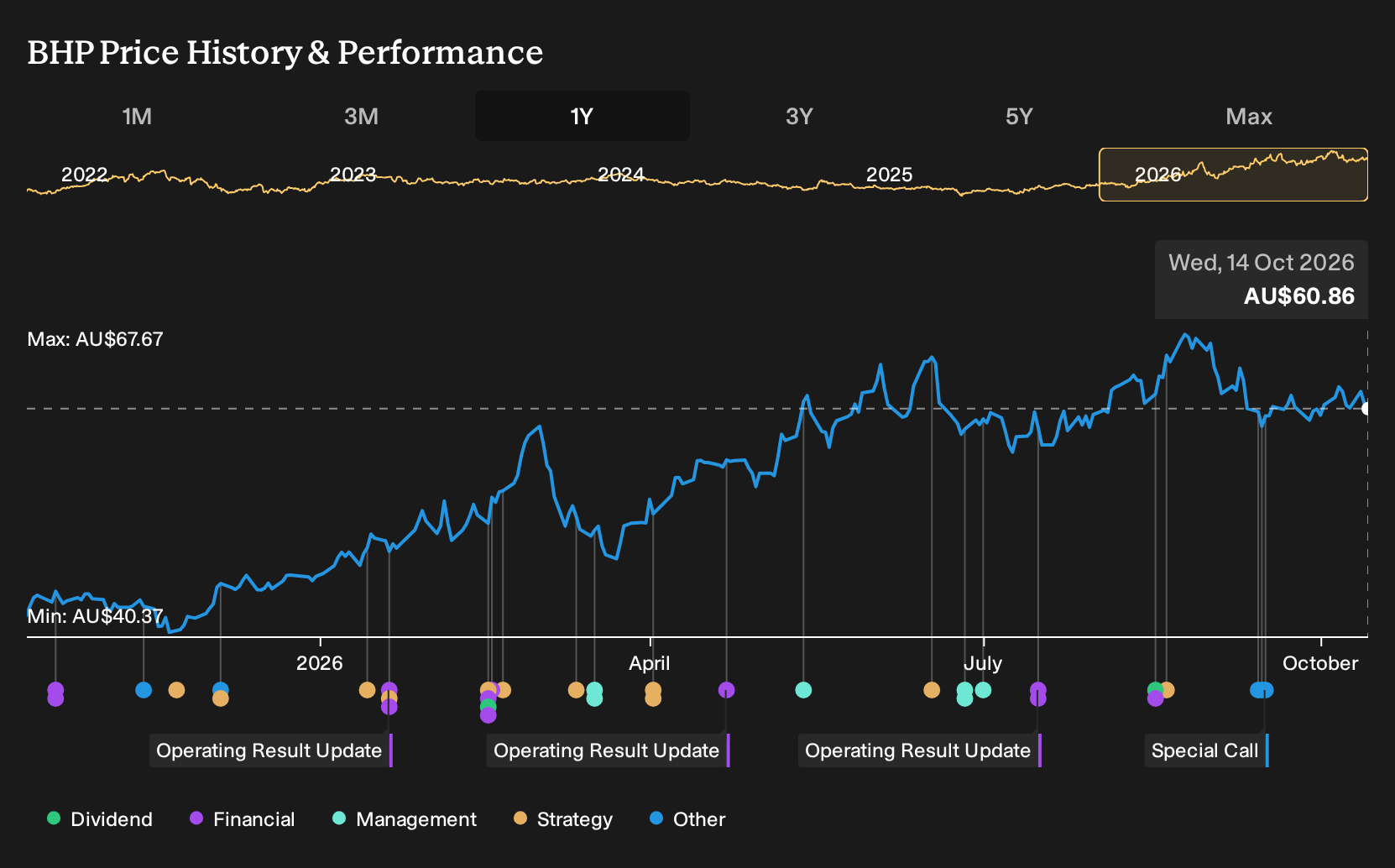
Exploring Other Perspectives
Some of the lowest BHP Group forecasts already baked in copper specific project risk well before this Escondida strike, with those analysts pencilling in revenue of about $50.5b and earnings of $11.8b by 2029. That is a far more cautious story. It shows how sharply opinions can differ, and why you may want to compare several viewpoints that could now shift again after this news.
Explore 15 other BHP Group fair value estimates, including one that suggests as much as 48% downside from the current price.
Reach Your Own Conclusion
Don't just follow the ticker; dig into the data and build a conviction that's truly your own.
- A great starting point for your BHP Group research is our analysis highlighting 1 key reward and 1 important warning sign that could impact your investment decision.
- See our latest analysis for BHP Group. The report includes a comprehensive fundamental analysis summarized in a single visual, the Snowflake, making it easy to evaluate BHP Group's overall financial health at a glance.
Looking for more BHP Group sized ideas?
Once you have a view on BHP Group, it can help to widen the lens and compare it with other businesses that share traits you care about, whether that is value, resilience or income. The Simply Wall St Screener lets you move from a single ticker to a curated set of stocks that fit those priorities.
- If you want to focus on potential mispricings rather than headlines, filter for companies that combine balance sheet strength with attractive valuations using the 4 high quality undervalued stocks.
- For investors who care most about stability, concentrate on companies with resilient financial profiles and lower assessed risk by starting with the 6 resilient stocks with low risk scores.
- If you prefer quality filters that sometimes sit off the beaten path, you can hunt for strong fundamentals and quieter coverage through the 15 high quality undiscovered gems.
This article by Simply Wall St is general in nature. We provide commentary based on historical data and analyst forecasts only using an unbiased methodology and our articles are not intended to be financial advice. It does not constitute a recommendation to buy or sell any stock, and does not take account of your objectives, or your financial situation. We aim to bring you long-term focused analysis driven by fundamental data. Note that our analysis may not factor in the latest price-sensitive company announcements or qualitative material. Simply Wall St has no position in any stocks mentioned.
Have feedback on this article? Concerned about the content? Get in touch with us directly. Alternatively, email editorial-team@simplywallst.com