
Equifax (EFX) Stock Looks Reasonable After Its 42% Five Year Fall
Equifax has seen its share price fall back over recent years, even as the business rolls out new mortgage scoring and verification tools that aim to deepen its role in consumer credit decisions. The question for you is whether the current US$150.36 price fairly reflects what the company is earning today.
- The stock has fallen 42.0% over 5 years, which puts the spotlight squarely on whether the underlying earnings now justify a much lower equity value.
- Efforts to expand VantageScore 4.0 adoption and launch products like Mortgage Ultimate can influence expectations for future profit streams, since lender uptake and pricing choices may affect both revenue quality and the timing of cash flows.
- Your read on Equifax is one view; the desks covering it have another. See what analysts think Equifax's shares could be worth.
The issue now is whether Equifax's current share price is supported by its earnings when lined up against the Fair Ratio benchmark.
If Equifax's recent 5 year share price decline and mortgage product rollout have you reassessing where you start your research, you may want to scan 33 high quality undervalued stocks.
Where Does Equifax Sit on Earnings?
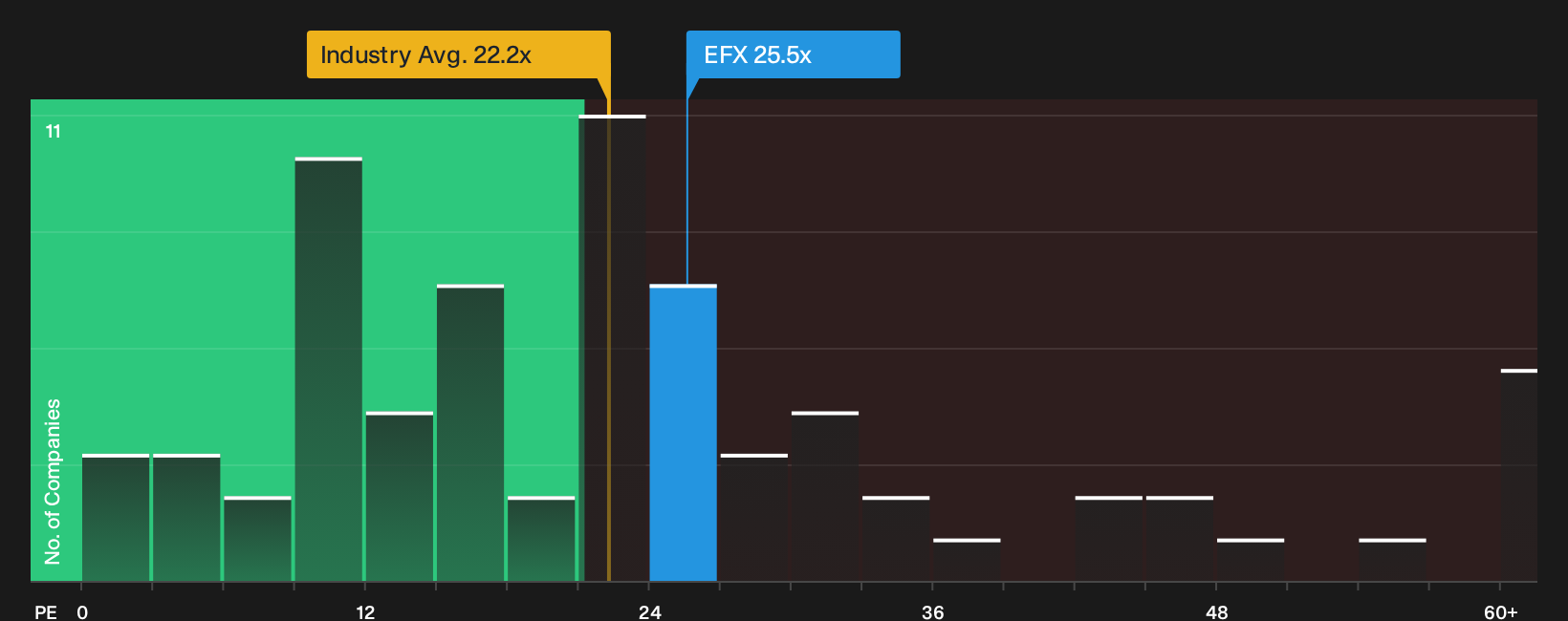
The P/E ratio works well for Equifax because earnings remain a central yardstick for how its credit and mortgage tools translate into shareholder value. On this measure, the stock trades on a P/E of 25.5x, against a Professional Services industry average of 22.2x and a peer group closer to 28.1x. That puts Equifax at a premium to the wider sector but at a lower level than similar businesses that investors tend to compare it with.
The Fair Ratio framework, which lines up the P/E multiple with the company’s growth profile, profitability, size and risk, points to today’s valuation being about right rather than clearly stretched or cheap. Because the recent push around VantageScore 4.0 and Mortgage Ultimate has raised the profile of Equifax in mortgage credit discussions, this kind of mid range P/E position suggests the market is recognising those initiatives without giving the stock a clear premium. Explore the numbers behind Equifax's P/E valuation.
The Equifax Narrative: What Would Justify Today's Price?
Simply Wall St Narratives pick up where the Equifax valuation puzzle leaves off. They spell out which paths for growth, margins and earnings would need to play out for the shares to look meaningfully higher or lower than today’s price. Each narrative anchors its number to a clear view on how Equifax's future expansion, profitability and risk profile might evolve, giving you something concrete to revisit as fresh information comes through.
One of the top community narratives on Equifax: 27% undervalued
"The main thing that has to go right is that Equifax turns its growing Work Number record base, government contracts and VantageScore mortgage traction into durable, less cyclical verification and analytics revenue while managing legal and regulatory risks..."
Discover why this Narrative puts Equifax at 27% undervalued.
An unresolved question on Equifax that could change how you view the stock
Valuation only tells part of the story for Equifax, because separate checks have raised issues that deserve a closer look before you lean too heavily on any single metric. Take a closer look at 1 warning sign before settling on a valuation.
This article by Simply Wall St is general in nature. We provide commentary based on historical data and analyst forecasts only using an unbiased methodology and our articles are not intended to be financial advice. It does not constitute a recommendation to buy or sell any stock, and does not take account of your objectives, or your financial situation. We aim to bring you long-term focused analysis driven by fundamental data. Note that our analysis may not factor in the latest price-sensitive company announcements or qualitative material. Simply Wall St has no position in any stocks mentioned.
Have feedback on this article? Concerned about the content? Get in touch with us directly. Alternatively, email editorial-team@simplywallst.com