
How Investors Are Reacting To Tate & Lyle (LSE:TATE) Commercial Grade Sweetener Milestone
- Tate & Lyle and BioHarvest Sciences reported that BioHarvest’s Botanical Synthesis platform has successfully produced the targeted commercial grade next generation sweetening solution, confirming practical progress in their joint programme to support sugar and calorie reduction.
- This milestone gives Tate & Lyle another potential specialty ingredient route that could help address customer demand for reliable, consistent plant derived sweeteners without relying solely on traditional agriculture.
- The next area of focus is how Tate & Lyle's investment narrative could be reshaped by this commercial grade next generation sweetener milestone.
Scan how Tate & Lyle’s sweetener progress compares with other ingredient specialists by reviewing our curated list of 5 high quality undiscovered gems gaining attention from institutional investors.
Tate & Lyle Investment Narrative Recap
To own Tate & Lyle today, you need to believe the shift toward specialty ingredients, productivity gains and disciplined integration can offset softer volumes in bulk sweeteners and regional pressure. The Botanical Synthesis milestone reinforces that sugar reduction remains central to the operating story, although the 3% like for like revenue and EBITDA decline keeps demand risk very present.
In the short term, the key swing factor is execution on CP Kelco and broader cost programs, while cash conversion and debt coverage improve. The new sweetener route helps the product toolkit but does not yet change the main risk, which is that muted demand and delayed project benefits hold back earnings and free cash flow.
The recent disclosure that Millennium International Management, Davidson Kempner, Pzena and others hold positions above 1% in Tate & Lyle is the most relevant accompanying news. These are cash settled derivatives or equity stakes rather than hard takeover evidence, but the cluster of filings around October keeps corporate activity firmly in view.
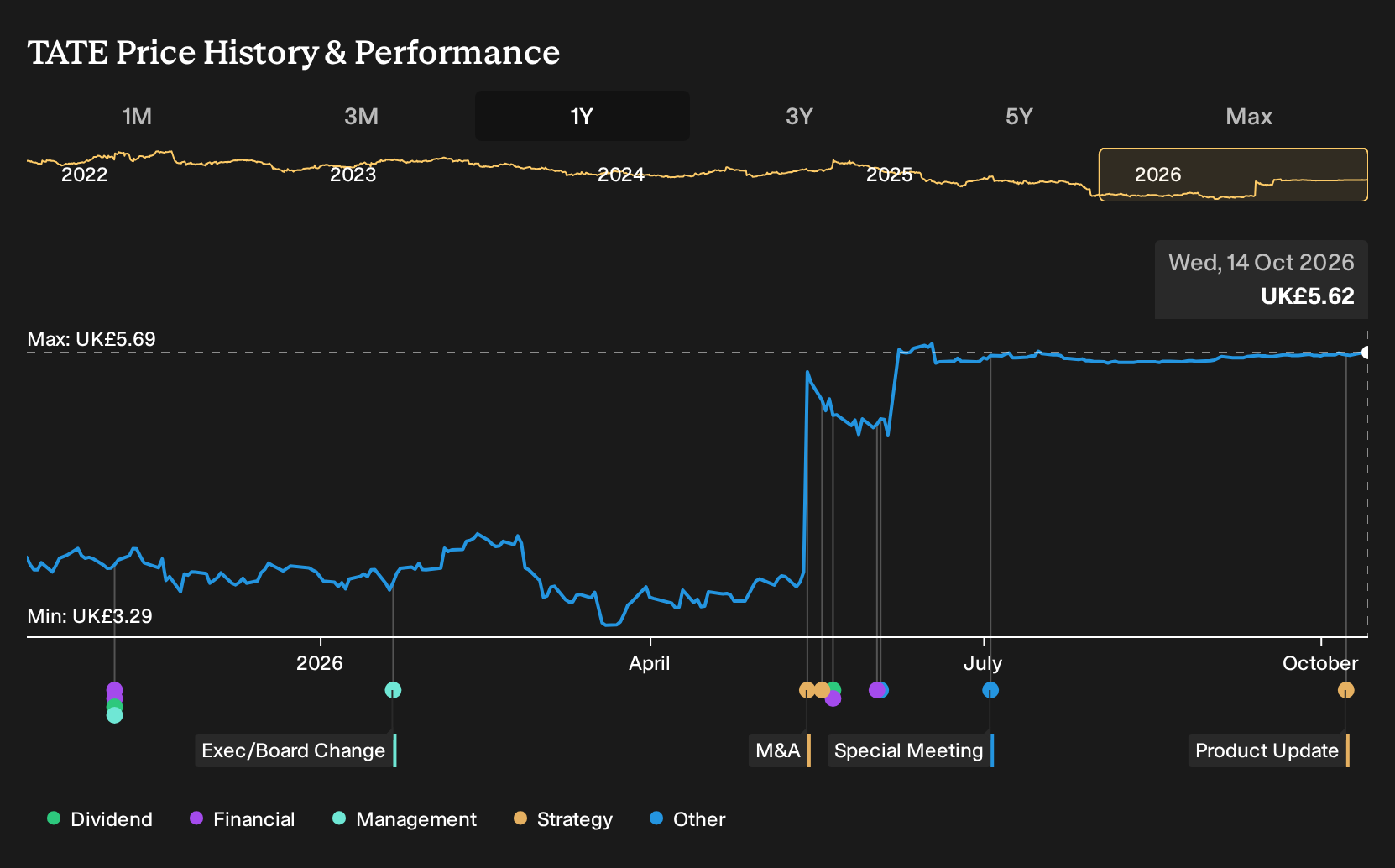
For catalysts, that matters because the Ingredion all cash offer and the CP Kelco tie up already frame expectations around future synergies and margins. As you consider the new BioHarvest sweetener, it helps to set it against this backdrop of active institutional interest, integration risk and a stock that has already risen 52.9% year to date.
Tate & Lyle Consensus Set-Up Around The New Sweetener Route
Tate & Lyle's next generation sweetener progress sits on top of a fairly specific analyst framework. That framework already bakes in steady productivity projects, CP Kelco integration work and the potential Ingredion tie up, so the Botanical Synthesis milestone slots into a story that is more about execution than blue sky upside.
Forecasts in the current consensus sketch out modest top line expansion, margin repair and a reset in valuation multiples over time. Analysts are assuming revenue growth of 2.7% per year over the next three years and an increase in profit margins from 4.8% today to 9.0% over the same horizon. That mix implies a heavier lift from efficiency and mix than from volume acceleration in bulk sweeteners.
Earnings expectations put a finer point on it. The group of analysts referenced in the Simply Wall St report is looking for earnings to reach £195.2 million by about 2029, compared with £97.0 million today, with the more optimistic forecasts going as high as £251.1 million. That consensus path implies earnings roughly doubling over the period, even before considering any upside or downside from the BioHarvest sweetener stream.
On the same numbers, the assumed P/E moves in the opposite direction. The shares are described as trading on a P/E of 25.6x today, with the illustrative 2029 scenario using a multiple of 15.7x on the forecast earnings. That target P/E also sits slightly below the 16.0x level cited for the broader GB Food industry, which signals that analysts are not treating Tate & Lyle as a premium outlier despite the specialty shift and the CP Kelco combination.
The share count is not a big swing factor in these projections, with forecasts for outstanding shares to grow by 0.1% a year over the next three years. Discounting in the Simply Wall St framework uses a rate of 7.56%, which anchors the present value of those future cash flows but still leaves plenty of room for investor debate about risk and the right hurdle rate for an ingredients supplier with ongoing integration projects.
On published numbers, the consensus anchors around revenues of £2.2b and earnings of £195.2 million by 2029. To square that with the analyst price target of £5.54, the model assumes the shares would be trading on a 2029 P/E of 15.7x and uses a rounded discount rate of 7.6%. The small gap between that £5.54 target and the current £5.61 share price suggests the market is already treating these projections and risks as broadly known quantities.
Where the BioHarvest collaboration edges in is through conviction on those ingredients and margin levers. A reliable, plant derived sweetener source that does not depend solely on traditional agriculture could help underpin higher value mix over time. For readers, the key question is whether this scientific progress makes the existing earnings and valuation path feel more resilient, or whether muted demand and integration risk still dominate the Tate & Lyle story at today’s price.
Tate & Lyle's narrative projects £2.2b revenue and £195.2 million earnings by 2029. This assumes 2.7% yearly revenue growth and roughly a doubling of earnings from £97.0 million today.
Uncover why Tate & Lyle's fair value is consistent with its current price.
Exploring Other Perspectives
Some of the most optimistic analysts already expected Tate & Lyle to push revenues toward about £2.2b and earnings near £250.4 million by 2029, driven by CP Kelco synergies. You now have this next generation sweetener milestone on top. That could eventually push those volume led forecasts higher or leave them looking stretched. Treat it as a cue to compare a more cautious £195.2 million earnings path with the bullish view and decide which storyline feels closer to your own expectations.
Explore 4 other Tate & Lyle fair value estimates, including one that suggests as much as 211% potential increase from the current price!
Reach Your Own Conclusion
Disagree with existing narratives? Extraordinary investment returns rarely come from following the herd, so trust your own analysis.
- A great starting point for your Tate & Lyle research is our analysis highlighting 3 key rewards and 3 important warning signs that could impact your investment decision.
- See our latest analysis for Tate & Lyle. The report includes a comprehensive fundamental analysis summarized in a single visual, the Snowflake, making it easy to evaluate Tate & Lyle's overall financial health at a glance.
Looking for more investment ideas beyond Tate & Lyle?
Once you have a view on Tate & Lyle, it can help to cross check that thinking against other opportunities that share some of the qualities you care about, whether that is value, resilience or balance sheet strength.
- For investors who want a margin of safety built into the entry price, review our curated set of 8 high quality undervalued stocks that combine solid fundamentals with more cautious market expectations.
- If capital preservation and lower volatility matter most to you, focus on the 4 resilient stocks with low risk scores that pass our stricter risk checks.
- When you care about financial robustness first and growth second, filter ideas using the list of solid balance sheet and fundamentals (9 results) and keep your watchlist anchored to stronger fundamentals.
This article by Simply Wall St is general in nature. We provide commentary based on historical data and analyst forecasts only using an unbiased methodology and our articles are not intended to be financial advice. It does not constitute a recommendation to buy or sell any stock, and does not take account of your objectives, or your financial situation. We aim to bring you long-term focused analysis driven by fundamental data. Note that our analysis may not factor in the latest price-sensitive company announcements or qualitative material. Simply Wall St has no position in any stocks mentioned.
Have feedback on this article? Concerned about the content? Get in touch with us directly. Alternatively, email editorial-team@simplywallst.com