
What Deere (DE)'s Yamaha Vehicle Partnership Means For Shareholders
- Yamaha Motor and Deere & Company recently agreed to work together on future Side-by-Side vehicles, combining Yamaha’s powertrain and design capabilities with Deere’s development, U.S. manufacturing, and customer insight, while each continues to operate under its own brand and dealer network.
- The collaboration gives Deere a new way to apply its equipment development and manufacturing base to utility and recreational SxS demand, which could matter for how its off-road vehicle offering fits alongside core agriculture and construction equipment.
- We will now look at how Deere’s investment narrative could be influenced by this Side by Side vehicle collaboration with Yamaha.
Scan how Deere’s off-road push compares with other machinery and equipment plays by checking companies on our curated 90 robotics and automation stocks list that are tied to automation and advanced vehicle platforms.
Deere Investment Narrative Recap
To own Deere, you need to be comfortable with a business that is heavily exposed to large agriculture cycles, while leaning on precision technology, construction equipment and services to support earnings. The Yamaha Side by Side collaboration probably does not change the near term story in a material way. The key near term swing factor remains how quickly large ag demand stabilizes, while tariff and cost pressures stay in focus.
The biggest operational risk still comes from weak large ag and South American markets, combined with high tariff expenses that weigh on margins. Deere’s forecast earnings growth and expanding digital ecosystem sit on the other side of that scale. The SxS tie up appears more like an incremental product extension than a core driver of the immediate outlook.
Given that there are no other fresh company announcements listed around this collaboration, the most relevant context is Deere’s existing execution on U.S. manufacturing investments. Management plans about US$20b of U.S. manufacturing spending over 10 years and is already producing Deere designed excavators in the expanded Kernersville facility. That focus on capacity and efficiency helps frame how investors might view any new vehicle platform.
If Deere can use its manufacturing footprint and connected machine base, nearly 1.2 million units, to support new Side by Side offerings, the collaboration could complement the broader equipment portfolio rather than distract from it. The operational question for you is whether these product extensions and digital tools help offset tariff costs, softer ag volumes and margin pressure over the next few years.
Deere's current analyst narrative points to US$48.8b in revenue and US$10.2b in earnings by 2029, compared with earnings today of US$4.9b. That implies revenue remaining broadly flat each year, while earnings would need to rise by about US$5.3b from current levels to reach the consensus forecast for that year.
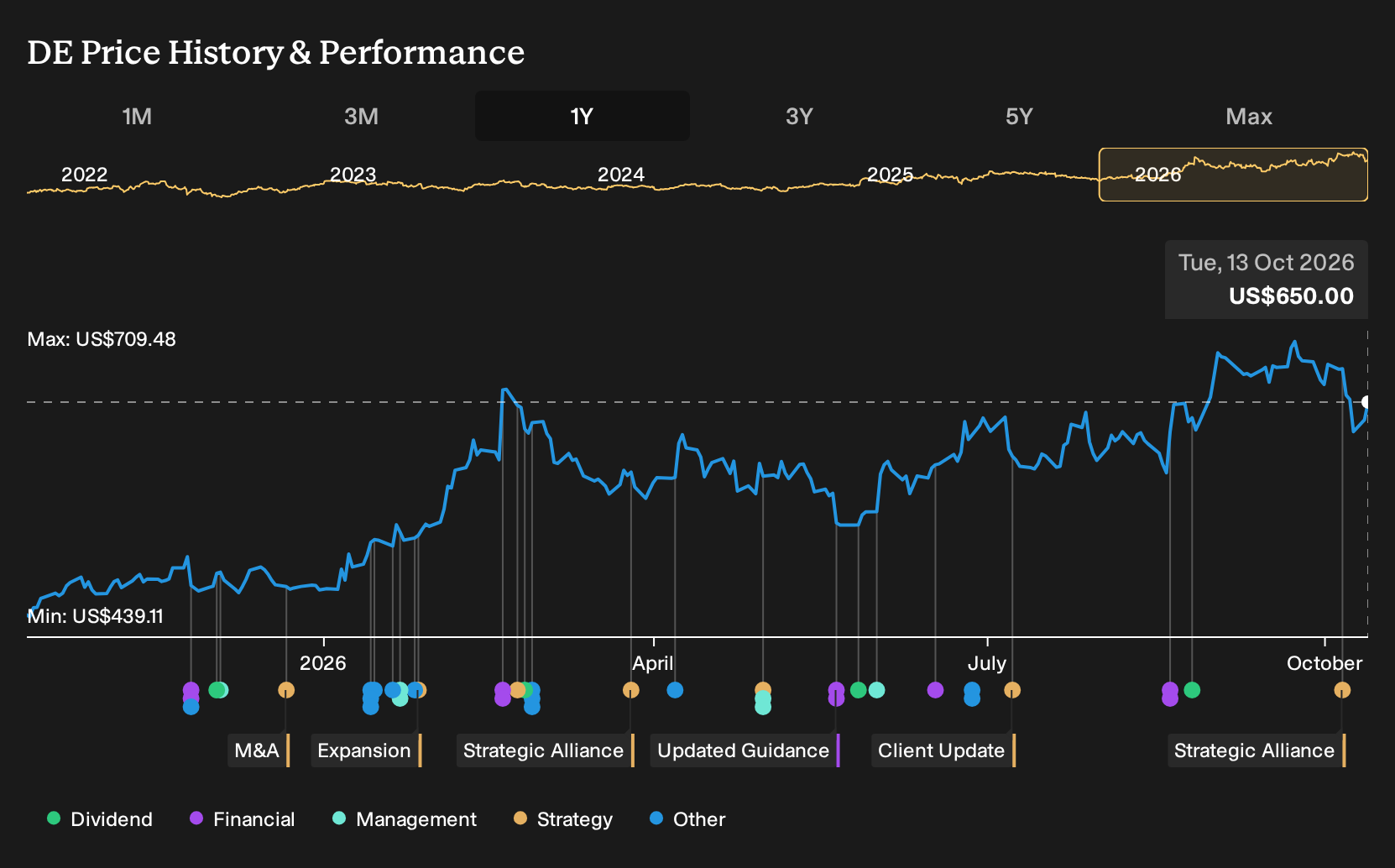
Uncover how Deere's fair value indicates a 6% potential upside to its current price. This potential could narrow quickly if sentiment turns more optimistic.
Exploring Other Perspectives
One alternate view says Deere’s biggest swing factor is not tariffs or large ag, but the risk that heavy tech and product investment earns less than hoped. The most cautious analysts were penciling in 2029 earnings of about US$7.1b on revenue near US$48.2b before this Yamaha Side by Side news. Their already lower expectations could shift again once this collaboration is fully reflected.
Explore 2 other Deere fair value estimates, including one that suggests it could be worth just $688.44.
The Verdict Is Yours
Don't just follow the ticker; dig into the data and build a conviction that's truly your own.
- A great starting point for your Deere research is our analysis highlighting 2 key rewards and 1 important warning sign that could impact your investment decision.
- See our latest analysis for Deere. The report includes a comprehensive fundamental analysis summarized in a single visual, the Snowflake, making it easy to evaluate Deere's overall financial health at a glance.
Looking for more investment ideas beyond Deere?
If Deere has sharpened your thinking about machinery, equipment and earnings power through cycles, it can help to compare it with other opportunities that fit different risk and income profiles. The Simply Wall St Screener lets you do that quickly by filtering for financial strength, valuation and income characteristics that match what you want from your next holding.
- For investors who want income that works harder than cash, review resilient high yield opportunities through our 8 dividend fortresses.
- If capital protection sits higher on your priority list, focus on companies with stronger balance sheets and dependable fundamentals using the list of solid balance sheet and fundamentals (25 results).
- When you are hunting for under followed prospects with quality metrics, start with our 20 high quality undiscovered gems.
This article by Simply Wall St is general in nature. We provide commentary based on historical data and analyst forecasts only using an unbiased methodology and our articles are not intended to be financial advice. It does not constitute a recommendation to buy or sell any stock, and does not take account of your objectives, or your financial situation. We aim to bring you long-term focused analysis driven by fundamental data. Note that our analysis may not factor in the latest price-sensitive company announcements or qualitative material. Simply Wall St has no position in any stocks mentioned.
Have feedback on this article? Concerned about the content? Get in touch with us directly. Alternatively, email editorial-team@simplywallst.com