
Raised Outlook Could Change The Case For NetApp Stock
- Diskover Data previously announced a collaboration with NetApp to extend Diskover Platform's governed visibility and control to ONTAP and StorageGRID environments for media, semiconductor design, and other file intensive sectors. The collaboration aims to give enterprise teams a searchable catalog of ownership, cost, and governance data across large file estates.
- The partnership highlights how NetApp's storage platforms are being used as a base for industry specific data discovery, cost allocation, and compliance workflows. These workflows directly address pain points around capacity management, chargeback, and regulated content in complex AI and data heavy projects.
- We will now look at how this AI focused demand backdrop and upgraded fiscal 2027 outlook could reshape NetApp's investment narrative.
NetApp Investment Narrative Recap
To own NetApp, you need to believe the business can keep shifting its center of gravity toward AI ready storage, cloud services, and subscriptions while managing pressure on gross margins and a premium P/E. The near term story hinges on execution against its raised fiscal 2027 revenue outlook and the ability to translate AI interest into repeatable, high quality deals.
The biggest risk still sits in traditional product softness and margin pressure as customers weigh on premises refresh against public cloud options, especially outside the Americas. The recent Diskover collaboration supports the AI storage narrative but does not fundamentally change those key drivers or risks on its own.
Among the recent updates, the raised fiscal 2027 revenue guidance of around 17% growth is most relevant to the Diskover news. Both point in the same direction: NetApp is leaning into AI and data intensive workloads across hybrid and public cloud, while trying to prove that this demand can support sustained top line progress.
For you as an investor, the question is whether NetApp can execute on that higher revenue bar while absorbing higher component costs and an unfavorable product mix that are expected to weigh on gross margins. Deals like Diskover and planned AI infrastructure acquisitions sit squarely inside that test as potential support for the growth side of the risk reward trade off.
What The NetApp Consensus Is Actually Pricing In
NetApp's current analyst playbook is built around fairly specific numbers rather than vague AI optimism. Consensus models point to revenue increasing at roughly 8.5% a year over the next 3 years, with profit margins moving from 19.2% today to 20.1% by around 2029. On the earnings line, the group view targets about US$1.9b of profit in 2029, compared with about US$1.4b today, even though some forecasters sit higher at roughly US$2.1b.
That earnings bridge matters for anyone trying to connect the Diskover collaboration and broader AI storage interest back to the stock. Moving from US$1.4b to US$1.9b implies an increase of roughly US$500m in annual profit over the next few years, with analysts also assuming a gradual reduction in the share count of about 0.83% each year. You are not looking at a blue sky story. You are looking at a defined earnings step up that has been translated into a very specific P/E and revenue path.
The multiple work is just as important as the growth work. For these forecasts to justify the current consensus price targets, NetApp would need to trade on a P/E of 25.7x its 2029 earnings, compared with about 29.1x today and slightly above the 25.6x level quoted for the broader US tech sector. That means the thesis on the stock is not only about AI storage demand. It also leans on the idea that NetApp can defend a modest valuation premium while the business mix tilts toward higher margin cloud and subscription revenue.
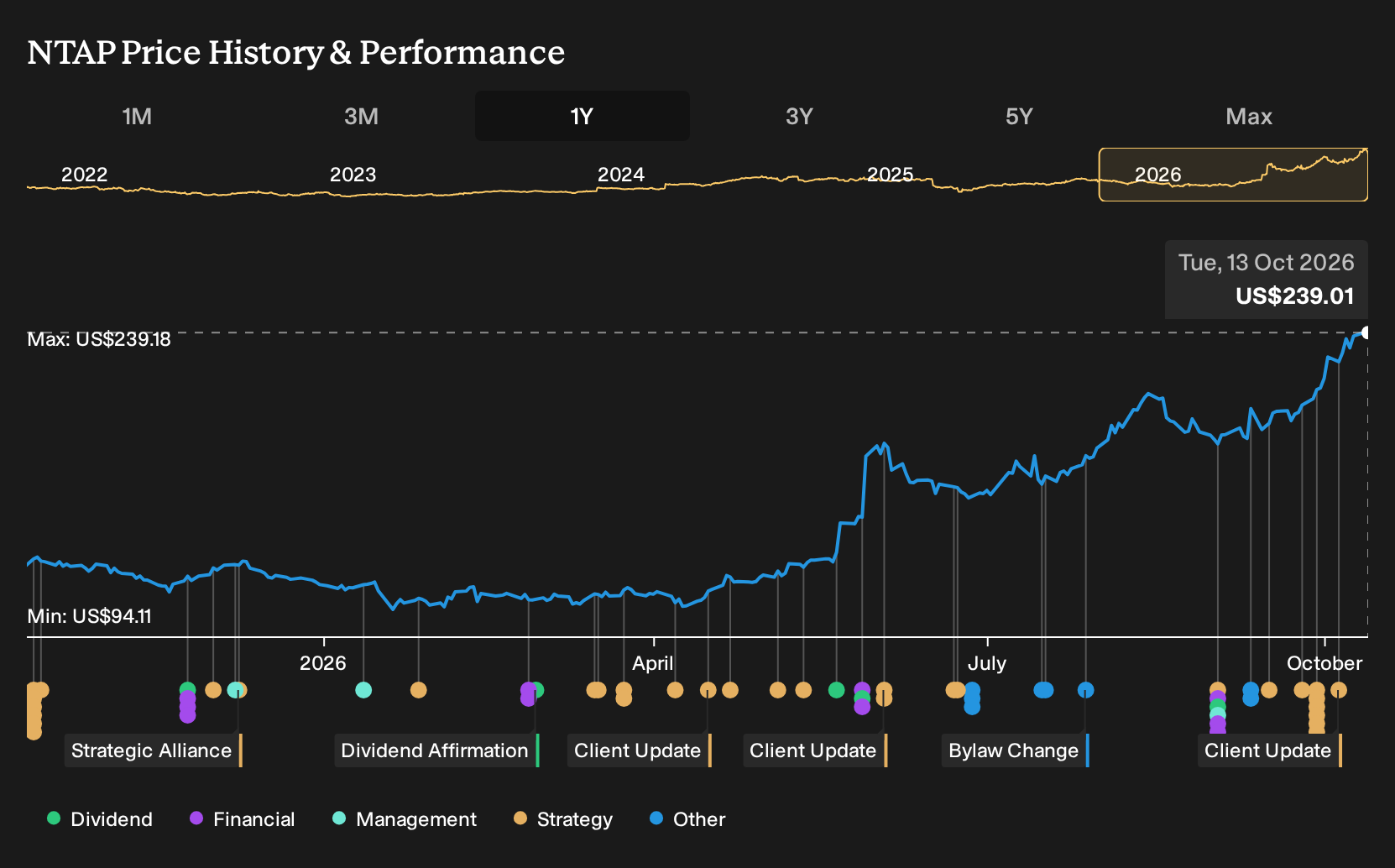
Price targets themselves sit in a fairly tight band. The average stands at US$198.25, with the highest at US$220.00 and the lowest at US$170.00, against a recent share price of US$210.08 as of October 2026. With the consensus target sitting about 6% below the market price, the analyst community as a whole appears to view the shares as broadly in line with their modeled fair value rather than deeply mispriced in either direction.
For you as an investor, the real work is sense checking whether those embedded assumptions about AI related storage demand, margin creep, and capital returns feel realistic. If the 8.5% annual top line growth and margin lift toward 20.1% look achievable in your view, the current valuation framework may feel reasonable. If you think traditional hardware headwinds, geographic softness, or partner power with the hyperscalers will weigh more heavily than consensus implies, your own fair value range may sit below the current market price.
NetApp's narrative projects US$9.4b in revenue and US$1.9b in earnings by 2029, built on 8.5% yearly revenue growth and roughly US$500m of earnings increase from about US$1.4b today.
Uncover why NetApp's fair value indicates a 17% potential downside to its current price, leaving little room for error.
Exploring Other Perspectives
One alternate view says the real swing factor for NetApp is not AI demand but rising DRAM and NAND costs. The most bearish analysts were only penciling in about 5.1% yearly revenue growth to roughly US$8.6b and earnings of US$1.7b by 2029. Those estimates came before this Diskover collaboration, so opinions may change as new information becomes available.
Explore 3 other NetApp fair value estimates, including one that suggests as much as 17% downside from the current price.
Form Your Own Verdict
Disagree with existing narratives? Extraordinary investment returns rarely come from following the herd, so go with your instincts.
- A great starting point for your NetApp research is our analysis highlighting 3 key rewards and 1 important warning sign that could impact your investment decision.
- See our latest analysis for NetApp. The report includes a comprehensive fundamental analysis summarized in a single visual, the Snowflake, making it easy to evaluate NetApp's overall financial health at a glance.
Looking for more NetApp sized investment ideas?
If the NetApp story has you thinking about portfolio upgrades, you can apply that same structured thinking across a wider watchlist. The Simply Wall St Screener lets you filter for financial strength, income potential, or mispriced quality so you are not relying on a single stock to carry your thesis.
- For investors who care most about sturdier balance sheets and resilient fundamentals, start with a list of solid balance sheet and fundamentals (25 results) to see which businesses clear a higher quality bar.
- If your priority is cushioning volatility with income, consider a range of 8 dividend fortresses that could help anchor your portfolio with regular cash flows.
- When the goal is finding quality before the crowd, focus on 20 high quality undiscovered gems that pair fundamentals with lower market attention.
This article by Simply Wall St is general in nature. We provide commentary based on historical data and analyst forecasts only using an unbiased methodology and our articles are not intended to be financial advice. It does not constitute a recommendation to buy or sell any stock, and does not take account of your objectives, or your financial situation. We aim to bring you long-term focused analysis driven by fundamental data. Note that our analysis may not factor in the latest price-sensitive company announcements or qualitative material. Simply Wall St has no position in any stocks mentioned.
Have feedback on this article? Concerned about the content? Get in touch with us directly. Alternatively, email editorial-team@simplywallst.com