
Is Grid Restoration Progress Altering The Investment Case For Duke Energy (DUK)?
- Duke Energy declared quarterly cash dividends on its common and Series A preferred stock, with payments scheduled for December 16, 2026, to shareholders of record on November 13, 2026.
- The utility is coupling regular shareholder payouts with grid restoration progress in North Florida, a multi year US$103b infrastructure plan, and Florida EV off peak charging incentives that directly link capital spending to reliability and demand management.
- We will now look at how Duke Energy's grid resilience progress shapes the broader investment narrative for this regulated utility.
Scan beyond Duke Energy and compare its grid heavy capital plans with other utilities pressing ahead on reliability upgrades, using the curated list of 43 power grid technology and infrastructure stocks as a starting point.
What Is Duke Energy's Investment Narrative?
Duke Energy appeals to investors who want a regulated utility with predictable demand, heavy physical assets, and a long investment horizon. The thesis rests on effective execution of its US$103b 2026 to 2030 build out, stable electric and gas demand across its US footprint, and the ability to keep earning a fair return on that capital under state regulation. The latest dividend affirmations on both common and preferred shares reinforce that management is still prioritizing regular cash returns alongside that grid and generation program, rather than hoarding every dollar on the balance sheet.
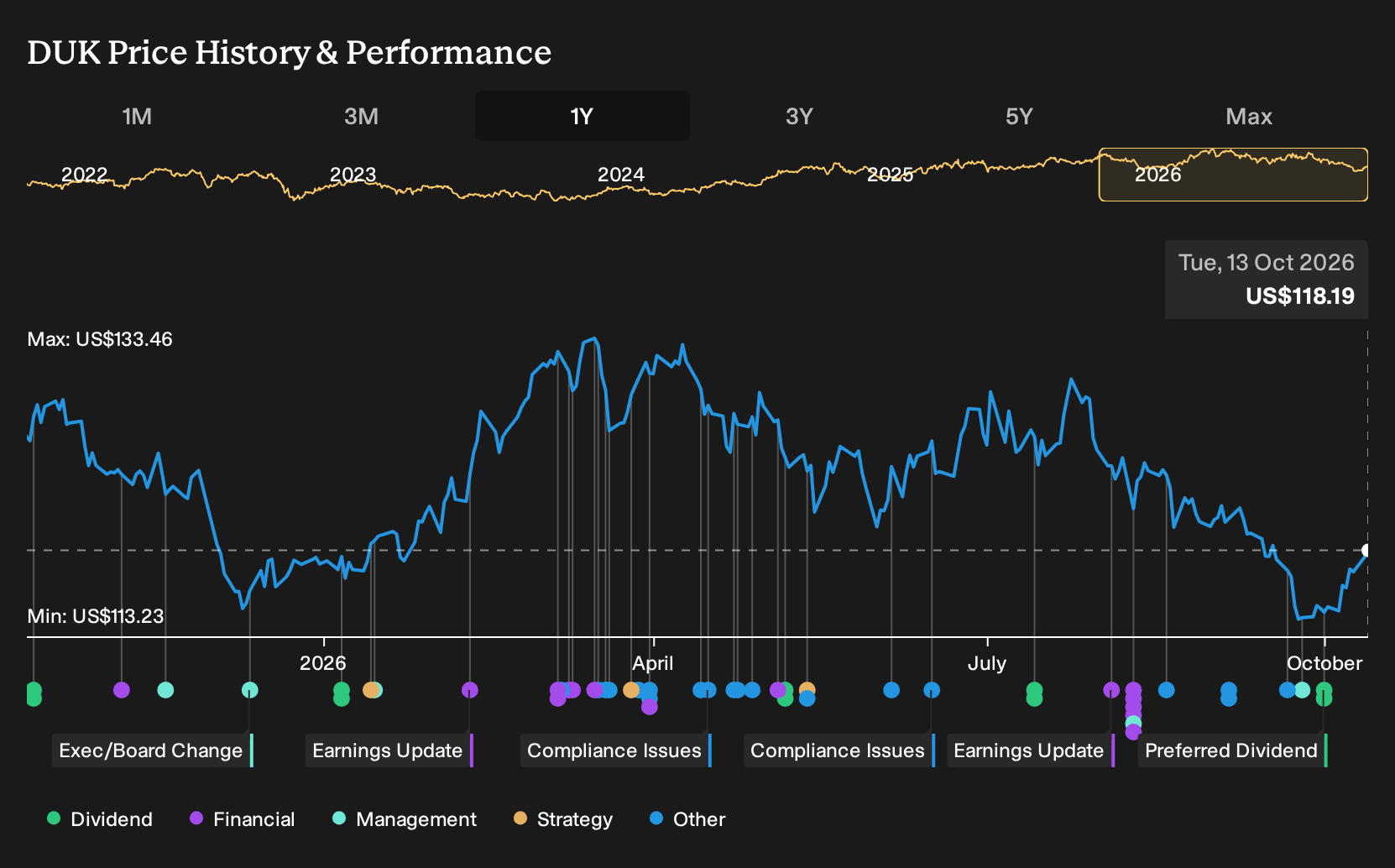
The grid resilience work highlighted after restoring roughly 10,000 Florida customers, plus the EV off peak charging incentives, shows how Duke Energy is trying to align capital intensity, reliability, and load management. In the short term, those headlines do not change the main swing factors. Earnings and cash flow still need to support interest costs that are not comfortably covered today, and a dividend that is not backed by free cash flow. With the stock trading on a P/E below both the US market and electric utility peers, the real question is whether that cautious pricing properly reflects one specific pressure that...
There's only one way to know the right time to buy, sell or hold Duke Energy. Head to Simply Wall St's company report for the latest analysis of Duke Energy's Fair Value.
Exploring Other Perspectives
The four fair value estimates from the Simply Wall St Community cluster between about US$101 and US$134 per share, which is a fairly wide band for Duke Energy. You are seeing different read throughs on the US$103b grid plan, dividend commitments, and Florida programs, so it makes sense to compare several of these viewpoints directly.
Explore 3 other Duke Energy fair value estimates, including one that suggests as much as 15% downside from the current price.
Reach Your Own Conclusion
Disagree with this assessment? Extraordinary investment returns rarely come from following the herd, so go with your instincts.
- A great starting point for your Duke Energy research is our analysis highlighting 4 key rewards and 2 important warning signs that could impact your investment decision.
- See our latest analysis for Duke Energy. The report includes a comprehensive fundamental analysis summarized in a single visual, the Snowflake, making it easy to evaluate Duke Energy's overall financial health at a glance.
Looking For More Investment Ideas Beyond Duke Energy?
Once you have a view on Duke Energy, it often helps to line it up against a broader watchlist. The Simply Wall St Screener can surface very different kinds of opportunities so you are not relying on a single story or sector.
- If you want potential mispricing with quality fundamentals, scan the 32 high quality undervalued stocks that pass a stricter balance of value and business strength.
- For income focused investing, review the 8 dividend fortresses that combine higher yields with supporting financial metrics.
- To dial down volatility in your portfolio, filter for the 32 resilient stocks with low risk scores that score well on resilience and financial stability.
This article by Simply Wall St is general in nature. We provide commentary based on historical data and analyst forecasts only using an unbiased methodology and our articles are not intended to be financial advice. It does not constitute a recommendation to buy or sell any stock, and does not take account of your objectives, or your financial situation. We aim to bring you long-term focused analysis driven by fundamental data. Note that our analysis may not factor in the latest price-sensitive company announcements or qualitative material. Simply Wall St has no position in any stocks mentioned.
Have feedback on this article? Concerned about the content? Get in touch with us directly. Alternatively, email editorial-team@simplywallst.com