
Should Phoenix Expansion Require Action From Mercury Systems (MRCY) Investors?
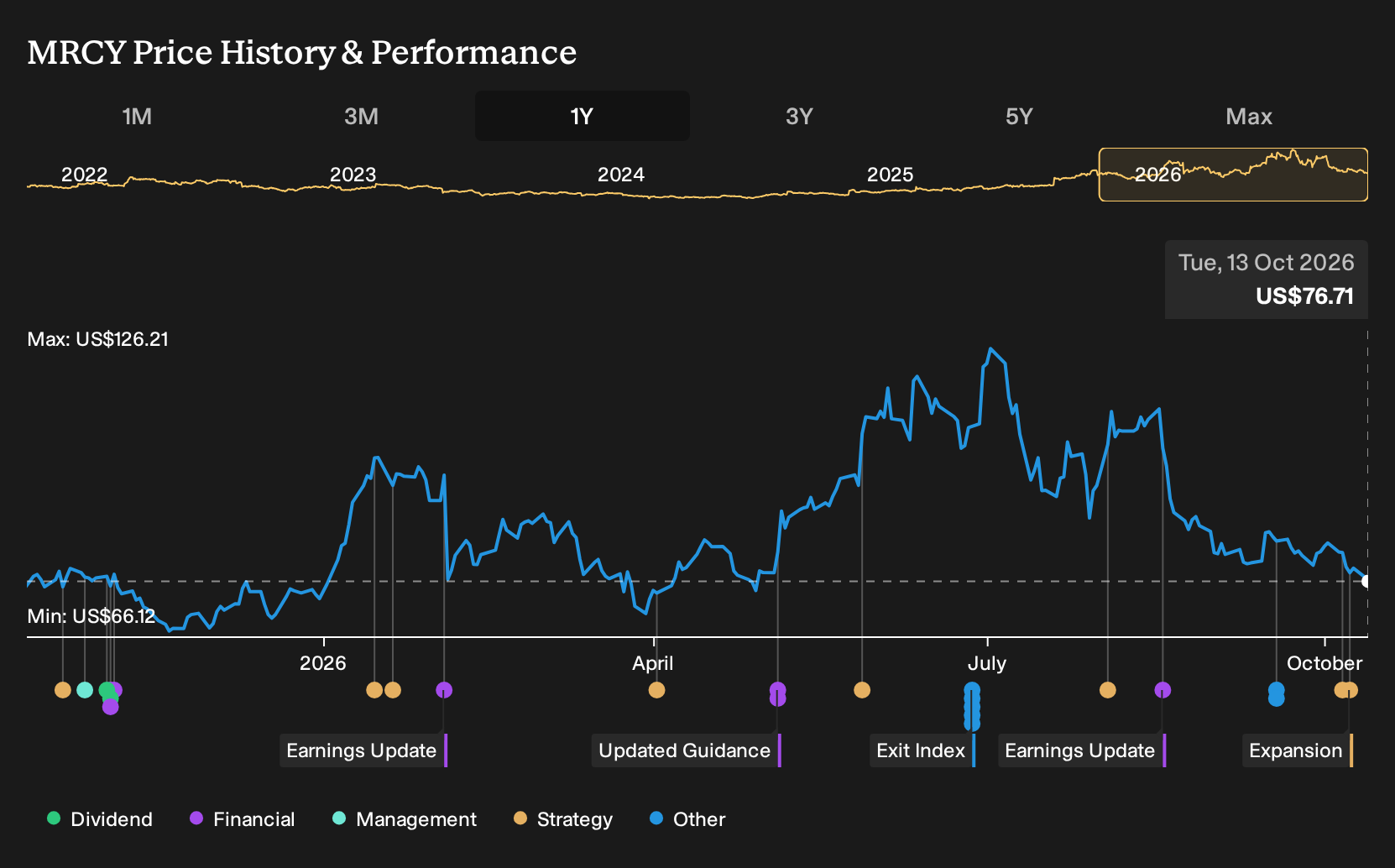
- Mercury Systems has expanded its Phoenix production facility by 50,000 sq ft and begun operations in a highly automated building that supports key U.S. and international defense programs, while also introducing RES One, a rugged edge server platform aimed at long-life military and industrial applications.
- The combination of vertically integrated, higher capacity manufacturing and a modular, long-duration edge compute product positions Mercury Systems to address defense customers that need faster delivery, stable interfaces, and lower lifecycle sustainment costs.
- The focus now turns to how Mercury Systems' expanded Phoenix manufacturing footprint could reshape the existing investment narrative that investors have been using.
Scan beyond Mercury Systems and see which defense and edge-compute suppliers are already aligning capacity, delivery speed, and rugged hardware demand in our hand-picked 32 resilient stocks with low risk scores.
Mercury Systems Investment Narrative Recap
To own Mercury Systems, you need to believe the business can convert defense modernization demand into healthier margins once legacy, low margin contracts roll off. The Phoenix expansion and automation push fit that story, because higher throughput and tighter vertical integration can support more complex radar, EW, and processing work without relying on pulling forward deliveries.
The key near term catalyst now sits with execution in that new Phoenix facility and early signals from upcoming quarterly results in November 2026. The biggest risk remains that a large share of capacity is still tied to older programs with limited revenue upside, which could blunt any operational gains from the added floor space.
The RES One rugged edge server launch ties directly into the Phoenix expansion and is arguably the most important announcement for the current thesis. Investors focused on catalysts will likely watch whether this platform gains traction in radar, EW, sensor, and compute heavy programs that align with Mercury Systems’ open architecture positioning.
RES One is positioned for long life, upgradeable deployments with shorter lead times, which relies on the firm’s vertical integration and supply chain. Execution risk is clear. Mercury still needs to scale production reliably, meet delivery timelines that compare with the 6 to 12 month industry norm, and demonstrate that modular refreshes lower lifecycle support costs for defense and industrial customers.
Mercury Systems' current analyst narrative points to revenue of US$1.3b and earnings of US$110.2m by 2029. That profile is built on a forecast 10.1% annual revenue growth rate and an earnings swing of about US$139.9m from today’s loss of US$29.7m to the 2029 consensus figure.
Uncover why Mercury Systems' fair value indicates a 51% potential upside to its current price, which could narrow quickly.
Exploring Other Perspectives
Some of the most upbeat analysts frame the Phoenix expansion as the missing link that could help Mercury Systems reach about US$1.4b of revenue and roughly US$82.0m of earnings by 2029. That is a more optimistic story than consensus, and it may shift again as investors reassess these targets after the latest news.
Explore 4 other Mercury Systems fair value estimates, including one that suggests there may be as much as 71% upside from the current price.
Form Your Own Verdict
Don't just follow the ticker. Dig into the data and build a conviction that's truly your own.
- A great starting point for your Mercury Systems research is our analysis highlighting 2 key rewards and 1 important warning sign that could impact your investment decision.
- See our latest analysis for Mercury Systems. The report includes a comprehensive fundamental analysis summarized in a single visual, the Snowflake, making it easy to evaluate Mercury Systems' overall financial health at a glance.
Looking For More Ideas Beyond Mercury Systems?
Once you have a view on Mercury Systems, it can help to compare it with other opportunities that share similar qualities or offer different risk and return profiles. The Simply Wall St Screener is built for that kind of side by side work.
- If you want to keep risk on a tighter leash, start with a 32 resilient stocks with low risk scores that already clear basic resilience checks.
- For readers hunting for mispriced quality, scan through 32 high quality undervalued stocks that pair fundamentals with attractive valuations.
- Income focused investors can zero in on cash return potential by filtering for 8 dividend fortresses that go beyond headline yield and look at durability.
This article by Simply Wall St is general in nature. We provide commentary based on historical data and analyst forecasts only using an unbiased methodology and our articles are not intended to be financial advice. It does not constitute a recommendation to buy or sell any stock, and does not take account of your objectives, or your financial situation. We aim to bring you long-term focused analysis driven by fundamental data. Note that our analysis may not factor in the latest price-sensitive company announcements or qualitative material. Simply Wall St has no position in any stocks mentioned.
Have feedback on this article? Concerned about the content? Get in touch with us directly. Alternatively, email editorial-team@simplywallst.com