
This Stock Is a Patient Investor’s Dream Buy at New 52-Week Lows
Residential and commercial heating and cooling specialist Lennox International (LII) hit a new 52-week low of $340.32 on Tuesday. It was one of 179 NYSE-listed securities to do so.
It was Lennox’s 24th new 52-week low in the past 12 months. It also hit a new two-year low and was only a few dollars from a new three-year low.
On Monday, venture capitalist Howard Lindzon’s blog post shared a chart highlighting 134 S&P 500 companies down at least 40% from their all-time highs. Lennox made the cut, down 47% from its all-time high of $689.44.
I don’t know if Lindzon was trying to convince his readers or himself that a good portion of the index wasn’t overpriced. Nonetheless, it’s a compelling visual.
At this point in the market cycle, I remain cautious about buying momentum stocks and tend to focus on value opportunities.
If you are a patient investor--that's someone who has no problem holding their stock as it moves sideways or lower over the first 12-24 months--Lennox should be on your watchlist.
Here’s why.
Lennox’s Business Is More Balanced
The company generates 59% of its revenue from its Home Comfort Solutions segment and 41% from Building Climate Solutions.
A decade ago, the latter contributed just 25% of 2016 revenue of $3.64 billion, slightly more than the 20% contribution from its Refrigeration unit. It sold off its European commercial HVAC (heating, ventilation, and air conditioning) and refrigeration business and folded its Heatcraft Commercial Refrigeration business into its Building Climate Solutions unit. It contributed an estimated 25% of the segment’s 2025 revenue.
Over the past six years, from 2020 to 2025, Building Climate Solutions’ revenues more than doubled, rising from $801 million in 2020 to $1.85 billion in 2025. Meanwhile, its percentage contribution rose more than 10 percentage points to nearly 36% in 2025 and 41% through the first six months of 2026.
Admittedly, some of Building Climate Solutions’ revenue gains came from folding Heatcraft into the operating segment. Nonetheless, it has invested heavily in its commercial business, and its profitability proves it.
Between 2020 and 2025, its gross margin improved by 480 basis points to 33.4% in 2025. Meanwhile, its EBIT (earnings before interest and taxes) improved by 630 basis points to 20.1% in the past year.
Meanwhile, according to S&P Global Market Intelligence, the operating margin for its Building Climate Solutions segment rose 630 basis points to 23.4% in 2025. At the same time, the operating margin for Home Comfort Solutions improved by 370 basis points to 21.8%.
So, its two revenue streams are more balanced, which helps given the slowdown in new residential construction in the U.S. More importantly, both of its operating units have become more efficient and profitable.
Lennox management is willing to shed some residential business if it means lowering profitability. That’s a good thing.
Free Cash Flow Continues to Provide Capital Allocation Flexibility
At the company’s March 2022 Investor Day meeting, it provided shareholders with five commitments: 1) Focus on the North American HVACR (HVAC+Refrigeration) market, 2) Invest in its manufacturing and distribution processes, 3) Convert more than 90% of its income to free cash flow, 4) Reignite growth of its commercial business while solidifying margins, and 5) Ongoing transformation of its business.
While all five are vital to Lennox's success now and in the future, I want to focus on the third point: free cash flow conversion.
Growing profits isn’t enough if the company can’t convert them into free cash, which it can use to pay dividends, repurchase shares, pay down debt, invest in the business, and fund strategic acquisitions.
Between 2023 and 2025, Lennox deployed its $2.4 billion in cash from operations into the five levers of capital allocation: acquisitions (28% of the $2.4 billion), capital expenditures (23%), share repurchases (23%), dividends (21%), and net debt reduction (5%).
First, it still has work to do on its 90% free cash flow conversion rate goal. Between 2023 and 2025, it generated $1.91 billion in free cash flow, or 86% of its $2.21 billion in net income over the three years. It’s close enough.
On the share repurchase front, it has repurchased 62.5% of the shares outstanding at the end of 2006 over the past two decades. With its stock down 34% over the past year, it has repurchased $152 million of its stock in the first half of 2026. It has $858 million left on its share repurchase plan.
In the first six months of 2026, it paid $151 million in dividends, almost matching its share repurchases. From 1999 through 2025, it increased its annual dividend by 13.7% compounded. Dividends tend to follow earnings, so that’s a healthy sign.
As for debt reduction, it aims to keep net debt as a percentage of EBITDA between 1.0x and 1.5x. It finished the second quarter right on 1.5x. That’s more of a timing issue. It was 1.2x at the end of 2025. It’s fine.
In 2026, Lennox expects free cash flow of $800 million at the midpoint of its guidance. That’s about the average between 2023 and 2025.
I like the flexibility it’s built into its capital allocation model.
Valuation Is As Reasonable As It's Been in the Past Decade
Based on an enterprise value of $14.07 billion, its current free cash flow yield is 5.7%. I consider anything between 4% and 8% to be fair value. Buying at current prices won’t break the bank.
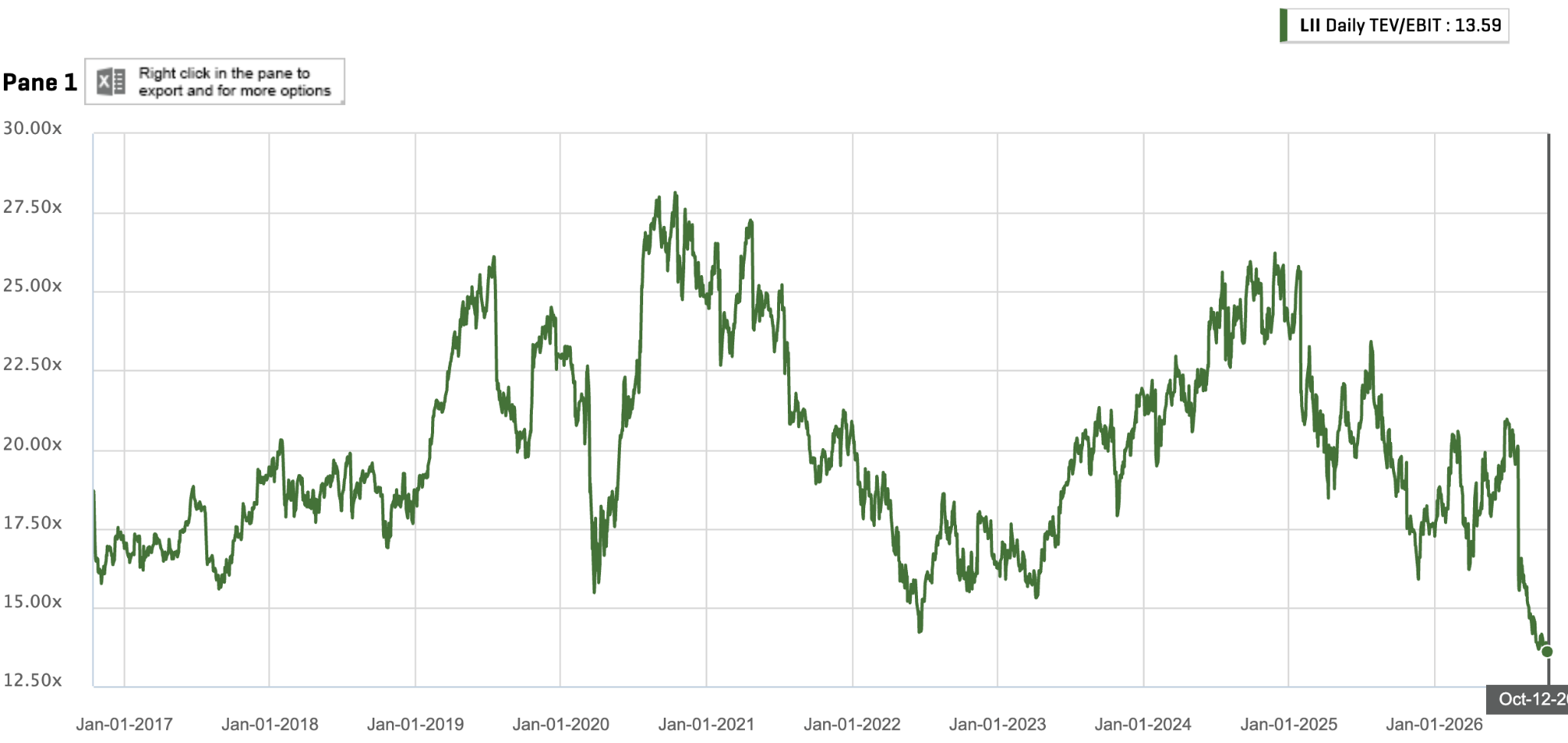
Source: S&P Global Market Intelligence
The chart above shows the company’s enterprise value-to-EBIT multiple over the past decade. At 13.59x, well below the 10-year average of 20.11x, this well-run business is, by many valuation metrics, historically reasonable, or cheap, by many valuation metrics.
Analysts are lukewarm about LII stock, with most giving it a Hold rating. I wouldn’t let that dissuade you from investing. If you’re willing to be patient with Lennox, you will be rewarded. HVACR demand in North America won’t go away anytime soon.
On the date of publication, Will Ashworth did not have (either directly or indirectly) positions in any of the securities mentioned in this article. All information and data in this article is solely for informational purposes. For more information please view the Barchart Disclosure Policy here.