
Does CEO Exit Change The Bull Case For Clorox Stock (CLX)?
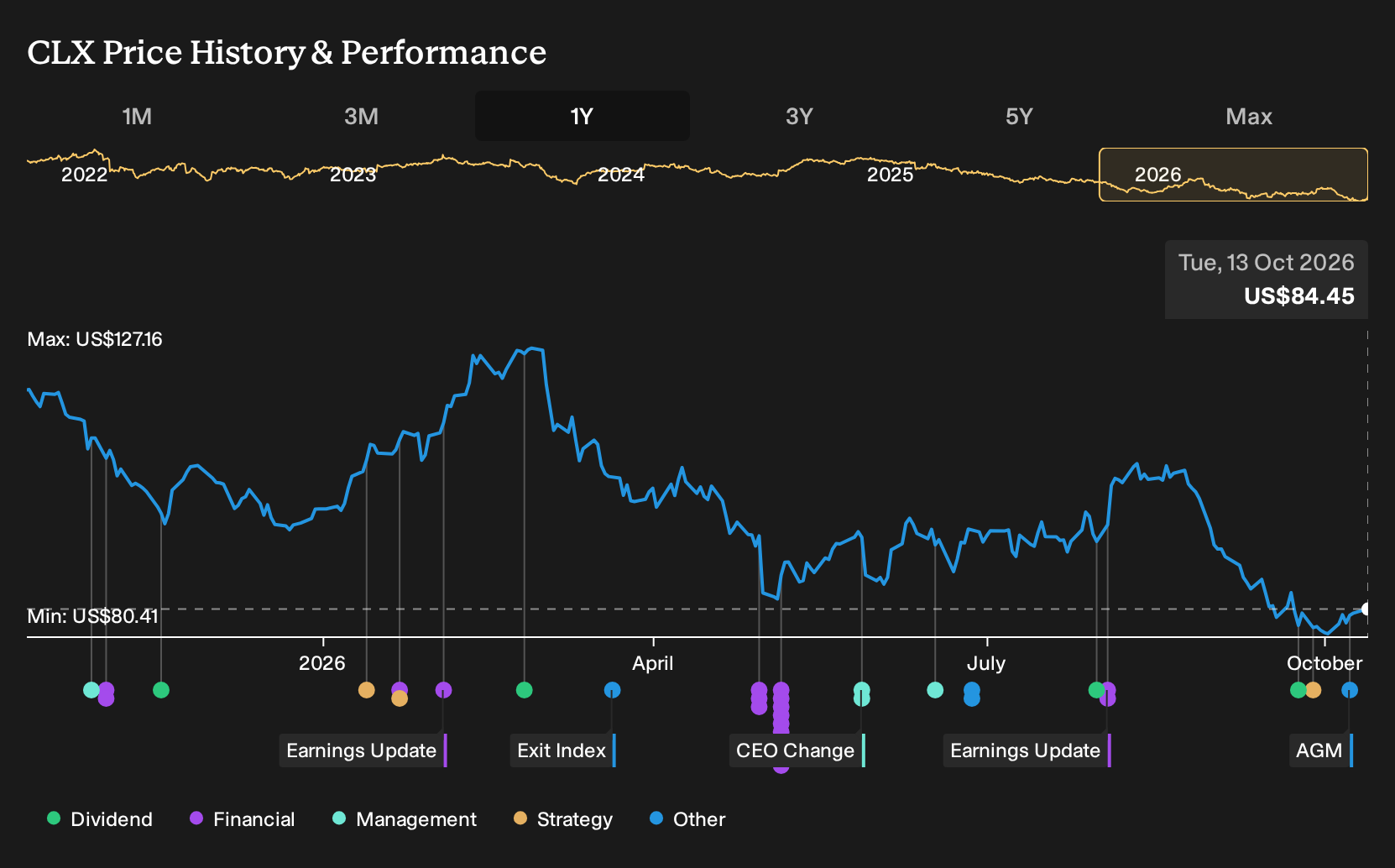
- Clorox recently faced a leadership change as CEO Linda Rendle decided to step down for health reasons, while the company continues to contend with declining sales, modest organic revenue growth and a weaker free cash flow margin.
- At the same time, Clorox’s dividend payout ratio has risen above free cash flow and debt increased after the GOJO acquisition, which concentrates attention on how much capital is left to support its health and hygiene expansion as well as its ERP driven efficiency plans.
- We will now look at how Clorox’s leadership transition and elevated dividend payout ratio could reshape the company’s broader investment narrative.
Compare Clorox’s pressured dividend and cash generation with peers by reviewing a curated set of 8 dividend fortresses that currently pair income potential with sturdier underlying finances.
Clorox Investment Narrative Recap
To own Clorox, you need to believe the health and hygiene focus, ERP rollout and GOJO integration can translate its branded strength into steadier earnings, even while categories stay sluggish and consumers keep trading into value channels. Recent news around sector underperformance and the stock trading well below some fair value estimates does not change that core thesis.
The sharper near term tension sits in cash generation. Dividend payouts running ahead of free cash flow, weaker margins and higher debt after GOJO leave less room if input inflation in fiscal 2027 stays elevated or productivity gains arrive slowly. That mix keeps dividend flexibility and cost control as the key watchpoints.
The most relevant recent item is Clorox’s plan to report first quarter fiscal 2027 results on 2 November 2026, alongside prepared remarks and a live Q&A with Linda Rendle and CFO Luc Bellet. With the dividend payout already high versus earnings and free cash flow, that update gives you the next clear look at how the ERP program and GOJO integration are feeding into working capital and cash conversion.
Attention naturally falls on three things in that release: first, any sign that free cash flow margins are stabilising after the recent drop; second, whether health and wellness, including GOJO, is adding to revenue quality without pushing selling costs too hard; and third, how management frames dividend priorities against debt that is not well covered by operating cash flow, which goes straight to the current risk reward trade off in Clorox.
Clorox’s current analyst script assumes revenues of US$8.0b and earnings of US$807.6m by 2029, based on 6.2% yearly revenue growth and an earnings increase of about US$220.6m from the US$587.0m reported today.
Discover why Clorox's fair value points to a 19% potential upside to its current price that could diminish quickly.
Exploring Other Perspectives
One alternative view puts less weight on the ERP upside and focuses on product relevance. In that more cautious Clorox story, the lowest analysts were pencilling in 5.0% yearly revenue growth and earnings of about US$742.7 million by 2029. Those estimates came before the CEO transition news, so their stance could shift.
Explore 6 other Clorox fair value estimates, including one that suggests as much as 12% downside from the current price.
Reach Your Own Conclusion
Disagree with existing narratives? Extraordinary investment returns rarely come from following the herd, so go with your instincts.
- A great starting point for your Clorox research is our analysis highlighting 2 key rewards and 2 important warning signs that could impact your investment decision.
- See our latest analysis for Clorox. The report includes a comprehensive fundamental analysis summarized in a single visual: the Snowflake, making it easy to evaluate Clorox's overall financial health at a glance.
Looking for More Investment Ideas Beyond Clorox?
Once you have a view on Clorox, it often helps to compare that thesis with other opportunities that offer different mixes of income, balance sheet strength and risk. The Simply Wall St Screener lets you filter for the traits you care about, then see which businesses line up with your own approach.
- If you care most about getting paid while you wait, focus on income ideas that match higher yields with sturdier fundamentals by reviewing 8 dividend fortresses.
- If capital protection matters more to you right now, narrow the field to companies that pair robust finances with lower risk scores through the 32 resilient stocks with low risk scores.
- If you want something less crowded by attention, look for financially sound stocks that have not attracted much coverage yet with the 20 high quality undiscovered gems.
This article by Simply Wall St is general in nature. We provide commentary based on historical data and analyst forecasts only using an unbiased methodology and our articles are not intended to be financial advice. It does not constitute a recommendation to buy or sell any stock, and does not take account of your objectives, or your financial situation. We aim to bring you long-term focused analysis driven by fundamental data. Note that our analysis may not factor in the latest price-sensitive company announcements or qualitative material. Simply Wall St has no position in any stocks mentioned.
Have feedback on this article? Concerned about the content? Get in touch with us directly. Alternatively, email editorial-team@simplywallst.com