
The rise in US CPI in September pushes up interest rate hikes, and high interest rates continue to test the rise in US stocks
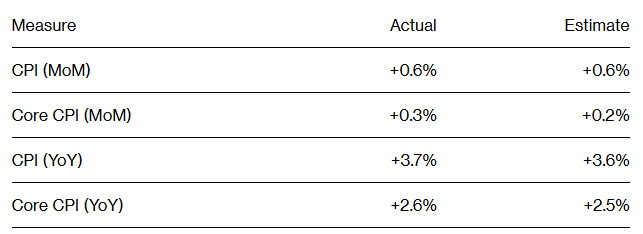
The Zhitong Finance App learned that US inflation heated up across the board in September, putting a big question mark on the market's expectations that the Federal Reserve will “stand still” in October. According to data released by the US Bureau of Labor Statistics on Wednesday, the consumer price index (CPI) rose 0.6% month-on-month in September, up from 0.4% in August; 3.7% year-on-year, higher than market expectations of 3.6%, and the previous value was 3.4% — the fastest increase in five months. Excluding volatile food and energy, the core CPI rose 0.3% month-on-month, the same as the previous value; the year-on-year increase was 2.6%, higher than the expected 2.5%, compared with the previous value of 2.4%. After the data was released, US bond yields jumped in sync with expectations of interest rate hikes.
The inflation picture: energy is only a fuze; the core does not fall but rises
The primary driver of September's inflation was energy. Article 1 quoted data from the Bureau of Labor Statistics as saying that gasoline prices rose 9.1% month-on-month; the US Energy Information Administration (EIA) data showed that gasoline rose 7.1% — the former was the gasoline sub-standard within the CPI, and the latter was the retail gasoline price caliber. The two statistics are different.
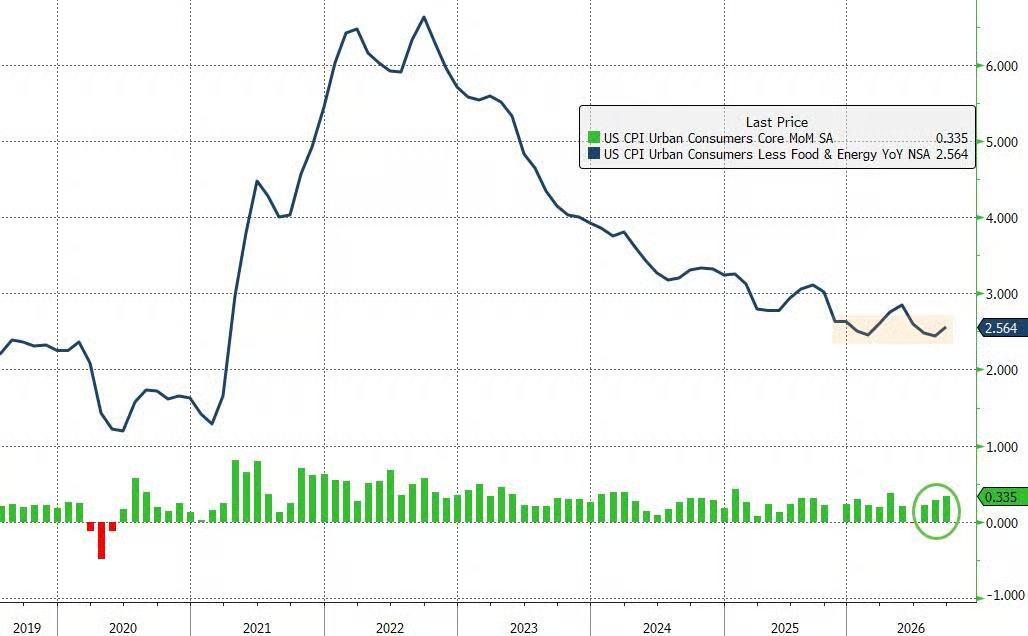
But what really makes the market nervous is that core inflation has not cooled as much as expected. Core CPI rose to 2.6% year over year from 2.4% in August. Moreover, this round of price pressure is “quite widespread,” not limited to energy: prices for leisure, used cars and trucks, education, air tickets, health care, and clothing are rising across the board. “Some of them may be due to tariffs and energy factors, but others point to sticky inflation.”
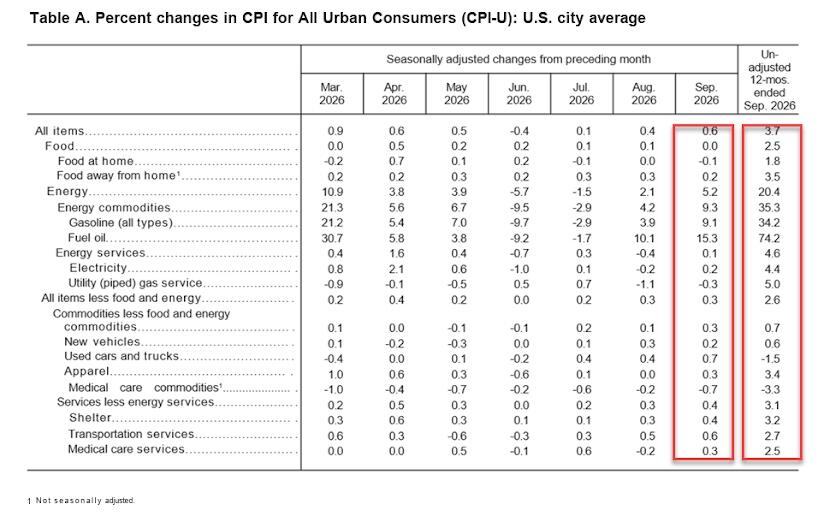
In terms of items, the price of healthcare services increased by 0.3%; owners' equivalent rent (OER), which is the largest component of the CPI, rose 0.3%; the price of used cars rose 0.7%, the biggest increase since October 2025; and the price of groceries fell slightly.
One detail that is easily overlooked is the price pressure brought about by data center construction: the price of computer software and accessories rose 28.4% year on year, setting a record; the price of computers, peripherals and smart home assistants rose 9.7% year on year, also setting a record. AI infrastructure investment is becoming one of the new sources of inflation.
Inflation is also eroding residents' real incomes. Another report showed that the average hourly wage in September, adjusted for inflation, fell year on year, for the sixth month in a row. Multiple surveys this month showed a further deterioration in consumer confidence and a decline in Trump's approval rating. According to a Reuters/Ipsos poll, about 78% of Americans blamed Trump's policies for rising prices (including tariffs and the war between the US and Israel against Iran). This CPI is not only the last before the November 3 midterm elections, but also relates to the annual cost of living adjustment for tens of millions of social security recipients — the “Senior Citizens League” predicts a COLA of 3.5% in 2027, up from 2.8% in 2026.
Market reaction: long-term yields jumped, interest rate hike bets were repriced
After the inflation data was released, the US bond market took the lead in responding. The 10-year US Treasury yield — the main benchmark for interest rates on mortgages, auto loans, and credit cards — jumped 9 basis points to 5.304%; the yield on 30-year Treasury bonds, which are more sensitive to geopolitical events, rose 5 basis points to 5.61%.
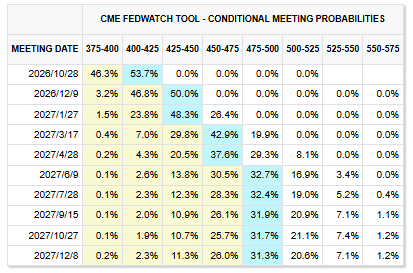
What is more drastic is the repricing of expectations of interest rate hikes. According to the CME FedWatch tool, before the data was released, the market priced the interest rate hike for the October 27-28 meeting at about 22%. After the data was released, the probability of interest rate hikes in October has soared to more than 50%, and 2-year US Treasury yields are soaring. The prediction market Kalshi's October probability “jumped from 21% to 33%.” Furthermore, traders expect the Federal Reserve to raise interest rates a total of three times by the end of 2027.
The dollar changed simultaneously with gold: the US dollar index rose by about 30 points to 102.52 in the short term, and spot gold fell by about $30 to $4,128.60 an ounce in the short term.
Federal Reserve Officials Speeches and Policies: Disagreements became apparent even before the data was released
The weight of this data lies in the timing — as Deutsche Bank analysts pointed out on Wednesday, this CPI is only two weeks away from the Federal Reserve's next interest rate decision. “Since we will not be able to get PCE inflation data until the second day of the next resolution (that is the indicator that the Federal Reserve officially focuses on), no matter which direction the accident takes, it will help shape the narrative leading up to the next meeting.”
The policy background is that the Federal Reserve raised the federal funds rate target range by 25 basis points to 3.75%-4.00% last month, the first rate hike since 2023, and suggests that it may be further tightened in the next few months.
Before the data was released, the official statements were now divided. Before the data was released on Wednesday, Federal Reserve Governor Bowman said she did not see the urgency of further action and advocated “wait and see” financial markets and economic trends; on Tuesday, New York Federal Reserve Chairman Williams thought it would be appropriate to raise interest rates again this year, but there is no need to continue to raise interest rates in 2027; Boston Federal Reserve Chairman Collins said that further interest rate increases may still be needed to curb inflation before the end of the year, but when to act depends on future data.
Furthermore, the analysis points out that the latest official statement after the September rate hike did not pave the way for continuous interest rate hikes in October, but this core inflation report, which exceeded expectations, “almost solidified, and September is by no means a one-time action.”
Indications about the future prospects of the Federal Reserve's interest rate hikes
The “instructions” given by this CPI can be understood on three levels.
First, September is definitely not a “one-off action.” Before the data was released, the market weakened bets on raising interest rates again during the year due to the fact that non-agricultural farmers only added about 29,000 new people in September (unemployment rate rose to 4.2%) and PCE fell short of expectations in July and August; after the data was released, interest rate hikes in October returned to view.
Second, the focus of the path is still in December. Before the data was released, the market pricing path was roughly “unchanged in October, 25 basis points added in December, and then added two more times until the end of 2027”; the probability of staying on hold in October once exceeded 78%, and the probability of raising interest rates in December was close to 88%. After this CPI, the differences between October and December were reactivated, but as long as subsequent data does not deteriorate further, December is still a more likely time.
Third, the lack of official guidelines makes the data more weighted. Federal Reserve Chairman Kevin Warsh (Kevin Warsh) has been inclined to avoid providing clear forward guidance to the market since taking office; he will hold a fireside conversation with IMF Managing Director Georgieva during the International Monetary Fund's annual meeting in Bangkok on Friday (11:30 Beijing time). This will also be the last public appearance before the Fed enters a period of silence (the quiet period for this meeting began on Saturday). His statement at the September resolution press conference was: “Inflation is too high, and it has been going on for too long.”
Wall Street Analyst and Expert Reviews
Wall Street's disagreement over whether to raise interest rates in October was magnified by this data. Christopher Hodge (Christopher Hodge) of Natixis said bluntly that this data brought October back to the game table: “We have said before that any data close to consensus is unlikely to change the Fed's narrative of October, but this deviation is enough to make it a debate. We still don't think the Federal Reserve will act in the end — the arguments presented by Williams and Jefferson suggest that there is no rush to tighten again right now, but at least today they gave the hawks more ammunition at the meeting.”
Some analysts pointed out that this data shows that price pressure is “quite widespread,” and “some of it points to sticky inflation. And that's what Walsh and his colleagues are most afraid of — you can't 'turn a blind eye' to it!”
Molly Brooks (Molly Brooks), an American interest rate strategist at TD Securities (TD Securities), previously hinted at the asymmetry of risk: “The risk brought about by this CPI report is not symmetrical. Higher than expected inflation data may mean that the Federal Reserve needs to speed up monetary tightening.”
Goldman Sachs, on the other hand, suggests an optimistic path based on segmented trends: it expects housing spending to continue to cool down and the impact of tariffs to weaken, which is expected to further slow the month-on-month increase in core CPI to about 0.1% in November and December; at the same time, it suggests that energy, materials, and some skilled labor requirements brought about by AI infrastructure investment constitute medium-term variables that require continuous observation.
What is the impact on US stocks?
As far as US stocks are concerned, this CPI is directly pressured to value through “higher and longer interest rates.” After the data was released, as of press release, the NASDAQ opened down 0.4%, the S&P 500 index fell 0.27%, and the Dow rose 0.28%. At the beginning of the US stock market, technology stocks took a collective dive: SK Hynix, AMD, and SanDisk fell 3%, Intel and Oracle fell 2%, and Nvidia, Micron Technology, and Qualcomm fell more than 1%.
The logical chain is clear: long-term yield jumps → discount rates rise → growth stocks and AI hardware stocks that are most sensitive to interest rates are under pressure. What is special about this time is that AI itself is not only an overvalued sector, but also one of the drivers of this round of inflation (computer software and accessories prices rose by record year on year). “AI capital expenditure drives up inflation, inflation pushes up interest rates, and interest rates suppress AI valuations” has formed a self-reinforcing negative feedback.
Goldman Sachs's judgment before the data was released still applies: if core inflation unexpectedly accelerates and yields rise again, the adjustment pressure on the overvalued sector may increase; in the end, subsequent trends will still need to be supported by corporate profit and performance guidelines — PPI, retail sales and first-time jobless claims data for this Thursday, as well as Walsh's speech on Friday, will be the next key observation window.