
September CPI: Inflation Remains Hot, Puts Pressure on Warsh
Consumer prices continued to swell in September, and they did so at a slightly brisker pace than expected, keeping pressure on the Federal Reserve to continue its rate-hiking cycle at some point over the coming months.
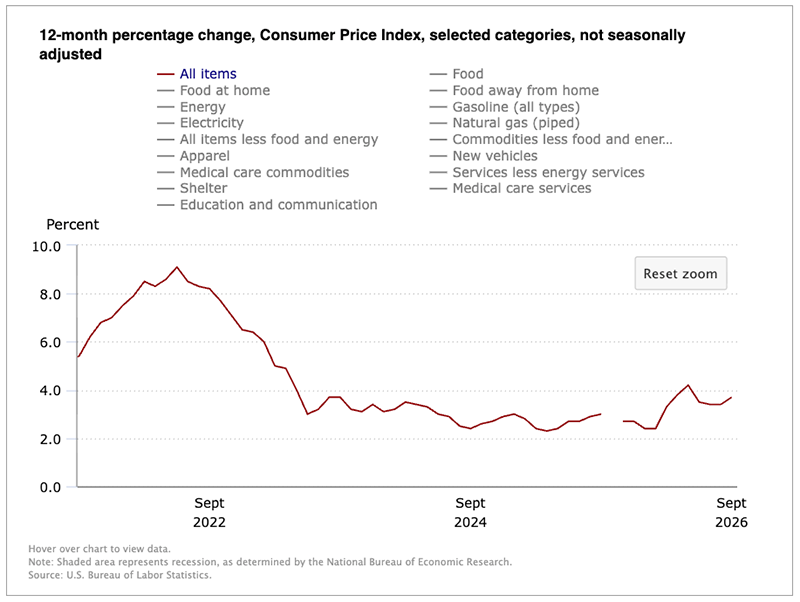
The U.S. Bureau of Labor Statistics reported Wednesday that September's consumer price index (CPI), which measures the change in prices on a variety of consumer goods and services, rose by a seasonally adjusted 3.7% year-over-year—ahead of Dow Jones-polled economists' estimates for 3.6% and faster than August's 3.4% headline figure. On a month-over-month basis, prices advanced by 0.6%, which was also quicker than the prior-month's pace but on par with expectations.
"Core" CPI—a measure of inflation that excludes food and energy costs (factors that are more volatile than the other prices tracked by the Labor Department)—was also quicker than economists predicted. September's core inflation was up 0.3% MoM and 2.6% YoY, ahead of consensus targets of 0.2% and 2.5%, respectively.
Related: Dividend Kings: The Full List of American Dividend Royalty
The data further raised Wall Street's expectations of another bump in the Fed's benchmark interest rate before 2026 ends.
“[Fed Chair Kevin] Warsh advised market participants to focus on the trend and not the incremental data; September CPI leaves intact the upward trend in core prices over the last six months," says Brad Conger, Chief Investment Officer at investment management firm Hirtle & Co. “At the margin, it bolsters the case for a hike at the October [Federal Open Market Committee meeting]. … I believe Warsh understands that the recent massacre of the long end owes something to lack of inflation fighting credibility, so his calculus is that a hike can settle the long end.”
Here's a quick look at September's key CPI figures:
- MoM CPI: +0.6% (estimate: +0.6%)
- YoY CPI: +3.7% (estimate: +3.6%)
- MoM Core CPI: +0.3% (estimate: +0.2%)
- YoY Core CPI: +2.6% (estimate: +2.5%)
Investors still largely see one more rate hike coming in 2027. The CME FedWatch Tool, which uses trading in federal-funds futures to determine Wall Street's expectations for future Federal Reserve actions, still shows just a 20% chance the central bank will raise its benchmark interest rate during the next Federal Open Market Committee (FOMC) meeting, scheduled for Oct. 27–28, 2026. But that probability jumps to 70% when looking at the December meeting.
Invest With CIBC
CIBC Investor's Edge lets you trade U.S. and Canadian stocks and ETFs, options, mutual funds, and bonds through registered accounts like FHSAs, TFSAs, RRSPs, and RESPs, as well as non-registered accounts.
Sign up with CIBC Investor's Edge today and you can make all of your fractional trades commission-free through Oct. 31, 2027.
However, Andrew Hollenhorst, US Chief Economist at Citi Research, says his firm believes the Fed will stay its hand.
"Core PCE inflation registered 2.05% annualized over the last three months. It will take more than three months of data to convince Chair Warsh and the committee that inflation is moving toward target at 'sufficient speed,'" he says. "In our base case, we expect no further hikes in this cycle, with the Fed cutting rates in mid-2027."
This report will be updated.
Get Elite Stock Analysis From Seeking Alpha
Among our favorite platforms for both data and picks is Seeking Alpha Premium, which gives you unlimited access to thousands of active authors who deliver stock analysis.
Seeking Alpha also provides you with stock research tools, real-time news updates, crowdsourced debates, and market data. Users can create their own portfolio of favorite stocks, see how they perform, and receive email alerts or push notifications about their investments.
Try out Seeking Alpha Premium free for seven days and get a discount on your first year's subscription.