
Dear Intel Fans, Mark Your Calendars for October 29
Intel (INTC) will release its third-quarter financial results after the market closes on Thursday, Oct. 29. Artificial Intelligence (AI)-driven demand and improving pricing give reason to be optimistic about Intel’s Q3, especially as its Data Center and AI (DCAI) business continues to grow rapidly.
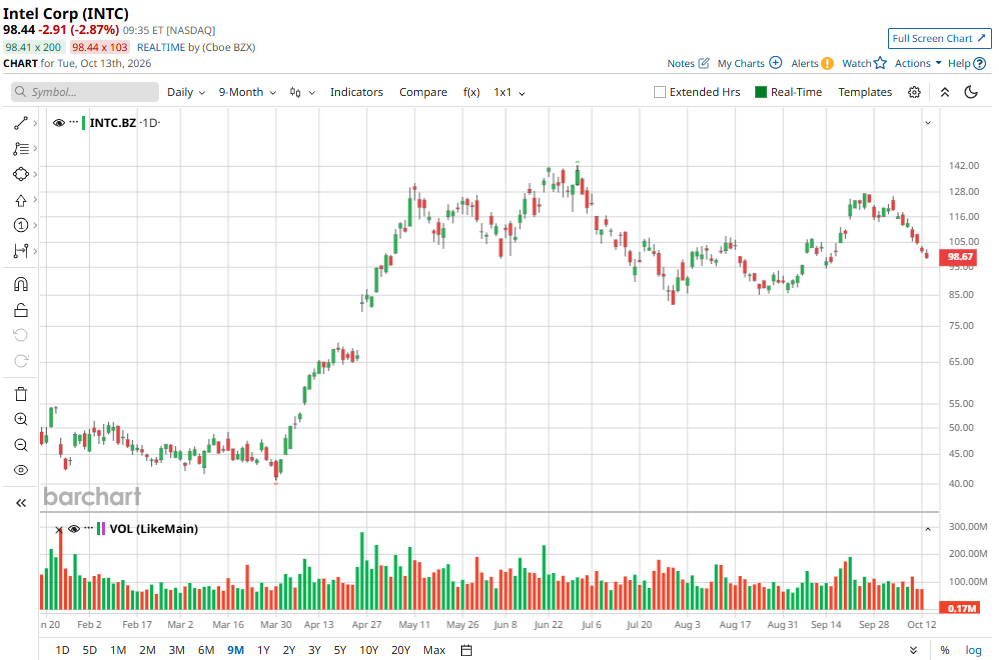
Notably, Intel shares have climbed 174.5% so far in 2026 as its operational turnaround is gaining momentum. Strong demand and pricing power have boosted Intel’s financials and investors’ confidence. However, INTC stock has retreated about 28.8% from its recent high, presenting an attractive entry point, especially as the upcoming results could act as a catalyst.
Intel’s Q3 Outlook: Demand and Pricing to Power Revenue and Earnings
Intel is positioned for solid third-quarter growth, supported by rising demand for computing infrastructure, improved pricing, and growing adoption of its data center products. Its broad product portfolio, spanning CPUs, GPUs, application-specific integrated circuits (ASICs), and processors designed for emerging agentic AI workloads, provides multiple avenues to capitalize on expanding investment in AI and cloud infrastructure.
Intel reported $16.1 billion in Q2 revenue, while its AI-related businesses expanded more than 70% year over year. The momentum will likely continue in Q3 and beyond. Management expects third-quarter revenue between $15.8 billion and $16.8 billion. At the midpoint of $16.3 billion, the forecast implies 19% year-over-year growth, indicating strong demand and pricing.
The DCAI segment is likely to remain a key growth driver. The business generated $6.3 billion in second-quarter revenue, up 59% year-over-year and 24% sequentially, reflecting stronger demand from hyperscale cloud providers and enterprise customers. Intel’s purpose-built silicon portfolio is also gaining traction, with revenue up about 20% sequentially and having nearly tripled year-over-year in Q2. These trends will likely continue in Q3.
A key factor supporting Intel’s growth is strong CPU demand, as AI workloads shift from model training to inference, agentic AI, and multi-agent systems. The company expects industry server CPU shipments to grow, with momentum extending into 2028.
Beyond revenue growth, Intel’s profitability is expected to improve in the third quarter. The company projects a gross margin of 42%, up from 40% in the year-ago quarter. Stronger revenue, improved manufacturing yields, and higher average selling prices driven by product mix and pricing initiatives are expected to support the expansion.
Intel forecasts adjusted earnings per share (EPS) of $0.38 for the third quarter, up 65% year over year. The projected increase reflects stronger sales, improving gross margins, and cost discipline. Analysts expect Intel’s earnings to more than double in Q3.
Overall, Intel’s third-quarter outlook points to continued progress on its turnaround plan, with data center demand, AI-related growth, and pricing improvements serving as the key catalysts.
Conclusion: Intel’s Q3 Could Push Stock Higher
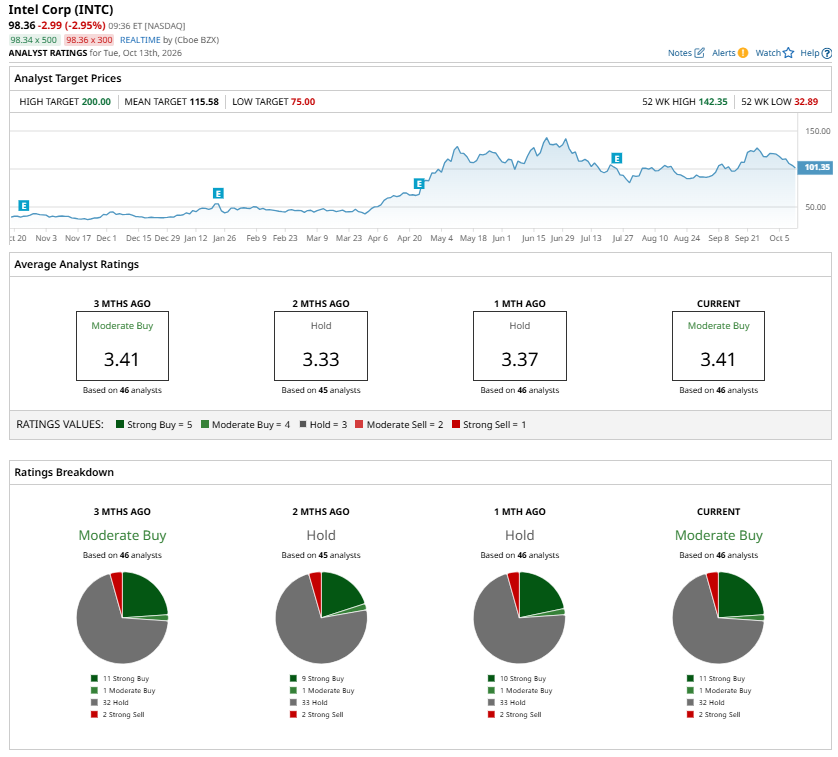
Analysts are cautiously optimistic about Intel stock ahead of its third-quarter earnings release and maintain a “Moderate Buy” consensus rating. INTC’s high valuation remains a key concern. Intel trades at a forward price-to-earnings (P/E) ratio of 102.9, significantly higher than those of peers such as AMD (AMD) and Nvidia (NVDA).
Despite this premium valuation, Intel’s Q3 results could serve as a major catalyst for the stock. Strong demand for AI infrastructure, improved pricing, and accelerating growth in its DCAI business could support higher revenue and earnings. Management’s guidance also points to continued operational improvements. Meanwhile, expectations for higher gross margins and adjusted earnings per share (EPS) reflect the potential benefits of a favorable product mix, greater manufacturing efficiency, and tighter cost control.
Another potential growth driver is rising demand for server CPUs as AI workloads increasingly shift toward inference and agentic AI. This trend could create a longer-term growth opportunity for Intel, helping the company capitalize on the expanding AI market.
On the date of publication, Amit Singh did not have (either directly or indirectly) positions in any of the securities mentioned in this article. All information and data in this article is solely for informational purposes. For more information please view the Barchart Disclosure Policy here.