
Why You Should Buy the Dip in T-Mobile Stock
T-Mobile US (TMUS), the wireless communications giant, known for its nationwide network and competitive mobile plans, saw its shares plunge 13.3% on Friday, Oct. 9, hitting a 52-week low of $147.90 after SpaceX (SPCX) unveiled plans to acquire additional wireless spectrum.
The announcement sent fresh jitters through the telecom sector, reviving fears that Elon Musk’s rocket and artificial intelligence (AI) company could eventually emerge as the fourth mobile wireless provider in the United States. Yet, entering the wireless business involves far more than securing spectrum.
Building a dependable network and winning over customers takes time, investment, and plenty of groundwork. The bigger distinction lies between owning spectrum and turning it into a reliable mobile network that delivers the coverage and service consumers expect. Established carriers such as T-Mobile already possess substantial spectrum resources and terrestrial network capabilities, giving them a meaningful head start.
Against this backdrop, Raymond James upgraded T-Mobile to “Outperform” from “Market Perform” on Monday, Oct. 12, ahead of its Q3 FY2026 results, suggesting investors may be giving the SpaceX threat too much weight.
Analyst Frank Louthan established a $170 price target, signaling confidence that the recent weakness does not tell the whole story. Louthan believes the competitive threat from SpaceX remains at least 3+ years away from becoming reality, while T-Mobile has spent years competing against larger industry players.
In his view, the latest pullback could offer investors an opportunity to reconsider the stock rather than rush for the exits.
About T-Mobile Stock
The Bellevue, Washington-based T-Mobile is a telecommunications provider with a market cap of approximately $162.9 billion. Through its T-Mobile, Metro by T-Mobile, and Mint Mobile brands, it offers wireless voice, messaging, mobile data, broadband, and a range of prepaid and postpaid plans, devices, and related services.
However, a strong market presence has not shielded TMUS stock from mounting pressure. Slower subscriber growth and intensifying competition have weighed on investor sentiment, sending the stock down 31.8% over the past 52 weeks. The decline has continued in 2026, with shares tumbling 24.4% in 2026 and sliding 15.8% over the past month.
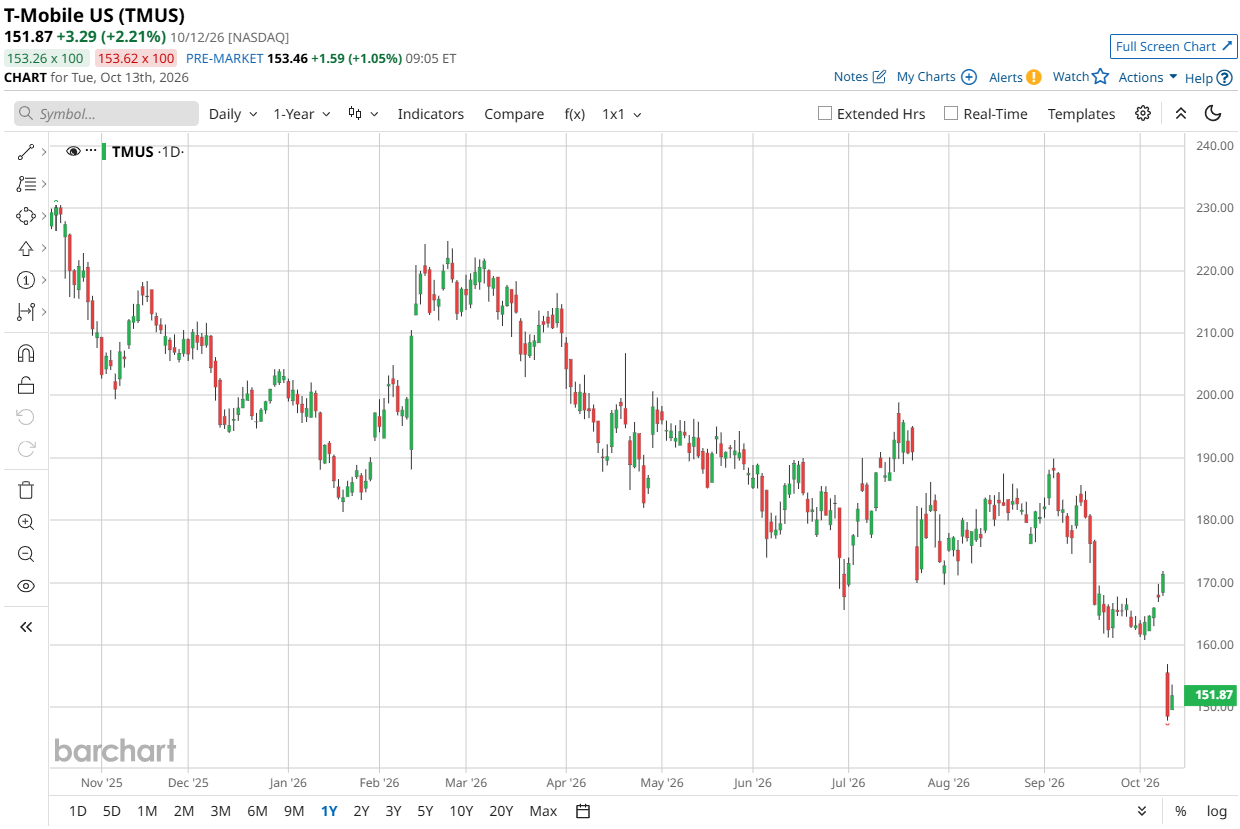
The sell-off has also brought T-Mobile’s valuation into sharper focus. The stock currently trades at 12.25 times forward adjusted earnings and 1.73 times sales. While both multiples remain above industry averages, they sit below their respective five-year averages, potentially offering long-term investors a more appealing entry point after the recent retreat.
T-Mobile also pays an annual dividend of $4.68 per share, yielding 3.08%. Its latest quarterly dividend of $1.17 per share is scheduled to be paid on Thursday, Dec. 10, to shareholders of record as of Wednesday, Nov. 25, adding another consideration to the stock’s investment appeal.
T-Mobile Surpasses Q2 Earnings
T-Mobile delivered a stronger-than-expected showing on Jul. 23, when it reported Q2 FY2026 results. Revenue rose % year over year (YOY) to $22.79 billion, surpassing Wall Street’s $22.74 billion estimate. Service revenue climbed 9% to $19 billion, while postpaid service revenue advanced 13% to $15.9 billion, reflecting stronger customer monetization and the appeal of its network.
However, the growth story was not without a few wrinkles. Postpaid net account additions fell 13% YOY to 277,000, raising questions about the pace of subscriber growth. On a brighter note, postpaid average revenue per account (ARPA) increased 2% to $152.91, helping offset the slowdown as T-Mobile generated more revenue from its existing customer base.
Profitability provided another reason for optimism. Core Adjusted EBITDA grew 12% from the year-ago value to $9.5 billion, while adjusted free cash flow rose 4% to $4.8 billion and operating cash flow increased 7% to $7.5 billion. Moreover, adjusted EPS climbed 10.2% from the year-ago figure to $3.13, beating Wall Street’s $2.49 estimate.
Looking ahead, management expects postpaid net account additions of between 950,000 and 1.05 million in 2026. They also raised their adjusted free cash flow guidance to a range of $18.4 billion to $18.8 billion, up from the previous forecast of $18.1 billion to $18.7 billion.
Analysts anticipate further earnings growth, forecasting Q3 FY2026 EPS of $2.86, up 10.4% YOY. For full-year FY2026, EPS is projected to reach $11.09, representing annual growth of 9.2%. The outlook strengthens further for FY2027, when earnings are expected to climb to $13.46, marking a 21.4% YOY increase.
What Do Analysts Expect for T-Mobile Stock?
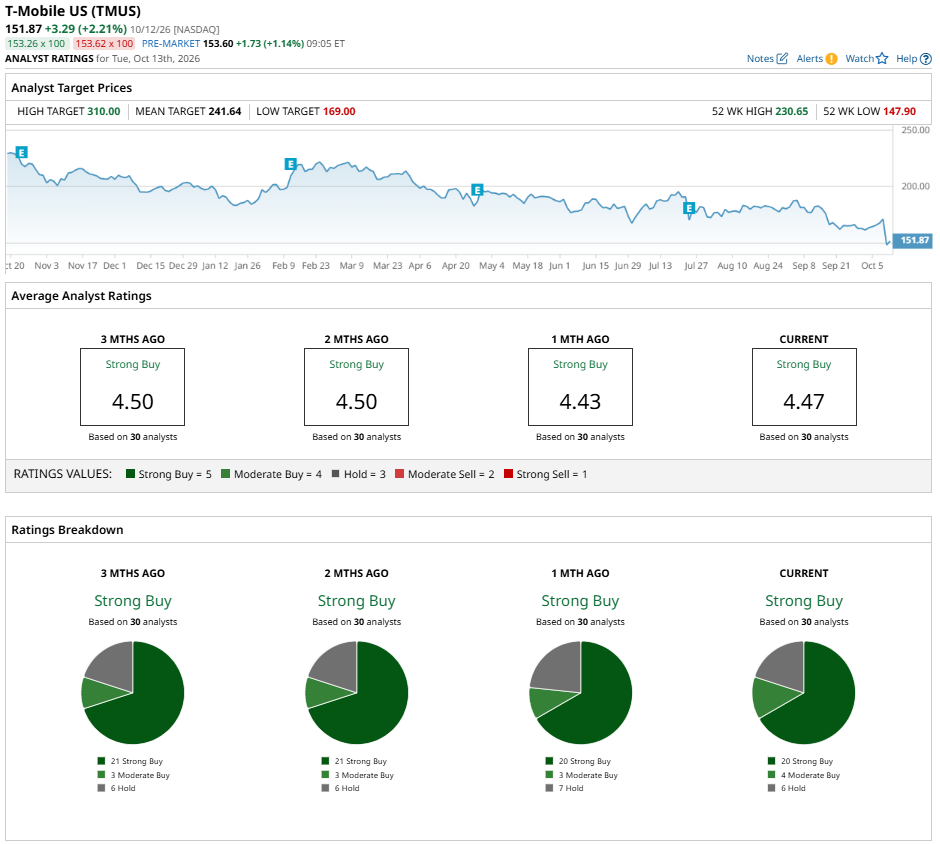
Despite the recent sell-off, Wall Street remains broadly bullish on T-Mobile, with the stock carrying an overall “Strong Buy” rating. Of the 30 analysts covering the name, 20 recommend a “Strong Buy,” four favor a “Moderate Buy,” and six have issued a “Strong Sell.”
Against that backdrop, the average price target of $241.64 represents potential upside of 59.1%. Meanwhile, the Street-High target of $310 points to a gain of 104.1% from current levels.
On the date of publication, Aanchal Sugandh did not have (either directly or indirectly) positions in any of the securities mentioned in this article. All information and data in this article is solely for informational purposes. For more information please view the Barchart Disclosure Policy here.