
Greggs (LSE:GRG) Posts Strong Sales Growth, Is The Upside Already Priced In?
Greggs (LSE:GRG) has drawn fresh attention after reporting 7.7% sales growth in the 13 weeks to late September, alongside a new manufacturing efficiency plan targeting £20m in annual savings.
That efficiency story is feeding straight into sentiment. Greggs’ share price has climbed 23.7% over the past month and 36.4% over the last 90 days, helping deliver a 38.1% one year total shareholder return, even though the five year total shareholder return is still down 16.8%.
Scan Greggs alongside other consumer stocks that may be benefiting from strong demand and cost discipline by reviewing the hand picked 8 high quality undervalued stocks.
After a 36.4% rise in 90 days and fresh talk of £20m in annual savings, Greggs now poses a simple question to investors: does the current valuation still leave enough upside to justify the risk?
Most Popular Narrative: 14% Overvalued
The most followed narrative for Greggs puts fair value at £18.74, which is below the last close of £21.42, so the recent rally now leans ahead of that view. That gap sets the stage for a debate about whether growth in new formats and digital demand can fully support the current price.
Greggs is actively expanding its store estate into underrepresented high-convenience channels such as drive-thrus, retail parks, supermarkets, and transport hubs. These locations align with rising demand for food-on-the-go and busy urban lifestyles, providing significant headroom for future revenue growth without cannibalizing the existing estate.
See why 98 investors see Greggs as 14% overvalued.
Result: Fair Value of £18.74 (OVERVALUED)
Still, the Greggs story can break if like for like volumes stay weak, and if wage and ingredient costs keep squeezing already thin profit margins.
Find out about the key risks to this Greggs narrative.
Another View: Greggs Through The DCF Lens
The analyst narrative pegs Greggs at around £18.74 per share, which frames the recent move to £21.42 as rich. Our DCF model paints a very different picture. It puts future cash flow value closer to £38.35, which implies the stock screens as materially undervalued on that framework.
The gap between a P/E based fair value near £18 to £19 and a cash flow estimate more than £38 is wide. It points to a simple question for you as an investor: do you place more weight on today’s earnings multiple, or on a long term cash flow view that suggests far more headroom?
Look into how the SWS DCF model arrives at its fair value.
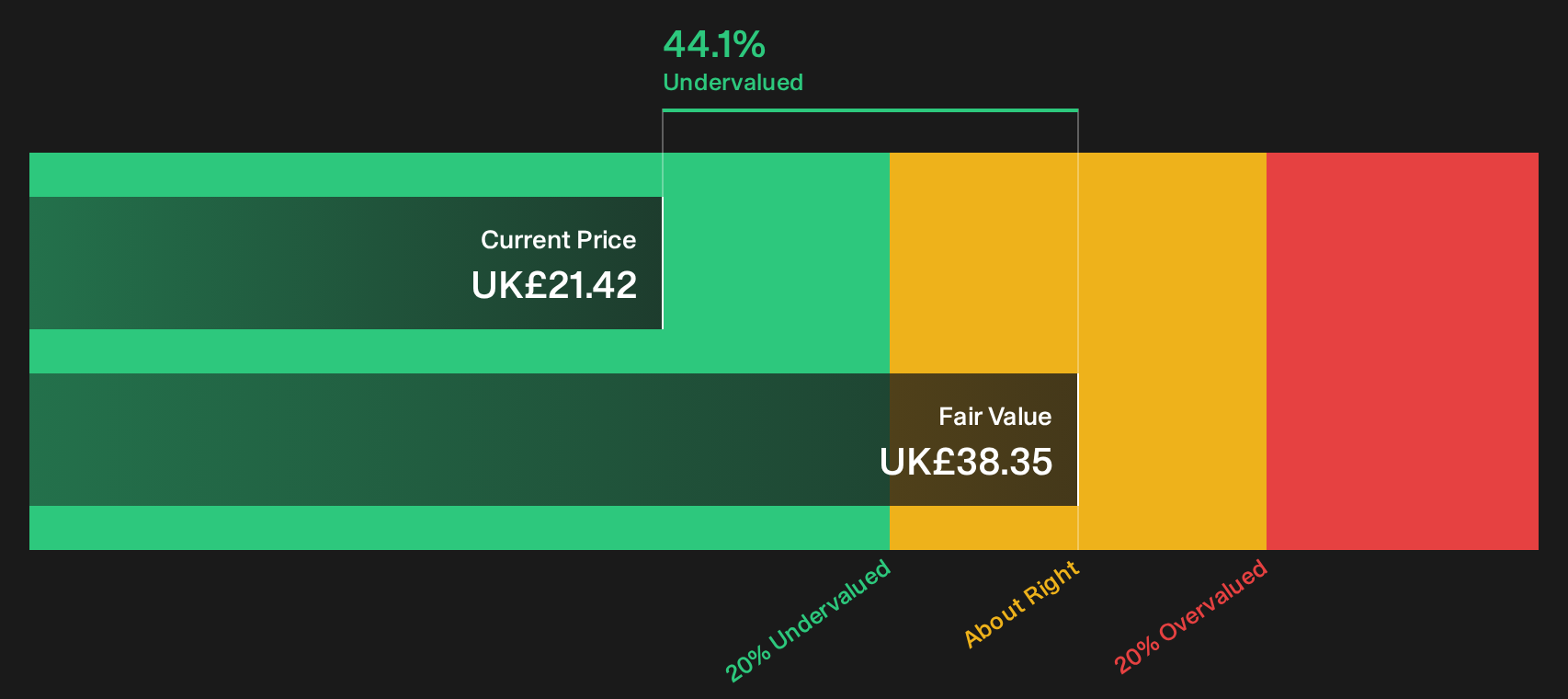
Simply Wall St performs a discounted cash flow (DCF) on every stock in the world every day (check out Greggs for example). We show the entire calculation in full. You can track the result in your watchlist or portfolio and be alerted when this changes, or use our stock screener to discover 8 high quality undervalued stocks. If you save a screener we even alert you when new companies match - so you never miss a potential opportunity.
Next Steps
If this Greggs debate feels finely balanced, look at the numbers yourself and decide quickly where you stand on both risk and upside. To weigh that mix of concerns and potential rewards side by side, start with the 2 key rewards and 1 important warning sign.
Looking for more investment ideas beyond Greggs?
If Greggs has sharpened your focus on valuation and risk, use that same mindset to hunt for other opportunities that fit your portfolio goals.
- Target steadier compounding potential by reviewing businesses that pair staying power with attractive yields through the 2 dividend fortresses.
- Zero in on balance sheet strength and resilient fundamentals by scanning the list of solid balance sheet and fundamentals (9 results) before the crowd catches up.
- Hunt for lesser known opportunities with robust metrics by working through the 5 high quality undiscovered gems while they are still off most radars.
This article by Simply Wall St is general in nature. We provide commentary based on historical data and analyst forecasts only using an unbiased methodology and our articles are not intended to be financial advice. It does not constitute a recommendation to buy or sell any stock, and does not take account of your objectives, or your financial situation. We aim to bring you long-term focused analysis driven by fundamental data. Note that our analysis may not factor in the latest price-sensitive company announcements or qualitative material. Simply Wall St has no position in any stocks mentioned.
Have feedback on this article? Concerned about the content? Get in touch with us directly. Alternatively, email editorial-team@simplywallst.com