
BMO signals caution against Roblox (RBLX.US): Google enters the user-generated gaming circuit, “dimensional reduction attacks” rewrite competitive narratives
The Zhitong Finance App learned that in a recent research report, BMO Capital Markets analyst Stan Velikov positioned Playground, a new experimental game creation platform launched by Google (GOOGL.US), as the most direct competitive threat facing Roblox (RBLX.US), rather than a challenge to traditional game publishers such as Take-Two Interactive Software (TTWO.US). The bank's judgment indicates that Wall Street's competitive landscape for user-generated content (UGC) game circuits is being repriced — competition no longer comes from horizontal competition on similar UGC platforms, but rather from a “dimensional reduction attack” leveraged by tech giants using AI capabilities.
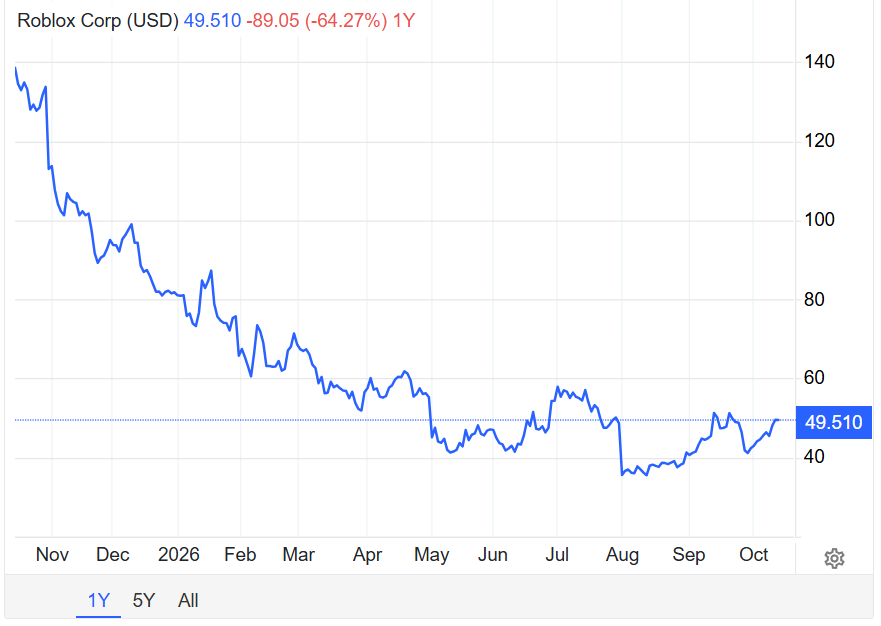
On the day Google launched Playground, Roblox's stock price plummeted. Although the stock has gradually recovered from its low point during the year, by the close of Tuesday, its stock price had fallen sharply by 60% from its 2025 high.
Google Playground: AI Redefines “Zero-Threshold Moment” for Game Creation
According to information, on October 7, Google Labs, the experimental project division of Google, officially launched the Playground platform. Users do not need to master programming, game design, or art production skills; AI can generate 2D or 3D games that can run directly in a browser through natural language descriptions. Users can choose game genres such as quiz and racing, or start with a blank project and then continue to modify game mechanics, physical effects, characters, and visual style through text instructions.
Playground's underlying technology combines Google Gemini, image model Nano Banana, and music model Lyria to integrate language processing, image generation, and music creation capabilities into a unified game creation process through a customized AI orchestration system. Once generated, the game can be run directly in a browser. It supports mobile phones and computers, and users do not need to install a client or configure a development environment. The platform also provides features similar to game communities. Publicly released games can be added to leaderboards, and creators can continue to iterate and improve their work after release.
More strategic is the simultaneous collaboration between Google and Unity (U.US). The two sides announced the establishment of a strategic partnership. Unity will integrate Spark technology into the playground later this year to provide professional-grade game mechanics, high-fidelity 3D graphics, and Unity runtime capabilities. This means that Playground's positioning may evolve from an experimental platform for rapidly generating simple games to a complete game development tool — users first quickly build prototypes through natural language and then use Unity technology to perfect content.
Currently, Playground is only open to users 18 years of age or older in the US. It uses a weekly AI-generated token model. The free user quota is limited, and the Google One AI subscription quota is higher. Player feedback from the first batch of games launched was polarized. There was a clear gap between actual machine performance and promotional expectations for some games, indicating that AI still has limitations in processing complex game mechanics.
Roblox's Mirrors and Contrasts: The Build Tool's Pioneer Dilemma
It is worth noting that Roblox is not a latecomer in the path of AI lowering the creative threshold. In July of this year, Roblox launched the AI creation tool Build on mobile, which allows users to generate basic games through text prompts, driven by various AI models, covering gameplay mechanics, environments, characters, visual style, and sound effects. At the RDC 2026 developer conference in September, Roblox further announced the expansion of Build to the desktop, and plans to allow creators to publish their works as standalone apps to mobile phones, PCs, and game consoles, allowing players to directly access games through web links.
The significance of this strategic adjustment is that Roblox is shifting from “bringing more people to the Roblox platform” to “making creative content on Roblox reach more places.” AI lowers the threshold for production, and cross-platform publishing expands potential audiences — the combination of the two could change Roblox's future business model and platform boundaries.
However, while BMO analyst Stan Velikov said he was “impressed” by Playground's launch, he also pointed out a key historical rule: “Big tech companies have always struggled to break into the gaming sector.” This judgment reminds investors that Google's previous attempts in the field of cloud gaming were unsuccessful — Stadia's cloud gaming service announced its closure in 2022, officially ceased operations in January 2023, and player fees were refunded. Playground chose a different path from Stadia: instead of relying on expensive game licenses and streaming, they let users fill their content shelves themselves.
However, the threat of Google entering the market this time is that its competitive logic is completely different from the past. Unity CEO Matt Bromberg once gave a widely quoted analogy when talking about AI game creation: having AI recreate a game that has already been made doesn't make you Hideo Kojima, a famous Japanese game producer. It's like putting the first section of “War and Peace” into a word processor, and doesn't make you Tolstoy. This suggests that Playground's goal is not to replace professional game development, but to open up a new creative class—those who are creative but lack technical skills.
Roblox's Deep Anxiety: Declining Monetization Rate and Explosive Dependency
BMO's cautious approach to Roblox is rooted in the significant deterioration its fundamentals are experiencing. In the second quarter of 2026, Roblox achieved revenue of 1.5 billion US dollars, an increase of 36% year over year, operating cash flow and free cash flow increased 60% and 66% year over year, respectively, and free cash flow profit margin of about 20%. However, the number of bookings increased by only 8% year over year, at the lower end of the guidance range, mainly hampered by a decline in the hourly monetization rate.
The deeper problem is that for the first time Roblox indicated a year-over-year decline in bookings — the first time in the company's history. BMO analyst Brian Pitz pointed out in the July downgrade report that user engagement has moved from popular games with high monetization capacity in 2025 to new games and Evergreen game combinations with low hourly monetization capacity. This shift has exceeded expectations. The median guidance for the third quarter was 12.5% lower than market expectations.
Roblox Chief Financial Officer Naveen Chopra's explanation during the earnings call revealed the structural difficulties of the UGC platform: “We attributed this unforeseen monetization gap to a shift in user engagement from popular games with high monetization capacity in 2025 to new games and evergreen game combinations with low hourly monetization capacity.”
Looking back at the summer of 2025, Roblox was in its prime. Grow a Garden set a record of over 22.3 million concurrent online players, breaking Fortnite's previous record of 15.3 million. Well-known analyst Matthew Ball pointed out in his “The State of Video Games” report that in the global game market outside of China in 2025, Roblox alone swallowed up 67% of the net growth of the entire industry. However, the popularity of these phenomenal games has drastically subsided — “Steal a Brainrot” has dropped from over 25 million to around 110,000 people online at the same time.
BMO expects “user engagement and monetization pressure to continue over the next few quarters, particularly when GTA VI is released in the fourth quarter of 2026.” Deutsche Bank analyst Benjamin Black also downgraded Roblox to a “hold” rating, dropping the target price from $56 to $38, pointing out that the quarter “substantially reduced recent visibility” and expected the stock price to “remain range-bound until monetization stabilizes in the UCAN region.”
A multi-dimensional perspective on the competitive landscape: More than just Google's rival
The entry into Google Playground is not an isolated event; it is a microcosm of the intensive explosion of the AI game creation platform circuit in the second half of 2026. In just two months, at least three giants brought “AI-made games” to the stage.
At the Connect 2026 conference held by Meta (META.US) at the end of September, the tech giant released two AI game tools, Horizon Create and Horizon Studio, which target mobile and browser devices, respectively, and allow users to build 2D and 3D games directly on mobile phones through natural language prompts. Meta's differentiation lies in its social distribution capabilities — the game can be played directly in the Instagram or Facebook stream, and it only takes two clicks to post to social platforms. More importantly, Meta's engine supports real-time collaborative authoring, and multiple users can edit and test in the same game world at the same time.
In June, Epic announced at Unreal Fest that big models such as Claude and Gemini will be connected to Unreal Engine 6 through the MCP protocol. Additionally, AI-native startup AstroCade closed a $56 million Series B funding round in May — the largest funding to date in the field of AI gaming platforms for consumers — with 5 million monthly active users and 75,000 creators.
From a macro perspective, the creator economy of the UGC game ecosystem is rapidly expanding. According to industry reports, in the UGC ecosystem represented by Roblox, Fortnite, and Overwolf, the total share of creators reached about US$2.2 billion in 2025, an increase of 47% over the previous year. According to data disclosed by Roblox itself, in the 12 months up to June 30, 2026, creator revenue distributed by the platform through the developer exchange program increased by about 50% year-on-year, and cumulative payments have exceeded 5 billion US dollars. However, the median income was only about $1,500, and the gap between top players was extremely wide — the top 10 creators received an average of 65.7 million dollars, while the top 100 received an average of $10.8 million.
This extreme fragmentation structure means that although AI lowering the creative threshold may expand the creator base, whether it can actually be converted into an increase in platform revenue still depends on whether these new creators can produce continuously attractive content. Roblox currently has nearly 4% of global gaming revenue flowing through its platform, and the company's CEO David Baszucki proposed a goal of capturing 10% of the global gaming market. In the context of the global game market of about 200 billion US dollars, the O18 user base accounts for about 80% of total consumption. This is exactly the direction Roblox is actively expanding — US O18 users account for about 1/3 of verified DAUs, and their monetization rate is more than 50% higher than that of U18 users.
Moats and Weaknesses: Roblox's Approach to Offense and Defense
In the face of menacing tech giants, Roblox isn't without barriers. Its core strength lies in the creator ecosystem and network effects accumulated over more than ten years. The platform has more than 120 million daily active users, more than 29 billion hours of user time, and the age verification penetration rate has increased to 57%. The developer exchange program has paid creators more than 5 billion US dollars, forming one of the world's largest UGC game economies.
Roblox is further consolidating this moat with AI tools. The company acquired Morpheus AI, which pioneered the Self Forcing and Pixel Potential World Model, transforming a slow offline video model into a fast, interactive real-time generation engine, enhancing the company's ability to achieve Roblox Reality — a fundamental multi-year bet. At the content distribution level, Roblox also plans to support browsers to directly open game links before the end of the year, so users don't necessarily need to open the Roblox client first.
But Roblox's weaknesses are also obvious. Its GAAP net loss for the second quarter of 2026 was US$183 million, a loss of US$1.42 per share, and the company is still in a state of continuous loss. The current market sales ratio is about 6.25 times, which is significantly lower than its historical median of 10.24 times, indicating that the market is pricing more moderate future growth expectations. The continued reduction in holdings by insiders has also drawn market attention — insiders have sold a total of US$105.6 million in the past 12 months, and there is no record of internal purchases.