
Dalio sounded the alarm again: the US debt bear market “still has a long way to go”! Will rising yields eventually trigger the AI bull market's “killing line”?
The Zhitong Finance App learned that at a time when the yield on US bonds with a long-term term of 10 years or more continues to be surging, Rui Dalio, a legendary US investor and founder of Qiaoshui Fund, once again warns the global equity market — a surge in global government and corporate financing, but the willingness of traditional big buyers to accept them may further weaken. Higher yields and the austerity path of central banks such as the Federal Reserve will further expand debt repayment burdens, creating a self-reinforcing debt cycle predicament. Faced with US bond assets that continue to surge in yield indicators, Dalio directly warned that the bearish decline in the US Treasury bond market “may still have a long way to go.”
Dalio previously reiterated in a speech on October 6 that the US may face a major debt crisis within three years. On the 13th EST, he made a further early warning judgment. The bond bear market is still far from over. The logic of his core concern is that the enormous demand for additional financing is challenging the market's ability to continue to absorb debt. On October 13, US 10-year and 30-year Treasury yields were 5.21% and 5.56% respectively. Although falling from recent highs, they still surged 46 and 31 basis points from the end of August, and are still near their highest point in more than 20 years. According to CME data for the same day, interest rate futures market traders set the probability that the Fed will continue to raise interest rates in October at about 19%, while the probability price of the Fed's interest rate hike in December is as high as 88%. Expectations for further tightening at the end of the year are still strong.
Dalio's latest warning means that the equity market is facing a capital cost reassessment driven by an imbalance between supply and demand for financing — the government continues to issue bonds, companies finance AI construction, and traditional buyers' willingness to undertake weakening, which may force issuers to attract capital with higher yields. As far as bonds are concerned, continuing to rise in yield will cause price losses, and long-term varieties are particularly sensitive; for stocks, higher discount rates lower the present value of forward profits, and more expensive loans will also erode profits and restrict expansion. Therefore, there may be a situation where the decline in bonds occurs at the same time as stock valuation contraction, and the hedging effect of equity bonds weakens. As high interest rates/high yields are gradually transmitted through old debt refinancing, the market must also re-evaluate whether corporate profits can withstand continued high capital costs.
Strong pressure on the energy supply side continues to prolong this tug-of-war between US bond yields and the Federal Reserve's benchmark interest rate pricing. On October 13, futures prices for Brent crude oil and WTI crude oil closed at 105.69 and 94.14 US dollars/barrel respectively, which meant a sharp increase of 46% and 42%, respectively, from before the US-Iran war at the end of February, and an increase of about 5% in the US diesel futures market. According to data disclosed by ING, the difference in the cracking price of ICE diesel was about 73 US dollars/barrel on October 7. Although it was lower than the extreme high of more than 90 US dollars in September, it was still at an all-time high, indicating a shortage of refined oil products and a heavy premium. The restoration of crude oil supply will not immediately fix the bottlenecks in refining and transportation. The increase in diesel prices will be transmitted along the freight, agricultural, and industrial supply chains, making it more difficult for inflation to cool down quickly.
The geopolitical situation shows that diplomatic negotiations coexist with military artillery attacks — Iran is still reviewing the US response to the Hormuz plan, but the Saudi Aramco Administration Building, one of the world's largest oil and gas giants, was attacked on the evening of the 13th; Russian-Ukrainian energy cease-fire contacts continue, and Kiev is still being attacked by the Russian military. The diplomatic window has yet to be transformed into a reliable energy security guarantee, and it is difficult to say that the situation has substantially eased.
Dalio warns that the decline in US Treasury bonds “may still have a long way to go”
Billionaire investor Ray Dalio warned that the sell-off in US bonds is far from over, as demand from some of the world's largest traditional buyers is weakening due to a surge in government and corporate borrowing.
The founder of Qiaoshui said in a big post on LinkedIn on Tuesday that the US is entering a phase where bond supply expansion boosts yields, which in turn raises financing costs and further increases debt. He said that this cycle may continue until higher interest rates fully weaken the economy and financial markets and rebalance supply and demand.
Dalio founded Qiaoshui in 1975 to study the economic cycle from debt, currency, and cross-border capital flows for a long time. The reason why his remarks have received positive attention from global institutions and retail investors for a long time is that he is inclined to advance equity market discussions from the logic of the next Federal Reserve monetary policy decision to “who will continue to absorb new debt.” This unique analytical framework may enhance investors' risk scrutiny of long-term debt assets, but their personal judgments do not represent Qiaosui's current position.
“The bond bear market may still have a long way to go.” Dalio wrote.
Dalio can be described as a long-term warning that the US debt crisis is approaching, which could cause the US stock market to fall into a deep bear market, and advocated that investors sell bond assets and continue to buy gold assets. His bearish stance is in stark contrast to the positive bullish stance of some investors and strategists, including the bullish stance recently put forward by BlackRock and Morgan Stanley Investment Management professionals; after 10-year US bond yields rose to the highest level in nearly a quarter of a century this month, approaching 5.4%, they turned bullish on US bond assets.
The controversy and controversy surrounding the debt crisis on Wall Street took place in a year when the bond market was hit hard. Increased energy prices and economic resilience prompted the Federal Reserve to return to the interest rate hike process. Coupled with the flood of government and corporate financing, a Bloomberg index that tracks US Treasury bonds has fallen by about 2.4% this year. The US bond price index may have recorded its first annual decline since 2022; in that year, the Federal Reserve began one of the most intense interest rate hikes to curb inflation, and the price of US bonds fell sharply by 12.5%.
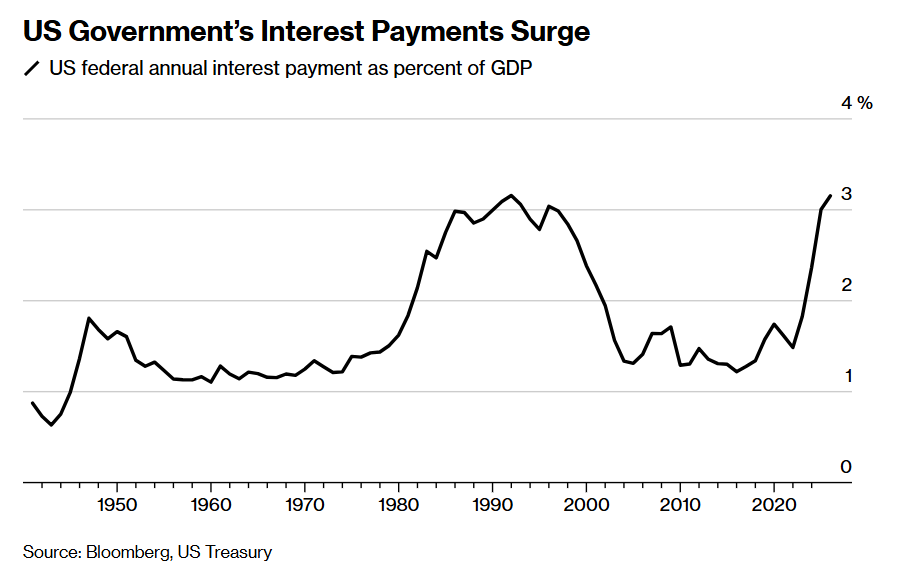
According to a forecast data released by Dalio, measured by total debt and bond repayment costs compared to government revenue, the US debt burden has reached the highest level since World War II, and will worsen further in the next few years.
According to Dalio's own forecast data, the US government will need to refinance about 10 trillion US dollars of maturing debt this year, while also borrowing an additional 2.1 trillion US dollars. He warned that with such a large maturity scale, even if investors' willingness to reinvest maturing payments back into US bonds declined slightly, it could cause a significant financing gap.
What is worrisome is that some of the largest foreign creditors, including China and Japan, may be less willing to buy debt. Dalio said, for example, that Japanese fiscal and economic policy makers are motivated to encourage domestic investors to reduce their holdings of US Treasury bonds of 1.1 trillion US dollars and repatriate funds to support the yen and domestic bond market; continued rise in Japanese treasury yields may reinforce this trend.
The US Treasury is also under pressure from companies to compete for capital: companies are financing AI construction by issuing more bonds and stocks. Dalio pointed out that there are already signs that investors are beginning to require issuers to provide greater “concessions in order to absorb these supplies” and refer to the corporate credit market as a “canary in a coal mine.”
“Combining these factors, anticipated changes in the supply of new bonds and demand have long made shorting US Treasury bonds more beneficial than going long, and this is still the case today.” Dalio wrote.
Huge interest is eating up fiscal space, and the unprecedented boom in AI investment also needs to be tested by financing costs
The core of Dalio's warning is that government debt issuance and AI construction financing expand at the same time, and capital acceptance capacity is not necessarily growing at the same time, forcing borrowers to pay higher interest rates.
For the AI computing power industry chain, a rise in long-term yield will not only increase the discount rate of long-term profits, but also increase the cost of data center construction, equipment procurement, and debt refinancing; however, computing power revenue will need to go through electricity access, equipment delivery, and rising utilization rates to be realized. Once it is difficult for the expected return of the project to continue to exceed the cost of capital, enterprises that are highly dependent on financing may slow their expansion, and pressure will spread along orders to core suppliers in the AI computing power industry chain such as chips, storage, CPUs, and data center optical interconnection systems. The so-called “cutoff line” of the AI bull market is the profit growth required by high valuations and high capital expenditure, and it is initially difficult to withstand the continuous rise in capital costs — the critical point depends on corporate cash flow and actual project returns, rather than a uniform US bond yield point.
Regarding the AI super-bull market that supports the bullish trajectory of the global stock market, especially those popular AI computing power infrastructure-related stocks that have experienced a surge in recent years, Dalio's latest warning can be described as meaning that the market will more strictly test whether huge capital expenses can be converted into cash flow covering capital costs. Data centers need to pay for chips, electricity, and construction costs in advance, but revenue reimbursement depends on power-up progress, computing power utilization, and customer payment capacity, and hardware depreciation continues to consume economic value; the higher the financing cost, the corporate credit bond market will increasingly seize the capital pool with long-term US bond issuance, which also means that there is less room for projects to allow delays in delivery and underutilization.
Under the simultaneous expansion of corporate debt issuance and the supply of long-term US bonds, if investors' ability to accept them does not increase accordingly, it will increase capital competition and drive up financing costs; while higher capital costs will not only increase the interest burden during the construction period of the project, but also increase the cash flow requirements after production is put into operation, further narrowing the space for delivery delays and insufficient utilization rates that enterprises can bear.
As a result, new cloud and data center operators that have long and continued to rely on continuous debt expansion are under more direct pressure; if customers delay investment as a result, the pressure may also spread to GPU, ASIC, storage and optical interconnect vendors along with orders. The stress test of the AI super bull market goes deeper into competition for financing capacity, order fulfillment, and return on investment: companies with sufficient cash flow, high delivery certainty, and project returns that can continue to exceed capital costs are better equipped to support valuations.
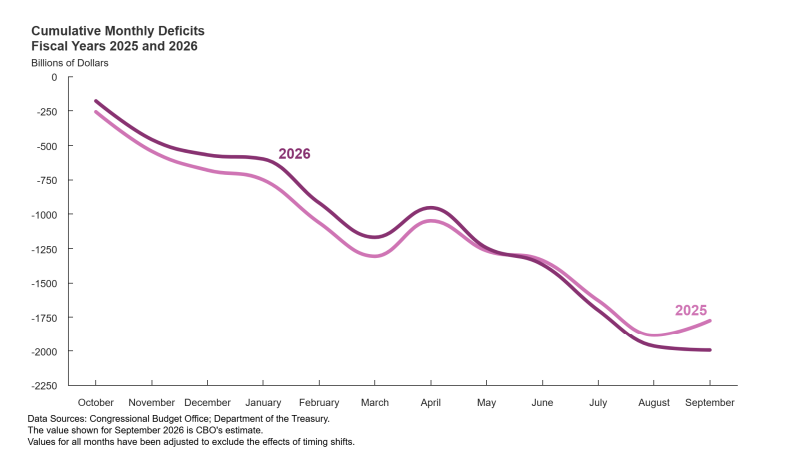
CBO (US Congressional Budget Office) preliminary estimates show that in the 2026 fiscal year, the US deficit was about 1.993 trillion US dollars, and net interest expenses were 1.143 trillion US dollars, which means that it is expected to increase sharply by 12% and 11%, respectively. After the old debt matures, it is renewed at a higher interest rate, and interest expenses gradually rise; if tax and expenditure adjustments cannot keep up, the new deficit will also require more debt issuance. This kind of financial risk will increase the long-term debt returns required by investors, but thankfully, there is insufficient and substantial evidence that this round of US debt and even global long-term treasury bond sell-offs are mainly driven by the risk of impending sovereign debt default.
The scale of refinancing makes marginal purchases particularly critical — based on Dalio's estimated maturity of 10 trillion US dollars, for every 1 percentage point reduction in the renewal ratio, it is necessary to find about 100 billion US dollars in alternative capital. Therefore, even if overseas creditors do not concentrate on selling, simply reducing their willingness to renew investments at maturity may force issuers to attract new buyers with higher yields.
Since the end of August, the 10-year real yield has risen by 44 basis points. After the recent decline in yield, it is close to the total increase of 46 basis points in nominal yield over the same period, indicating that this round of adjustments involved a significant revaluation of actual capital costs. The huge trillion-dollar AI computing power infrastructure construction related to AI computing power first takes up financing, electricity, and equipment, and productivity benefits are then realized; when the government and enterprises compete for capital at the same time, data center projects must cover capital costs with higher utilization rates and cash flow. If interest spreads in the corporate credit bond market widen at the same time, it will also create a double squeeze between the benchmark interest rate and the credit premium. Global capital reallocation may spread pressure to overseas bond markets, while increasing the discount rate for technology stocks and the opportunity cost of holding gold. The yield on British 30-year treasury bonds once hit 6.05% on October 8, a record high since 1998, reflecting the global nature of this long-term debt revaluation.