
The net interest income of the three major US banks hit a record for the fifth consecutive quarter: customers continue to borrow money and interest rates rise to “feed” banks
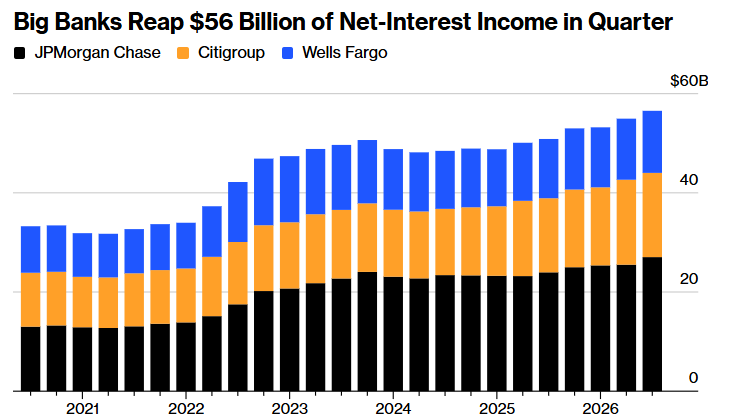
The three largest banks in the US set a new record for loan revenue in the third quarter — that is, convenience rates continued to rise, and customers continued to borrow money.
The Zhitong Finance App learned that J.P. Morgan Chase (JPM.US), Citigroup (C.US), and Wells Fargo Bank (WFC.US) announced on Tuesday that they achieved a total net interest income (NII) of US$56.5 billion in the third quarter, a new record high for the fifth consecutive quarter. J.P. Morgan Chase also predicts that its net interest income will rise further in 2027.
From “Expected Interest Rate Cuts” to “Interest Spreads Are King”: A 180-degree Turn of the Narrative
This outlook is in stark contrast to the market climate at the beginning of this year. At the time, the banking industry generally expected interest rates to decline, and the focus of market attention was on the explosive growth of the trading business — the investment banking trading department's impressive performance once attracted most of the investors' attention, but the more traditional profit model of earning interest by issuing loans and other interest-bearing assets was instead hidden from the spotlight.
Now the direction of the wind has changed. Interest rates remain high or even upward, and customer demand for loans remains resilient, making net interest income once again the most important part of the profit engine of major banks.
At the same time, banks see that the ability of consumers and businesses to maintain their solvency is still not a problem. The number of so-called “non-accrual loans” (non-accrual loans, loans where banks have stopped confirming interest income) announced by the three banks during the quarter has all declined, indicating that the quality of credit assets is still improving rather than deteriorating.
Bank of America will announce third-quarter results on Wednesday, when the market will further confirm this trend.
Why are high interest rates “feeding” banks
From a structural point of view, it is not difficult to understand that this round of net interest income reached a record high. The Federal Reserve maintains a tight interest rate environment, making the bank's asset side (loans, credit cards, portfolios) repricing faster and higher than the debt side (deposit costs), and net interest spreads expand accordingly. At the same time, corporate capital expenditure intentions and consumer credit demand did not cool down significantly due to high interest rates, and “sharp rise in volume and price” jointly boosted interest income.
More noteworthy is J.P. Morgan's forward-looking guidance. The bank clearly predicts that net interest income will be higher in 2027, which means that management judges that the interest rate center is difficult to decline significantly in the short term, and that the balance sheet structure is sufficient to support the continuation of interest spread earnings. For the market, this is actually a kind of “interest rate guide” in disguise — revealing the real judgment of major banks on the macroeconomic environment more directly than any economic forecast.
Concerns Remain: Geopolitics and the Prudence of “Strict Defense”
However, behind the impressive numbers, banks are still on high alert. Geopolitical uncertainty — ongoing war between Ukraine and the Middle East, stubborn inflation, and high oil prices — are all lingering concerns of management.
Jeremy Barnum (Jeremy Barnum), chief financial officer at J.P. Morgan Chase, said on Tuesday: “We're just making sure every corner is thoroughly checked. Capital is being taken away through all sorts of different mechanisms, and we have to be online very, very constantly to make sure nothing slips through our fingers.”
Analysts pointed out that this statement reveals a double meaning: on the one hand, banks do not think systemic risk is imminent — otherwise they will not give higher profit guidance; on the other hand, geographical conflicts and energy prices are gradually eroding the balance sheets of enterprises and households, and banks are reserving buffers for potential tail risks through provision reviews and credit “launderings”. In other words, the “record revenue+prudent provision” combination is the current standard response attitude of the US banking industry to the “high interest rate and high uncertainty” environment.