
Nvidia’s Bold d-Matrix Bet Could Help the Chip Leader Expand Its AI Dominance
Navigating the rapidly evolving artificial intelligence hardware market requires looking beyond individual product cycles to understand how dominant ecosystem leaders secure long-term infrastructure demand. By partnering with emerging technology developers, leading chip designers can capture specialized AI workloads while maintaining influence over enterprise data-center architecture. Reflecting this approach, Nvidia has reportedly moved to invest in AI inference chip startup d-Matrix, a company that competes with Nvidia in parts of the AI server market.
About Nvidia Corporation
Nvidia Corporation (NVDA) is a global leader in accelerated computing, artificial intelligence, graphics processing units, and data center infrastructure. Headquartered in Santa Clara, California, the company designs the Blackwell and Rubin AI platforms, CUDA software, networking products, and automotive technologies that support generative AI, cloud computing, robotics, and high-performance computing worldwide.
Nvidia Stock Performance
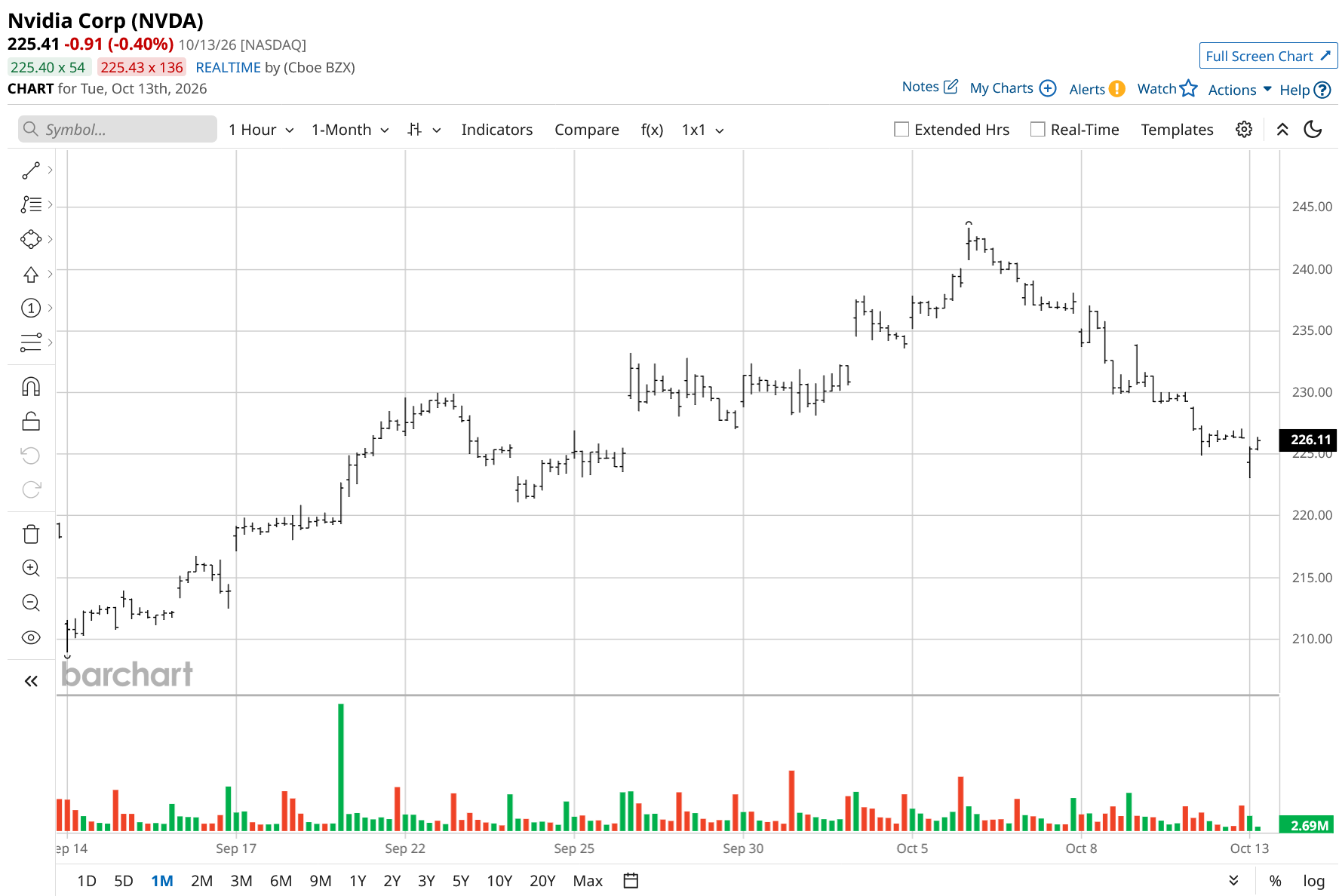
Nvidia's stock has remained one of the market’s most closely watched AI stocks in 2026, supported by exceptional demand for its data center GPUs and AI infrastructure. NVDA shares were up about 21% year-to-date (YTD) as of mid-October, while the broader S&P 500 ($SPX) had gained roughly 14.1%, highlighting Nvidia’s continued market outperformance. The stock has been volatile, however, as investors weigh record earnings against elevated expectations, AI capital expenditure cycles, China export restrictions, and concerns over future gross-margin normalization.
Compared with the S&P 500 Information Technology Index ($SRIT), Nvidia’s 2026 performance has been solid but less dominant than in prior years. The SRIT was up approximately 29% YTD as of Oct. 13, ahead of NVDA’s roughly 21% YTD return. While Nvidia remains a core driver of the technology sector’s AI-led rally, broader semiconductor, software, and large-cap technology names have also contributed strongly to the sector’s gains.
Record Revenue and Strong Earnings
Nvidia delivered another record-breaking quarter for the period ended July 26, 2026, reporting revenue of $96.2 billion, up 18% sequentially and 106% year-over-year (YoY). The result exceeded Wall Street’s consensus revenue estimate of $92.27 billion. Non-GAAP earnings per diluted share came in at $2.22, beating the analyst consensus of $2.09 by $0.13, while GAAP EPS was $2.46. The beat was driven primarily by demand for Nvidia’s Blackwell Ultra GPUs, AI factories, hyperscaler infrastructure buildouts, and sovereign AI projects.
From a financial metrics perspective, Nvidia’s profitability remained exceptional. Data Center revenue reached $89.0 billion, up 117% YoY and representing more than 90% of total revenue, confirming that AI accelerators and data center systems remain the company’s principal growth engine. GAAP and non-GAAP gross margins were both 75%, up 2.6 percentage points from 72.4% a year earlier. GAAP operating income surged 124% YoY to $63.7 billion, while operating cash flow was $24.1 billion and free cash flow totaled $21.3 billion.
Management’s outlook remained strongly bullish despite rising memory costs and geopolitical uncertainty. For fiscal Q3 2027, Nvidia guided revenue to $108.0 billion, plus or minus 2%, implying roughly 89% YoY growth and another sequential acceleration from Q2’s $96.2 billion. The company expects GAAP and non-GAAP gross margins of 74%, plus or minus 50 basis points. Importantly, management said its guidance assumes no Data Center compute revenue from China, a conservative assumption given ongoing export-control restrictions.
Nvidia Looking to Invest in Rival d-Matrix
Nvidia is reportedly planning to invest in d-Matrix, a developer of artificial intelligence server chips that competes with Nvidia in the fast-growing AI inference market. According to The Information, the potential investment reflects Nvidia’s broader strategy to make its GPUs, networking technology, and AI infrastructure compatible with chips designed by other semiconductor companies.
For Nvidia, the move could strengthen its ecosystem rather than signal a retreat from competition. By supporting interoperability with rival AI accelerators, Nvidia may encourage data center customers to adopt its NVLink-based systems, networking, and software while also using specialized third-party processors. The company has pursued similar compatibility-focused arrangements with Marvell Technology (MRVL), Intel (INTC), and Amazon (AMZN).
The reported deal terms, including the investment size and timeline, have not been disclosed, and Nvidia has not publicly confirmed the transaction. Still, the reported d-Matrix investment underscores Nvidia’s effort to remain central to AI infrastructure as custom silicon, inference chips, and alternative AI accelerators gain traction across hyperscale data centers.
Should You Buy NVDA Stock?
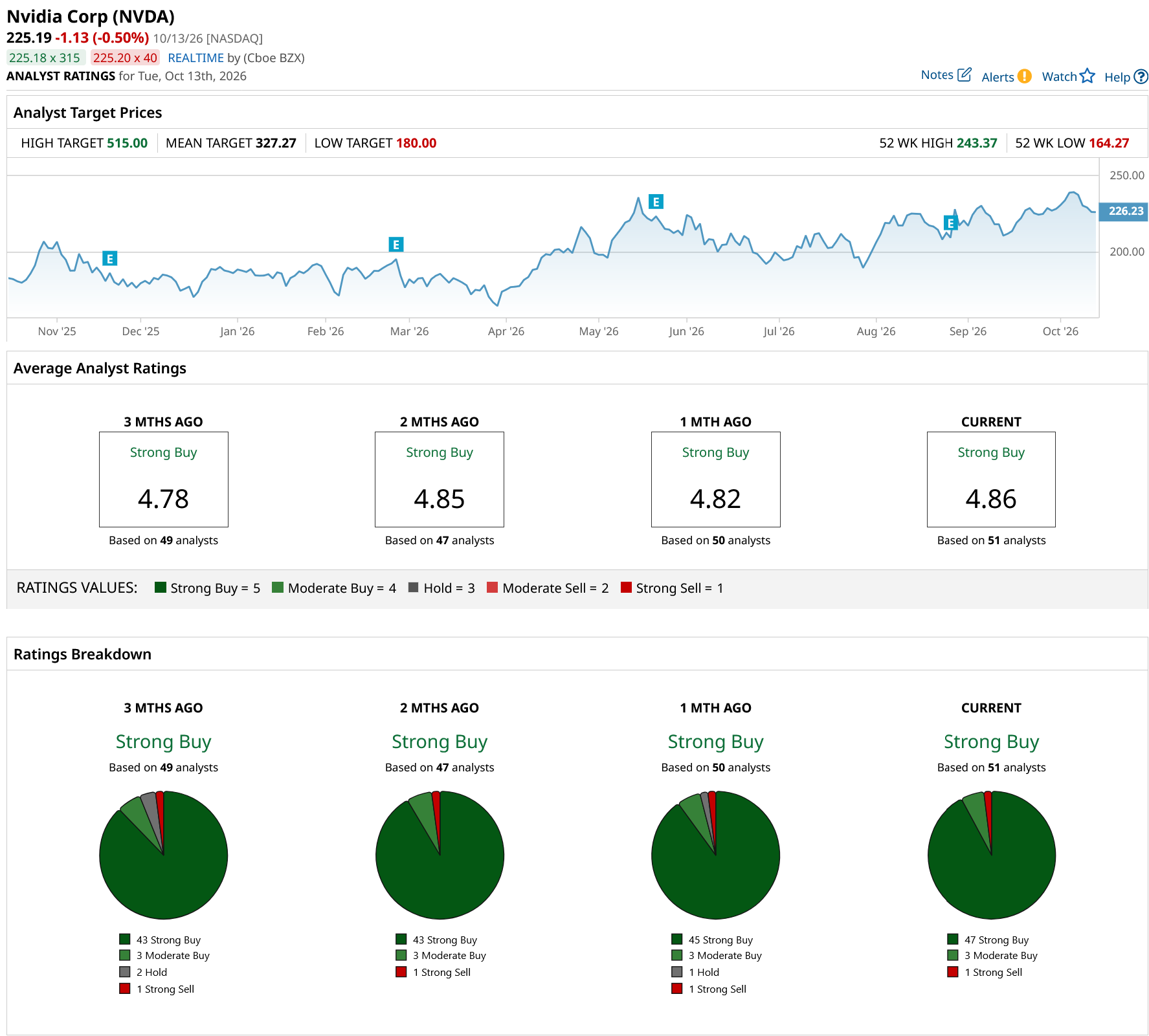
Nvidia’s reported plan to invest in d-Matrix reinforces its strategy of extending the NVDA ecosystem beyond its own GPUs, improving interoperability while keeping Nvidia central to AI data-center architecture. With record revenue growth, dominant Data Center demand, and a “Strong Buy” consensus from 51 analysts, including 47 “Strong Buy” ratings, NVDA remains a compelling long-term AI infrastructure play. The mean price target of $327.27 implies roughly 42% upside, although investors should monitor valuation, China restrictions, and margin pressure.
On the date of publication, Ruchi Gupta did not have (either directly or indirectly) positions in any of the securities mentioned in this article. All information and data in this article is solely for informational purposes. For more information please view the Barchart Disclosure Policy here.