
Mattel (MAT) Stock Looks About Right After Its 20% Jump
Mattel has bounced hard in recent weeks, yet the real question for anyone looking at the stock now is whether that share price better reflects earnings or takeover hopes. With a new chief executive incoming and activists pushing for big corporate moves, the focus turns to what the current valuation asks you to pay for the toy maker's profit stream.
- The share price has climbed 19.6% over the past month, which puts fresh pressure on investors to judge whether the recent rebound lines up with the business's current earnings power.
- Shareholder pressure to explore a possible sale and ongoing talks around a reported US$6b takeover may support higher expectations for future profitability or a faster reshaping of Mattel's portfolio, which both matter for how its earnings are valued.
- The analysts covering Mattel have run their own numbers. See what analysts think Mattel's shares could be worth.
The stock's next move may depend on whether today's valuation looks well grounded in Mattel's earnings once you compare its current P/E with what the Fair Ratio benchmark implies.
If you want a reference point for how other businesses with earnings stories are being priced, check out 29 high quality undervalued stocks.
Does Mattel Look Fairly Valued on Earnings?
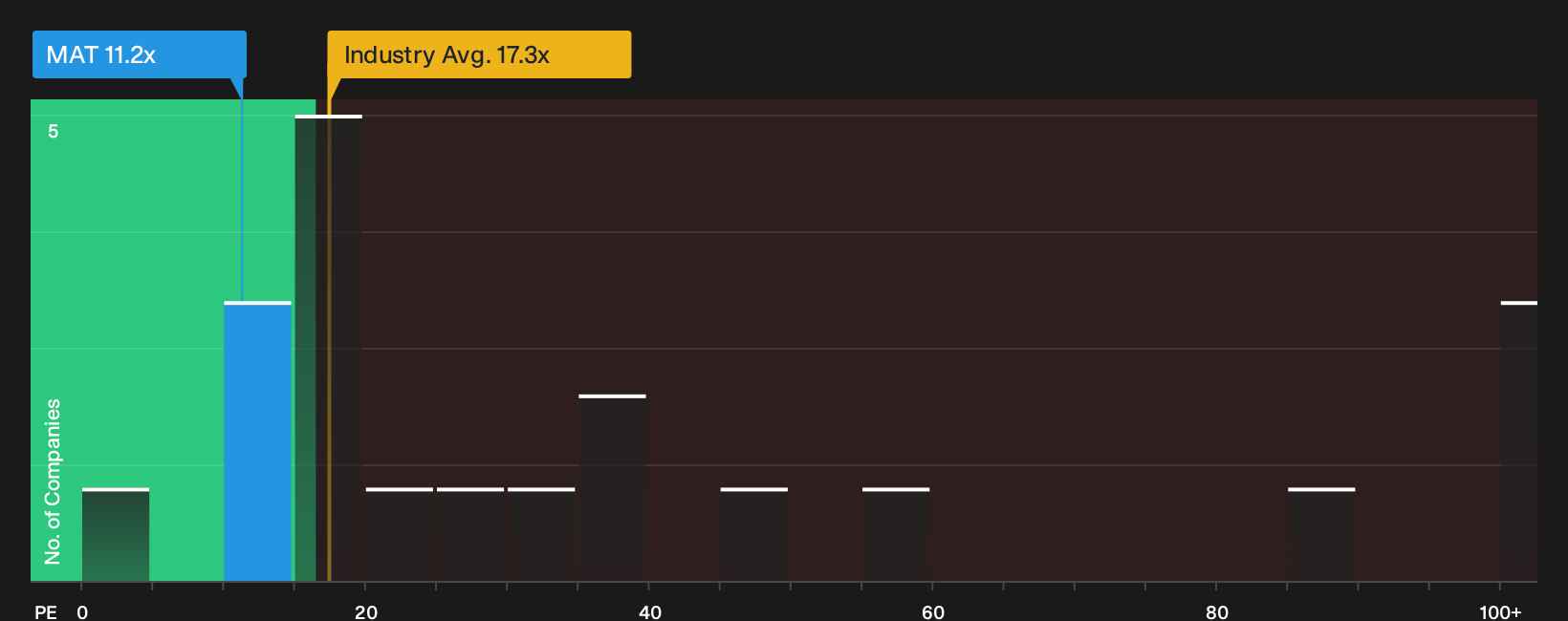
For Mattel, the P/E ratio is the cleanest way to line up the current share price with the earnings story that investors are really paying for. The stock trades on a P/E of 11.2x, which is well below the Leisure industry average of 17.3x and also under the broader peer group on about 22.5x. Against the Fair Ratio benchmark, which reflects what you might expect given Mattel's own growth profile, profitability and risk, the current multiple sits only slightly on the cheaper side. As a result, the discount to peers looks less dramatic once those fundamentals are taken into account.
Because shareholder pressure and takeover talk have been front and center in recent weeks, it matters that the valuation still anchors mostly to earnings rather than a pure bid premium story. The result is a P/E that suggests the market is not paying up as fully as it does for many Leisure stocks, yet is also not treating Mattel as a distressed outlier on this metric. Explore the numbers behind Mattel's P/E valuation.
The Mattel Narrative: What Would Justify Today's Price?
Mattel Narratives pick up where the P/E puzzle leaves off by spelling out the future paths for growth, margins and earnings that would need to play out for the stock to look meaningfully cheaper or richer than today's quote. They sit on Simply Wall St's Community page. Instead of giving just a single number, these frameworks map out the future business conditions that figure rests on so you can watch over time whether those assumptions actually show up.
Community views on Mattel split between those who see the 2026 investment spend as a springboard and those who think long term pressure on traditional toys will bite harder.
Bull case: 37% undervalued
"Management’s decision to treat 2026 as an investment year, with about US$150 million of extra OpEx and heavier advertising, creates room for a sharper operating income inflection..."
Discover why this Narrative puts Mattel at 37% undervalued.
Bear case: 52% overvalued
"Mattel faces a secular decline in demand for traditional physical toys due to the accelerating shift among children toward digital entertainment and mobile devices..."
Explore why this Narrative puts Mattel at 52% overvalued.
Before you make a call on Mattel, there is one more piece to check
Valuation only tells you what the market pays for Mattel’s profits today. The real leverage often sits with the people setting priorities and their pay packets, which deserve a closer look too. See who runs Mattel and how they are paid.
This article by Simply Wall St is general in nature. We provide commentary based on historical data and analyst forecasts only using an unbiased methodology and our articles are not intended to be financial advice. It does not constitute a recommendation to buy or sell any stock, and does not take account of your objectives, or your financial situation. We aim to bring you long-term focused analysis driven by fundamental data. Note that our analysis may not factor in the latest price-sensitive company announcements or qualitative material. Simply Wall St has no position in any stocks mentioned.
Have feedback on this article? Concerned about the content? Get in touch with us directly. Alternatively, email editorial-team@simplywallst.com