
SpaceX (SPCX.US) targets mid-band blocks, AST SpaceMobile (ASTS.US) spectrum moat under threat
The Zhitong Finance App learned that telecom analyst Roger Entner (Roger Entner) said that if SpaceX (SPCX.US) takes Ligado's Viasat-related spectrum and wins a license in a proposed US Federal Communications Commission (FCC) auction, Starlink may control a “huge” mid-band spectrum block. This judgment caused AST SpaceMobile (ASTS.US) spectrum strategy to be re-examined.
ASTS closed up nearly 1% to $51.46 on Monday, stabilizing slightly after a cumulative decline of 16% over the previous two trading days. This round of sell-off began when SpaceX agreed to buy private equity firm Grain Management's national 800 MHz spectrum portfolio last week, and the spectral battle for directly connected satellite phones came back into focus.
Entner said on X that major telecom operators are likely to object to the FCC's proposed auction of 25 MHz spectrum. “Every major operator is likely to bid for these licenses for offensive or defensive purposes,” he said. His larger vision was based on Ligado and Viasat — “If Elon Musk were to acquire Ligado and Viasat and take over this new batch of spectrum, Starlink could control a huge mid-band block for terrestrial business and direct-connected equipment services.”
The FCC wants to auction 25 MHz, which happens to be next to the AST spectrum
The FCC is seeking comments on auctions of the 1675-1695 MHz and 2020-2025 MHz bands, for a total of 25 MHz. According to the agency's documentation, the proposed plan includes three unpaired blocks: Block A (1675-1685 MHz), Block B (1685-1695 MHz), and Block C (2020-2025 MHz), which allows flexible use of terrestrial wireless, direct-attached devices (D2D), or a mix of the two. The matter will be voted on at a public meeting on October 29, and the final rules and auction date are yet to be determined.
The same agenda also includes overhauls to the “Space Supplemental Coverage” (SCS) framework — to release an additional 482 MHz licensed spectrum for SCS and lower regulatory thresholds for transactions and secondary market transfers; and to lift restrictions on drones in the 800 MHz cellular band and release the 50 MHz low frequency band.
These bands closely follow the AWS-4, Ligado, and Viasat spectra. This is particularly sensitive to AST: According to the 2025 list of terms, AST will receive up to 40 MHz of L-band spectrum from long-term use of Ligado in the US and Canada, plus 5 MHz of the 1670-1675 MHz band — the latter is right on the lower edge of the band the FCC plans to auction.
AST SpaceMobile's agreement with Ligado also includes a trade-in arrangement: Ligado will receive warrants that can be converted into AST shares (worth approximately $120 million within 12 months) and an annual cash payment of $80 million over an 80-year lease. According to the documents submitted by AST to the US Securities and Exchange Commission (SEC), AST is required to pay Ligado approximately US$550 million at the time of delivery and must meet conditions such as regulatory approval. Ligado filed for Chapter 11 bankruptcy protection in January 2025 — previously its plan to use the L-band for terrestrial 5G networks ran aground due to GPS interference disputes; under the restructuring plan, its debt would be reduced from $8.6 billion to about $1.2 billion, while the company is still proceeding with a $40 billion lawsuit against the US government.
Viasat was named because it inherited the latter's L-band and S-band mobile satellite spectrum and global market access after acquiring Inmarsat in 2023, and is also Ligado's creditor (Ligado is obligated to pay for Inmarsat); Viasat had previously planned a direct connection business with Ligado cooperative satellites.
The field of the two routes AST and SpaceX
The path difference between AST and SpaceX is the underlying logic of this battle. AST relies on cooperation with operators to connect satellites to ordinary mobile phones: AT&T has signed a final commercial agreement with AST for cellular broadband in space, and Verizon has also signed its own direct cellular service agreement; according to Ticker Report, TELUS and AST have completed Canada's first network integration test for directly connected mobile phones to satellites. T-Mobile (TMUS.US) currently uses SpaceX's Starlink.
SpaceX is building a more direct mobile network model — combining satellite, spectrum, and terrestrial infrastructure. Last week's two-step move made this line even more clear: on October 7, the FCC approved its second-generation Starlink Mobile constellation application, which allows the launch of up to 15,000 satellites optimized for the 2 GHz spectrum (operating in extremely low Earth orbit, with the goal of increasing bandwidth and reducing latency); on October 8, SpaceX announced a final agreement with Grain Management to acquire 100% of its national 800 MHz spectrum portfolio, including up to 14 MHz pairwise low band spectrum. The parties did not disclose the price, but according to people familiar with the matter, it was around $8 billion in cash; the deal still requires FCC approval.
Low-band penetration is Starlink's previous shortcoming — the current 2 GHz mid-band has high bandwidth but poor wall penetration capability. Musk called the deal a “very significant event” on X, and SpaceX said in its official blog that this batch of “high-quality low-band spectrum addresses one of the remaining key technology gaps and will make Starlink Mobile a major US mobile operator.”
Following the news, T-Mobile, Verizon (VZ.US), and AT&T (T.US) shares each fell about 6% after the market on October 8. Verizon spokesperson Rich Young responded, “This company can have a lot of spectrum, but it doesn't matter if it doesn't have a network that uses that spectrum. It was just radio waves in the air.” According to the International Financial News, the three operators have jointly established a satellite joint venture in May of this year, and outsiders generally believe that the intention is to prevent SpaceX.
How is the market priced?
The magnitude of the fluctuations in ASTS itself explains the unease in the market. According to FinanceFeeds records, the stock fell 6.1% during the regular trading session on October 8, then fell about 4% after the SpaceX-grain deal was announced; it once fell to $47.57 during the session on October 9 (down 13.7% from the closing price of $56.93 on the previous trading day). By October 12, the stock price closed at $51.46, up 0.97%, but the cumulative decline during the year was 29%; the 52-week range was $47.57 to $133.86, and the current price is close to the lower end of the range.
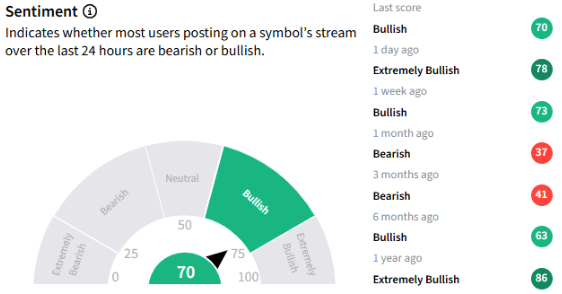
Retail sentiment is also paralyzed: users on Stocktwits accuse ASTS of not having commercial revenue or profit, and that they have promised not to increase sales; another user called this a typical increase in shipments.
According to StockAnalysis data, AST's rolling 12-month revenue was US$115.3 million (up about 2,257% year over year), net loss of US$619 million, cash balance of US$2.29 billion; the 2026 revenue guidance is US$150 million to US$200 million, with order reserves of about US$1.3 billion. The next financial report is scheduled for November 9.
The seller's views were clearly divided. Deutsche Bank raised ASTS to a purchase and target price of $93 on October 12, believing that the sale related to SpaceX was a misjudgment, and mentioned spectral value and catalysts; the bank also believes that T-Mobile may shift direct-connected equipment cooperation from Starlink to AST. On the reverse side, B. Riley Securities was lowered to neutral on October 2, and the target price dropped from $85 to $65. According to StockAnalysis, AST's target average price is around $78.
There is also no market consensus on SpaceX's path. ARK Investment Management analyst Tasha Keeney believes that spectrum transactions and satellite licensing give Starlink Mobile “a trusted path to becoming a complete mobile operator, not just a backup for blind spots,” that the low frequency band can improve indoor coverage, and that terrestrial radios and small cell units linked to the Starlink antenna infrastructure can supplement capacity.
Moffettnathanson's Craig Moffett believes that SpaceX is still far from having the conditions needed to compete head-on with the Big Three, and that its viable path is still to obtain mobile virtual network operation (MVNO) agreements from the three major operators. New Street Research notes that SpaceX will still “significantly lag behind” in the low frequency spectrum, and that the newly purchased low frequency spectrum is currently incompatible with its first and second generation direct-connected equipment satellites. Walt Piecyk of LightShed Partners determined that the low band requires huge antennas and satellites that are not suitable for mass production. This batch of 800 MHz spectrum is more likely to become the “base layer” of its terrestrial network rather than upstream to the satellite.