
Muse Wonder is adding fuel to the smart device frenzy, and the market is buzzing about Meta (META.US)'s second growth curve! Can “AI FOMO” ignite earnings season?
The Zhitong Finance App learned that according to a recent research report released by Wall Street financial giant Citigroup, the parent company of Facebook and Instagram, Meta (META.US), recently launched the Muse Wonder series of personal AI agents/AI models codenamed “Watermelon” on Monday local time, which is expected to enhance the product cycle with memory, reasoning, and continuous execution capabilities, and the massive expansion of AI computing power resources led by user growth, channel distribution advantages, and the large expansion of AI computing resources led by Meta commercialization.
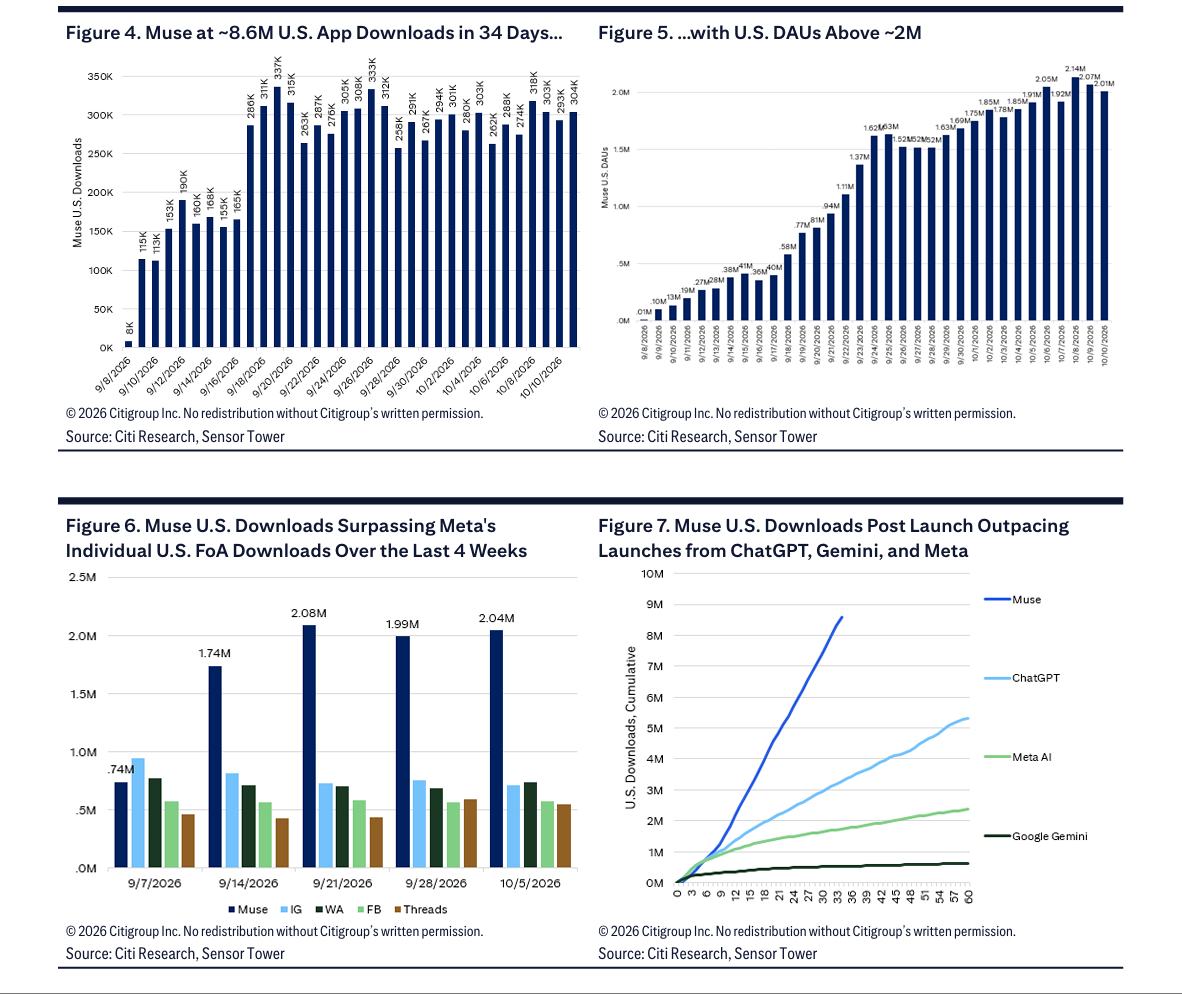
The Citigroup strategist team said that Meta's newly launched Muse Wonder series of AI application products enhances complex task processing, long-term programming, and professional scenarios such as finance and law through Active Memory (active memory, active recall) cross-conversation memory and Active Focus continuous execution capabilities, further enhancing Meta's AI product cycle. According to data quoted in the research report, in the 34 days since Muse went live, the US has accumulated about 8.6 million downloads and more than 2 million daily activity, yet Meta's huge application distribution advantages still need to be further unleashed. Citi emphasized that the Muse series of AI agents is expected to drive Meta's expansion from advertising monetization to long-term paid subscriptions for AI agents, model APIs, and professional work services. The business layout associated with AI agents is expected to become the “second growth curve” after the 100 billion dollar digital advertising business, and the future commercialization space for smart devices is far stronger than digital advertising.
At a time when Meta Muse and OpenAI's GPT-6 Astra are fully detonating a wave of AI agents, “AI FOMO transactions” (meaning investors are worried about missing out on rising opportunities in AI-related assets, and are therefore chasing down or making up for previously lowered positions) can be described as making a comeback. Looking at the underlying architecture of AI computing power infrastructure, Muse and Astra are expected to further expand the scope of use of AI agents. The massive expansion of AI inference workloads brought by them will also increase the demand for model inference, tool execution, and state management, while deepening the competitive pressure on some software companies. Accelerators such as GPUs and TPUs undertake model computation; high-performance server CPUs run browsers, virtual machines, product search, database queries, and transaction orchestration; HBM and server DRAM carry model data, context, and concurrent working environments; enterprise-grade SSDs store product indexes, task records, and persistent states, and high-speed networks and optical interconnections support distributed data exchange.
According to the Citigroup strategist team, this AI FoMo trading boom is even expected to ignite the bullish frenzy of the US stock earnings season that began in October — the popularity of products mainly based on AI agents is expected to shift on a large scale from this year to more and more users using long-term token calls/long-term subscription payments, and will work with the digital advertising growth ecosystem to support expanding computing power investment, further reflecting the competitiveness of models/agents as strong profit growth expectations.
A team of strategists from Citibank said that Wall Street analysts, whose profit increased year-on-year in the third quarter of the S&P 500 index, agreed that it had been significantly revised from 26.7% at the beginning of the quarter to 29.6%. The energy and AI technology topics are the main sources of incremental improvements, and all 11 industries are expected to achieve year-on-year profit growth. Citigroup's exclusive model predicts that 66.2% of the Russell 1000 constituent stocks will experience positive profit surprises (that is, profits exceed market consensus expectations) and a related positive share price return trajectory (that is, the Citigroup model also predicts a positive direction of related stock price returns), which is significantly higher than the already strong 60.9% in the previous quarter, reaching the highest level since the fourth quarter of 2021.
Wall Street financial giant Jefferies recently said that the S&P 500 index is expected to soar to 8,000 points by the end of 2026 and further hit 9,000 points in 2027, driven by the dual engine of AI investment frenzy and rising profits of AI-related companies exceeding expectations. Jefferies's core logic is clear and powerful: in a cycle where AI-driven profit growth exceeds the historical average by more than two times the historical average, fighting against profit trends is dangerous. Jefferies's 2026 8,000-point S&P 500 benchmark forecast is based on earnings per share (EPS) reaching $373 (up 35% year over year, well above 29% of market consensus) and a price-earnings ratio of 21.5 times.
From competing with big AI models to leading the way for individual AI agents, Muse is expected to open up a second growth curve
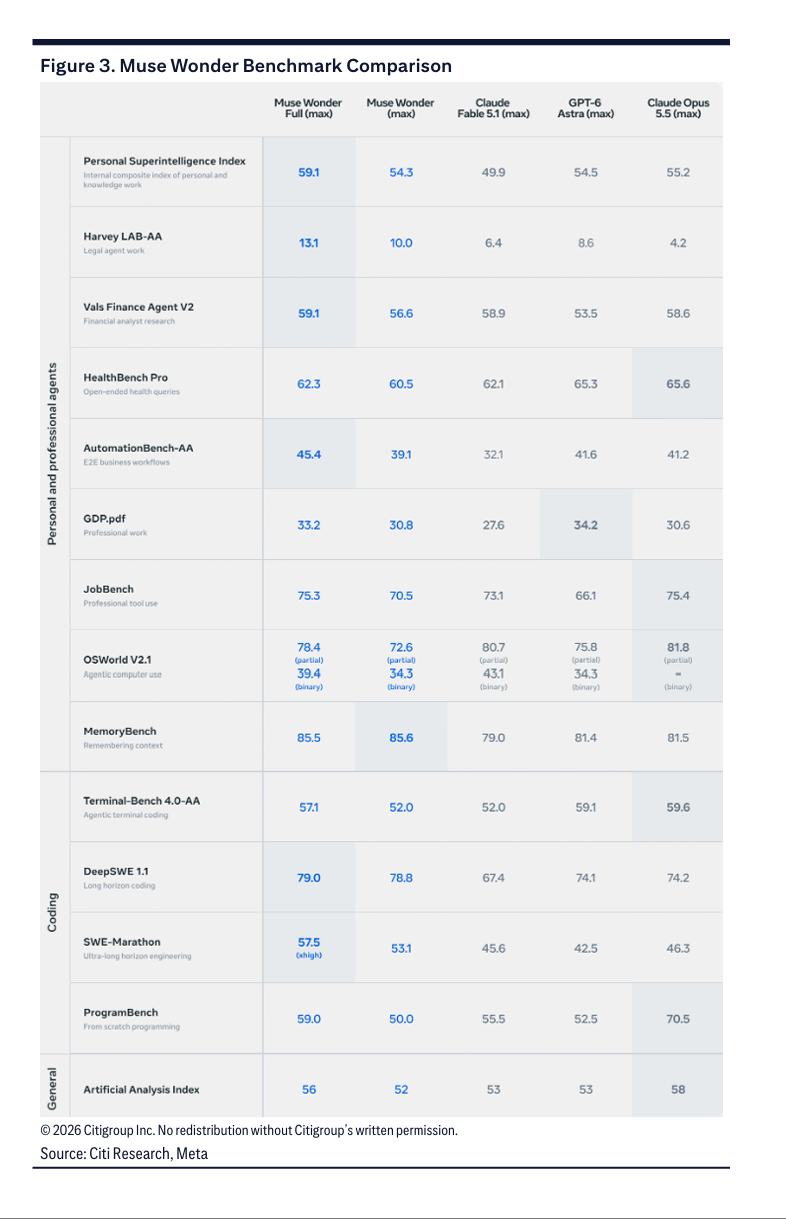
Meta's latest Muse Wonder series is a large-scale underlying AI model that drives cutting-edge AI agents. It focuses on “deep memory of background, continuous execution, and completion of delivery”. Active Memory retrieves relevant information across dialogs. Active Focus supports blocking solutions, error correction and follow-up, focusing on long-term coding and financial, legal, and health tasks. Compared to Anthropic and OpenAI flagship products, its differentiated competitiveness focuses on contextual continuity and execution reliability for long tasks, with the goal of reducing repeated user explanations and manual takeover. Wonder is connected to the Meta Model API and Muse Code, and Full is available to Muse Code subscribers; upgrades to the Muse app will be rolled out first to subscribers.
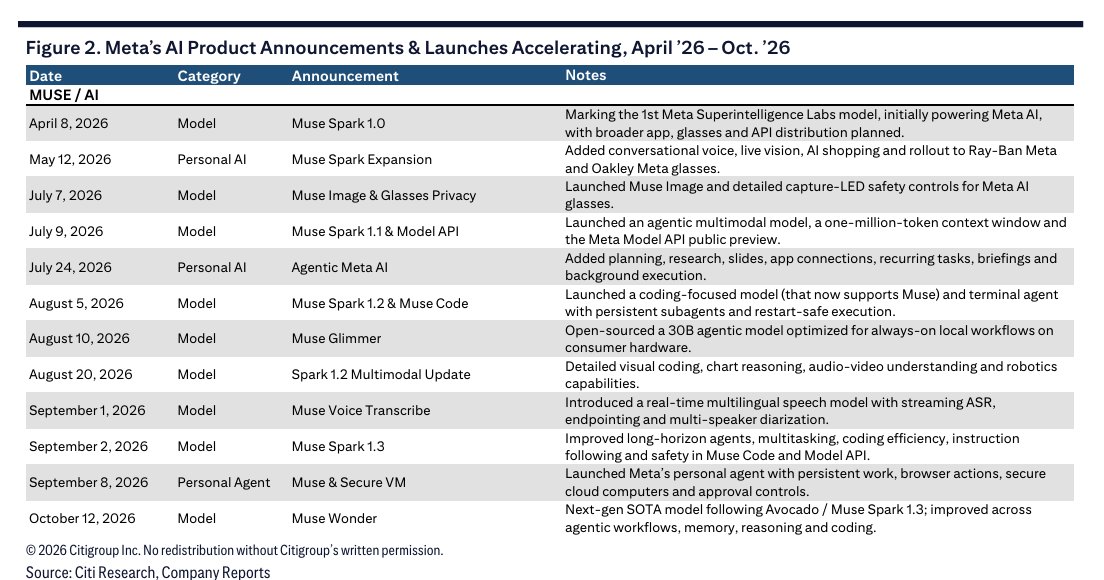
On Monday 12th EST, Meta officially released the Muse Wonder series models, including Muse Wonder for fast cutting-edge performance, and the full version of Muse Wonder Full. Zuckerberg said on social media that the Muse Wonder is a type of model that is larger in scale and more advanced than the previous Muse Spark, marking Meta's move to the cutting edge of the industry in terms of AI capabilities.
Muse Code is Meta's programming agent tool for software development. It is a different product from the generic Muse Agent application. According to this release schedule, Muse Wonder Full is only open to Muse Code subscribers, and non-subscribers cannot use Full; the regular version of Wonder is already available through the Meta Model API and Muse Code. Furthermore, the Meta ecosystem platform that covers Facebook and Instagram has not officially announced that GM Muse can immediately use Wonder Full.
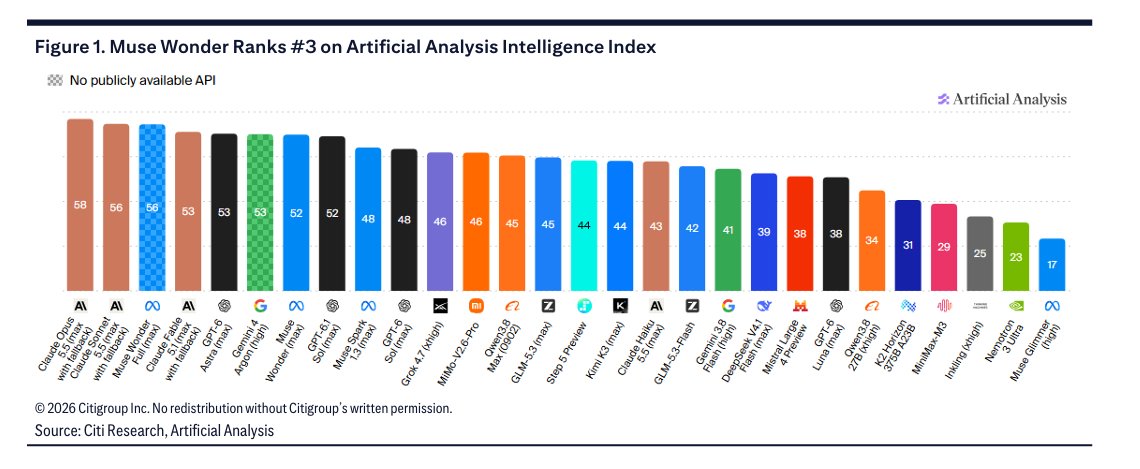
Wonder Full is ranked third in the Artificial Analysis list cited by Citi; the strengths in the research report's comparison focus on memory, law, finance, and long-term software development. This means Meta is entering professional workflow competition. The product chain sorted out in the research report continues to iterate from Spark to Muse Code, open source model Glimmer, voice vision, smart glasses, and SecureVM execution environment: the underlying capabilities, tool interface, and execution environment are gradually integrated, which is conducive to faster transformation of model progress into deliverable services.
The application data provides preliminary verification: in the 34 days of Muse's launch, the US has accumulated about 8.6 million downloads and more than 2 million daily activity. The early download speed was ahead of the launch stages of ChatGPT, Gemini, and Meta AI. The number of downloads exceeded that of individual Meta apps in the last four weeks. Citi believes that the Group's distribution advantage is only beginning to be unleashed, and is looking forward to experiences such as Muse Voice live chat and Business Calls on behalf of users. The investment means potential increases in subscriptions, APIs, and professional services; as agents take over cross-software processes, some software companies' interface entrances and per-seat fees will also be under competitive pressure.
From 1GW training to 14GW expansion: the earnings season will test how Meta's huge computing power resources turn into token cash flow
According to Citi research data, Wonder trains at the 1GW Prometheus super-large data center. Citigroup Research estimates a total computing power capacity of about 14GW in 2027, which means that the supply of computing power may double year-on-year, support the release of more intensive models and smart devices, and may also leave room for short-term computing power cooperation.
Looking at engineering mechanisms, the popularity of smart devices also increases the need for model reasoning, tool execution, and state management: accelerators and HBM undertake inference, CPU execution tools, persistent storage and retrieval support long-term memory, and network connections to all aspects. Citi emphasized that Meta's advantage depends on whether these resources can work together to improve the completion rate of tasks and reduce the cost of each successful delivery.
The core change brought about by cutting-edge AI agents such as Muse and Astra is the upgrade of a one-time question-and-answer session to a continuous task execution process. Long-term memory, continuous reasoning, and tool call enable a user requirement to expand into planning, retrieval, code execution, result verification, and iterative correction, and multi-agent collaboration may also increase parallel tasks and model calls; as more real work enters this process, computing power requirements are expected to expand simultaneously to computing, memory, storage, and communication.
In a computing power system with extensive inference workloads throughout the manufacturing process, GPUs use programmability to undertake complex training and diverse inference; for mature workloads that complete software adaptation, large call scale, and high utilization rates, ASICs such as TPU can reduce inference costs through computation, storage, and interconnection optimization. The CPU is responsible for tool operation, browser environment and task scheduling; HBM and server memory handle model weight, KV cache and operation status; SSD and database store long-term memory, knowledge data and task records; and optical interconnection and network infrastructure support model collaboration and data exchange across nodes and racks.
Therefore, the smart device frenzy catalyzes heterogeneous computing power requirements that can be fully delivered and operated continuously: chip performance must be matched with memory bandwidth, storage response, network latency, and power cooling to be transformed into more successfully completed tasks. When the scope of use of proxy agent workflows and the number of tasks in the AI inference era expands far beyond the increase in single-task computing efficiency, AI demand is expected to expand further from purchasing a single accelerator to investment in a complete data center. This is also the key point where the Muse smart product cycle can provide industrial logic support for AI FOMO transactions.
Before the smart device business became a firm second growth curve, in Citi's view, Meta's profit base was still advertising. Citi expects 2026-2028 revenue of US$2542, 3101, and US$371.6 billion, respectively, and GAAP earnings per share of US$28.11, 36.92, and 46.17 US dollars. In 2027, the total advertising revenue was about US$296.8 billion, accounting for about 95% of total revenue; the number of daily active users in the app family is expected to increase by only 2.8%, but per capita income according to the daily activity level will increase by 18%, showing the importance of Reels and advertising monetization efficiency. The app family's other revenue is expected to increase from $4.4 billion in 2026 to $19.5 billion in 2028, but not all of it can be classified as Muse revenue. The financial model prepared by Citigroup also expects GAAP operating profit margin to rise from 30.7% to 38.1%, and Reality Labs' losses gradually narrow, reflecting operating leverage for revenue growth exceeding cost growth.
Citi's target price of $800 corresponds to about 22 times the 2027 GAAP earnings per share and 11 times EV/EBITDA, which is equivalent to about 20 times the current price; at the same time, depreciation and amortization is expected to rise from US$29.8 billion to US$59.8 billion from 2026 to 2028, and the popularity of Muse may also increase reasoning costs. Meta will release its earnings report after the market on October 21. Citi expects revenue of US$63.6 billion for the third quarter, an increase of 24.2%. Citi emphasized that Meta's stock price will further open up space, and require joint implementation of advertising growth, smart payments, and cost control, as well as the uncertainty of competition, privacy regulation, and return on non-advertising investments.