
Gulf crude oil has returned, and diesel is still in short supply! Goldman Sachs reveals why the “war premium” is not going back, and global assets continue to face the test of inflation
The Zhitong Finance App learned that Gulf oil exports are close to normal, yet the crude oil spot price benchmark is still paying the “war price”. Wall Street financial giant Goldman Sachs's latest estimates show that exports have recovered to 22-23 million barrels per day, but demand for inventory replenishment, shortages of refined oil products, and the risk of further supply disruptions have supported the recent rapid approach to the $120 spot price. Meanwhile, long-term US bond yields have risen to a 20-year high, and energy shocks are being transmitted to global financing costs.
Spot Brent (Spot Brent Crude Oil), write “Spot Brent Crude Oil Spot Assessment Price” when it comes to specific prices. It was published by Platts (Platts), a subsidiary of S&P Global, based on an evaluation of the price and transaction situation in the physical crude oil market; “Precisely” emphasizes that the delivery date of these crude oil shipments has been determined, reflecting the price of recent physical supply delivery, which is different from common Brent crude oil futures quotes on news pages.
At around noon on October 12, Beijing time, Brent and WTI futures were reported at 103.18 and 90.31 US dollars respectively. They were significantly lower than the trading prices in the early Asian session. The declines were about 1.47% and 1.68%, respectively. The “Russian-Ukrainian energy cease-fire” initiative emphasized by Trump on social media came into effect and Russia's diesel supply promise improved expectations, but Ukraine is still awaiting details of the energy cease-fire and Russia has yet to officially confirm the “energy cease-fire”; recent major arms attacks at Saudi airports and oil tankers in the Gulf indicate that the Middle East has not fully cooled down.
Goldman Sachs recently raised its December Brent forecast from 85 to $90. Based on the calculation of 72.48 US dollars and 67.02 US dollars on February 27 before the war broke out, the two major benchmark oil prices increased cumulatively by about 45.5% and 37.9%, respectively. The pricing trajectory and reaction of the crude oil market that opened on Monday shows that some cease-fire news that came out over the weekend has yet to drastically allay market concerns about supply disruptions.
From oil barrels to long-term debt: rising inflation is drastically raising the financing threshold
On October 7, US 10-year and 30-year Treasury yields hit 5.368% and 5.735% respectively, both high levels since 2002; official daily data fell back to 5.24% and 5.60% on the 9th. The 30-year yield in the UK surged to 6.05% on October 8, a record high since 1998.
Looking at the pricing mechanism, shortages of a range of refined oil products, such as crude oil and diesel, and aviation coal have drastically increased transportation costs and increased inflationary stickiness in the short term; financial financing demand and policy uncertainty have raised term premiums, and AI financing demand and bond hedging markets have been further pressurized. Therefore, expectations of short-term interest rate hikes are cooling down, which does not mean that long-term capital costs will fall at the same time.
The heavy pricing of US bonds is also transmitted to Europe and Japan through global asset allocation. At the investment level, the restoration of the supply of a range of refined oil products such as crude oil and diesel is insufficient to relieve the cost pressure of air transportation; for technology stocks linked to high valuation AI, continued high interest rates/high US bond yields simultaneously lower the present value of forward cash flow and raise the threshold for expansion financing.
The reason why long-term yields are difficult to fall quickly with just one cease-fire declaration is because their pricing includes both future short-term interest rate paths and the term premium required to hold long-term bonds. Higher energy prices increase the risk that inflation will continue to be high and limit the central bank's room for relaxation; fiscal financing needs and policy uncertainty will increase the compensation required by investors to bear long-term risks. The 10-year term premium estimated by the New York Federal Reserve model recently rose to about 96 basis points, a 12-year high; on October 9, the actual yields on 10-year and 30-year inflation-protected treasury bonds were 2.91% and 3.32%, respectively, indicating that financing pressure is also reflected in higher actual capital costs.
The AI investment boom is also increasing this pressure through the financing market: after some institutions buy long-term bonds from tech giants, they will sell US bond futures to hedge for a long period of time, or sell US bonds to free up investment credits; rising interest rates will extend the expected life of mortgage securities, which will also trigger additional interest rates to offset the market. The combination of corporate financing and hedging transactions may reinforce the sell-off of bonds. Therefore, even if expectations of interest rate hikes cool down in the near future, long-term bonds may still be under pressure from supply and risk compensation.
This pressure is also being transmitted overseas. The yield on British 30-year treasury bonds hit 6.05% on October 8, the highest since the beginning of 1998; in addition to rising global interest rates, France was also affected by deficits falling short of expectations, debt burdens, and political uncertainty. The yield premium on French 10-year treasury bonds compared to Italy rose to 30 basis points, setting a record since the establishment of the euro. It also reveals an important change — shared energy shocks and rising capital costs are amplifying countries' different fiscal vulnerabilities.
Needless to say, a credible and ongoing energy cease-fire between the warring parties is expected to simultaneously improve the cost and demand environment for aviation, transportation, and some consumer companies, and ease the heavy pressure of US inflation and continued discounting on growth stocks; however, falling oil prices can only lift some of the restrictions, and fiscal risks and long-term financing needs will not disappear with it.
Oil is back, and fears haven't subsided: Gulf exports are back to normal, and spot buyers are still paying war prices
Goldman Sachs predicts that in the past two weeks, Persian Gulf oil exports, including hidden exports, have recovered to 22-23 million barrels per day, close to the 2025 average; however, the war risk premium is still significant, and the spot price of spot Brent crude oil remains high.
The core contradiction in the oil market is that while exports have recovered, spot prices are still high. The recovery in crude oil flow is conducive to a gradual decline in the benchmark price, but the continued strong premium in the spot price of spot Brent crude oil shows that buyers are still snapping up spot crude oil at high prices to replenish depleted inventory, causing the front end of the curve to maintain a clear rise in recent months. Refined oil products are still the most scarce. Even with the normalization of crude oil supply, diesel and aviation coal refining profits are still supported. The Houthis claimed to have attacked Saudi Aramco facilities over the weekend, posing an immediate test: Saudi Arabia has been leading the resumption of exports, and any confirmed supply interruption could increase the spot premium again.
Concealed exports refer to goods transported by the tanker after turning off the satellite positioning transponder, making it difficult to track. Goldman Sachs estimated this type of traffic to be around 5 million barrels per day in September, which is an important reason why its estimates are higher than other agencies. Another Wall Street financial giant, J.P. Morgan Chase, uses a more conservative approach, estimating that recent oil exports from the Gulf countries are about 89% of 2025; most of the difference depends on how much hidden fleet traffic is included.
The restoration of energy supply to overseas countries mainly comes from crude oil rather than refined oil products. Goldman Sachs's research report in late September said that crude oil exports have surpassed the 2025 average: Saudi exports more than doubled in that month, close to 12 million barrels per day, and the UAE is also above normal. Satellite data did not show Iran's seaborne crude oil exports. Refined oil products are clearly lagging behind, and exports of diesel, gasoline, and aviation coal are only half of normal levels. Goldman Sachs attributed more shutdowns at regional refineries and higher risk for smaller product tankers carrying more flammable goods.
Spot prices and traffic data present a different picture. Projected Brent (spot Brent crude oil), which reflects the price of North Sea crude oil shipped on a specified date, has recently been close to $120 per barrel, which is significantly higher than futures. Goldman Sachs believes that this gap is due to concerns that the escalation of the conflict will damage long-term production capacity, and that global oil inventories fell to a record low after excluding the commercial inventory of the OECD, which prompted buyers to replenish their stocks faster. The bank estimates that the average risk premium in the Brent spread in September was $22 per barrel, the second-highest monthly level in history, exceeding the peak during the 2022 Russian-Ukrainian war.
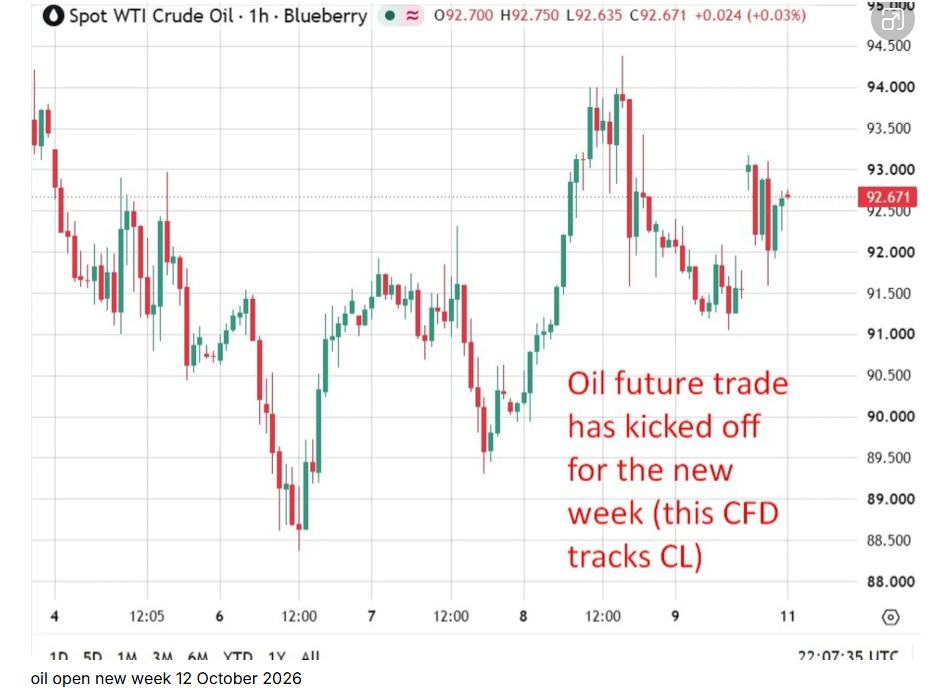
Goldman Sachs has raised the December Brent forecast from 85 to 90 dollars, but lowered the benchmark forecast to 80 dollars for 2027, while warning that a further escalation of the conflict may drive oil prices up sharply. The Houthis claimed to have attacked Saudi Aramco facilities over the weekend, pointing the risk directly to Saudi crude oil leading to a recovery in supply.
Significant Brent refers to the spot price of real crude oil from North Sea that has been shipped on a specified date. It is different from recent month futures contracts. At the beginning of April, its premium over futures was over $25 per barrel; usually this difference is very small.