
Global bond market sell-off “raise interest rates for central banks”: yields soared 4% to the highest level since 2000, and expectations for interest rate hikes in the eight major economies plummeted by nearly 200 basis points
The Zhitong Finance App learned that the global bond market is driving up financing costs on its own and undertaking some austerity tasks for major central banks. This may reduce the number of benchmark interest rate increases required by central banks to suppress inflation.
After weeks of sell-off, bond yields have soared to multi-year highs, and the financial environment has tightened significantly even if policymakers don't take further action. According to compiled data, traders lowered their expectations for interest rate hikes; since mid-September, interest rate hikes set in interest rate swap contracts in the eight major economies have fallen by a cumulative total of nearly 200 basis points.
Currently, there are few signs that the wave of bond sell-offs is fading. From the US and Japan to France, the market is concerned about financial expenses in various countries, prompting investors to demand higher risk compensation; at the same time, the issuance of large numbers of artificial intelligence (AI) related bonds also continues to absorb market capital.
The rise in borrowing costs is spreading to mortgages and junk credit, thereby causing a certain economic deterrent effect — an effect that the central bank is hoping to achieve by raising policy interest rates.
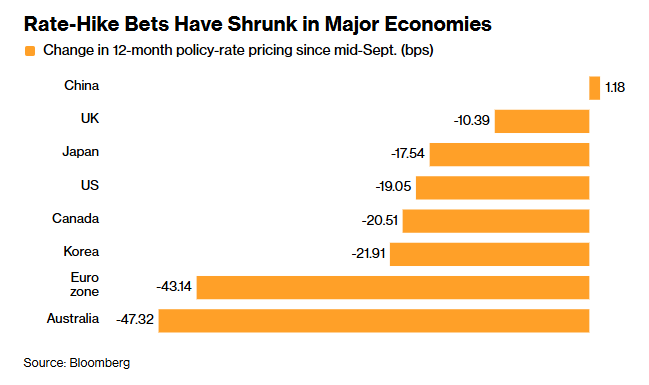
“The higher the degree of tighter market pricing, the tighter the financial environment,” T., who manages $1.9 trillion in assets. Ken Orchard, head of international fixed income at Rowe Price, said, “And the tighter the financial environment, the less austerity policies the central bank may need — or can — implement in the end.”
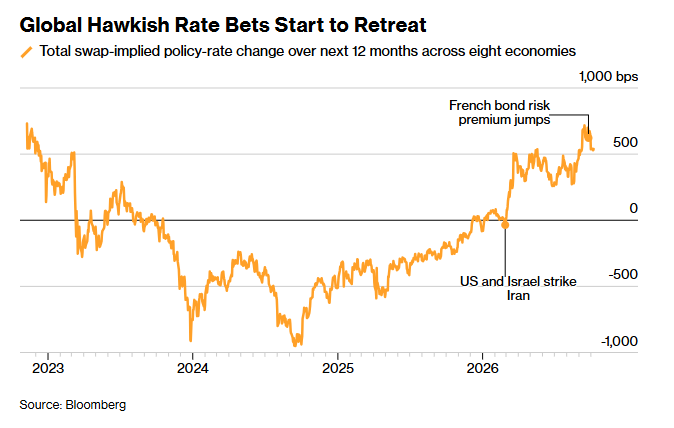
According to compiled data, traders are currently pricing a total rate hike of 539 basis points for the eight major economies, down from 717 basis points in September. At that time, the market's interest rate hike expectations were the highest since 2022. The biggest decline was in Australia, followed by the Eurozone, which was affected by concerns about France's fiscal outlook, followed by South Korea and Canada.
The average yield on global government bonds has risen above 4% to the highest level since 2000, raising questions about where exactly the tipping point is. While rising yields can certainly share the central bank's anti-inflation efforts, if the central bank appears to be too focused on underpinning growth, investors may question its determination to fight inflation, and in turn demand higher premiums for holding long-term bonds.
“The central bank must ultimately balance its growth mission with the risk of short-term inflation,” said Yuxuan Tang, head of Asian interest rate and foreign exchange strategy at J.P. Morgan Chase Private Bank. “We believe most interest rate markets currently overestimate the risk of further rate hikes given the increasing downside risks of growth due to the impact of geographical conflicts.”
For investors, this may make bonds look attractive again. Tang said that high-quality fixed income is worth buying because it is still one of the best hedging tools against inflation and slowing growth, adding that the sharp rise in yield over the past month has significantly improved the risk-reward ratio.
Deutsche Bank currently sees an opportunity in US Treasury bonds. “Our view is that, at least from an energy perspective, the current situation will not last forever,” said Christian Nolting, the bank's chief investment officer at Global Private Bank in Frankfurt. “The energy situation will improve and inflation will fall back. From that perspective, I don't think we're in the middle of a full cycle of rate hikes.”
Barclays strategists said that the market has shared some of the austerity pressure on the Federal Reserve. “This round of partial austerity is already taking place independently of the Fed's expectations of additional rate hikes,” they wrote. “With other conditions unchanged, this should reduce the urgency of the Fed's interest rate hike, even if the risk management framework still favors further tightening.”
However, not everyone agreed with this judgment. Some believe that the market is still underestimating the risk of interest rate hikes, and that the geopolitical conflict has prolonged inflationary pressure by pushing up oil prices. Oil prices remain above $100 per barrel, and traders are weighing Iran's escalating attacks on oil tankers in the Strait of Hormuz with US President Trump's statement that the US “will not attack” Tehran before the November midterm elections.
Macro strategist Michael Ball said, “Actual economic activity better absorbed repeated uncertainties and a tighter financial environment than expected, and strengthened the view that equilibrium policy interest rates were higher than previously anticipated.”
Kenneth Goh, director of private wealth management at Dahua Jixian in Singapore, said that even if damage to growth becomes more difficult to ignore and the central bank chooses to suspend interest rate hikes, fiscal concerns may still limit the room for long-term returns to decline.
US Treasury Secretary Scott Bessent tried to appease skeptical investors, saying that stronger growth and spending constraints would “very quickly” improve the trend of US debt. In Japan, Prime Minister Sanae Takaichi said that if bond yields fluctuate abnormally, his government is prepared to re-examine expenditure and revenue plans.
Since the second half of the year, US 10-year Treasury yields have jumped more than 70 basis points, Japan's yield has risen 31 basis points over the same period, and Germany and France have climbed 61 and 121 basis points, respectively.
Currently, policymakers are signaling that they are ready to act. Federal Reserve officials voted unanimously to raise interest rates last month, for the first time since July 2023. Although some officials advocated maintaining policy flexibility, they suggested they might not act again this month. The Bank of India has turned hawkish, restarted interest rate hikes after a lapse of nearly four years, and hinted that it will further tighten its policy.
This context will be overshadowed by the International Monetary Fund's annual meeting to be held in Bangkok on Monday. Global policymakers will focus on growth, inflation, interest rates, and government debt. The US will release the September CPI data on Wednesday, and the market will also closely search for clues about the Fed's interest rate path.