
How Investors May Respond To Halliburton (HAL) Sea Lion Project Exit
- Halliburton reported that it had engaged with the Argentine Federal Authority and confirmed that it will not perform work on the Malvinas Islands Sea Lion project or conduct hydrocarbon activities in or around the area.
- This clarification removes a potential source of legal and regulatory friction in Argentina. This could help Halliburton focus resources on projects with clearer operating and contracting frameworks.
- We will look at how Halliburton's investment narrative is influenced by this Argentina compliance update on Malvinas related hydrocarbon activity.
Scan beyond Halliburton's Argentina update and compare its risk profile with a curated group of resilient companies in our 31 resilient stocks with low risk scores.
Halliburton Investment Narrative Recap
To own Halliburton, you need to be comfortable with a business that leans heavily on multi year upstream spending, international contracts and the rollout of higher margin technology and digital services. The Argentina update on Malvinas looks more like housekeeping than a shift in direction. It clarifies where Halliburton will not work rather than where it is leaning in.
The key short term swing factor remains how quickly international awards in places like Latin America and the Middle East translate into steadier utilization and margins. The biggest risk still sits at the structural level. Faster decarbonization, tighter emissions rules or sustained capital rotation toward renewables could cap long term demand for Halliburton services.
This Argentina disclosure links most directly to Halliburton activity in Latin America, where projects such as Vaca Muerta with YPF are already important to the long term contract book. By confirming there is no involvement in Malvinas related hydrocarbons, the company keeps focus on jurisdictions where the operating and regulatory path is clearer.
For catalysts, the more relevant angle is execution on those existing integrated contracts and technology heavy awards. The cleaner Argentina stance reduces the chance of legal or certification disputes distracting management or customers. That can matter if you are tracking how effectively Halliburton converts its backlog and digital offerings into higher quality earnings and cash flow.
Halliburton earnings and revenue setup to 2029
For Halliburton, the analyst story is built around modest top line expansion and a stronger focus on profitability. Consensus numbers point to revenue rising at 3.9% a year over the next few years, while net income is projected to increase from US$1.6b today to US$2.7b by 2029. That implies roughly a 1.7x increase in earnings power over this timeframe, with a forecast profit margin shift from 7.2% to 10.7% contributing more than sales growth alone.
Halliburton's narrative centers on US$25.1b in revenue and US$2.7b in earnings by 2029. This is based on 3.9% yearly revenue growth and roughly a 1.7x increase in earnings from US$1.6b today.
The earnings forecast also sits alongside expectations for a small reduction in the share count, with analysts modeling a 1.01% annual decline in shares outstanding over the next three years. Less equity in issue can support earnings per share if profit delivery tracks the US$2.7b target. However, the absolute cash generation still needs to justify the capital returns story. Analysts point to earnings per share of US$3.34 by 2029 on these assumptions. This would only be relevant for you if you think the margin and contract execution thesis can be maintained throughout that period.
Uncover why Halliburton's fair value indicates a 33% potential upside to its current price, a gap that could narrow quickly if investor sentiment improves.
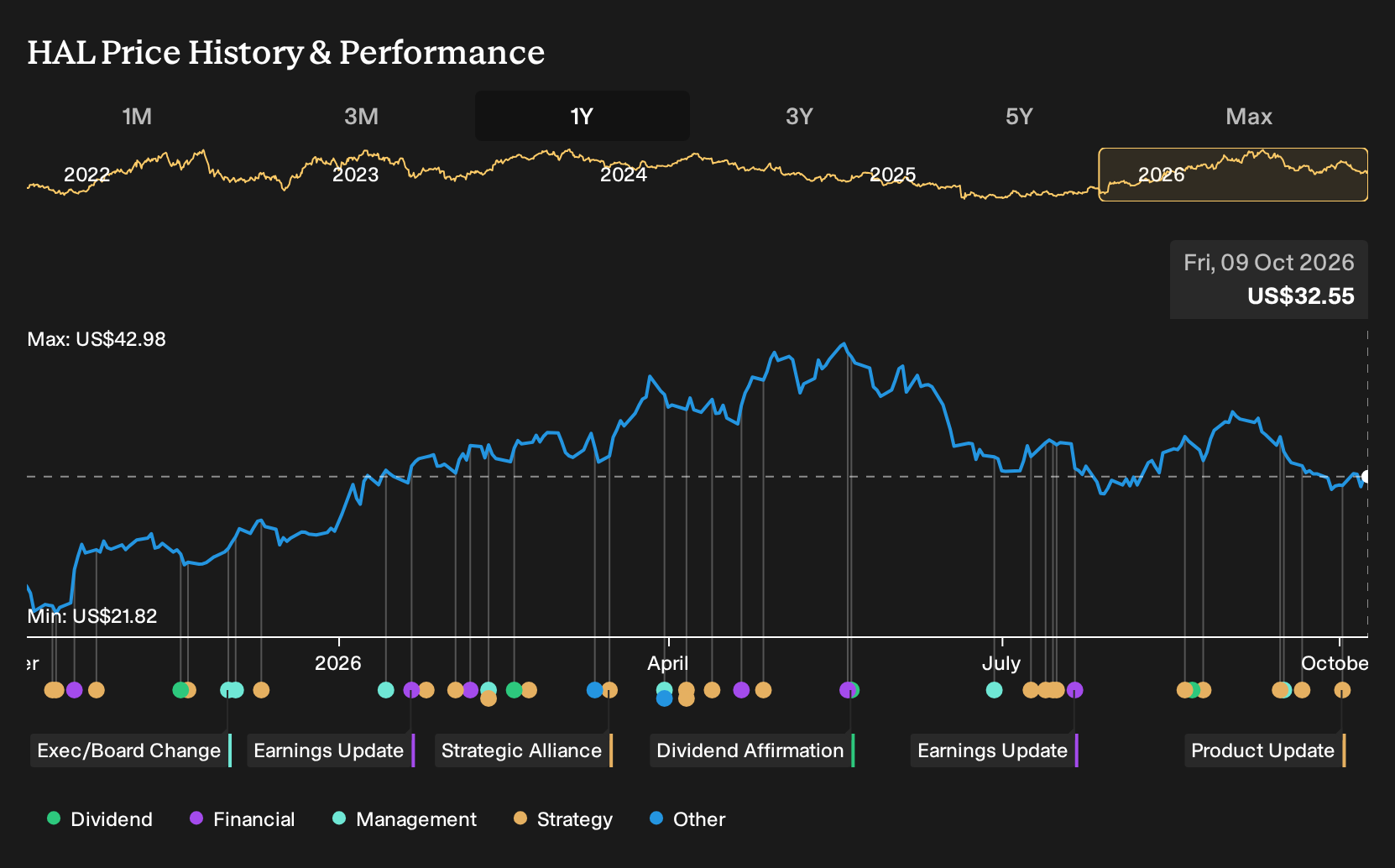
Exploring Other Perspectives
Some of the lowest Halliburton forecasts lean heavily on Middle East conflict risk, which is a different concern to the Argentina compliance story you just read about. These bearish analysts were only penciling in about 1.2% annual revenue growth to US$23.2b and US$2.8b in earnings by 2029, before this news. Their view could shift meaningfully once this update is fully absorbed.
Explore 4 other Halliburton fair value estimates, including one that suggests it could be worth just $34.03.
Reach Your Own Conclusion
Disagree with existing narratives? Extraordinary investment returns rarely come from following the herd, so go with your instincts.
- A great starting point for your Halliburton research is our analysis highlighting 4 key rewards and 2 important warning signs that could impact your investment decision.
- See our latest analysis for Halliburton. The report includes a comprehensive fundamental analysis summarized in a single visual, the Snowflake, making it easy to evaluate Halliburton's overall financial health at a glance.
Looking for more Halliburton sized investment ideas?
If this Halliburton story has you rethinking where risk and reward line up best in your portfolio, it can help to line it up against a wider field of opportunities using the Simply Wall St screener.
- If you want income that feels more predictable, start by reviewing 8 dividend fortresses that may suit a portfolio built around regular cash payouts.
- For investors focused on balance sheet resilience and fundamental strength, scan the list of solid balance sheet and fundamentals (25 results) to see which businesses match your risk tolerance.
- If you are hunting for opportunities that receive less attention from the market, look through 20 high quality undiscovered gems that combine quality metrics with lower profile coverage.
This article by Simply Wall St is general in nature. We provide commentary based on historical data and analyst forecasts only using an unbiased methodology and our articles are not intended to be financial advice. It does not constitute a recommendation to buy or sell any stock, and does not take account of your objectives, or your financial situation. We aim to bring you long-term focused analysis driven by fundamental data. Note that our analysis may not factor in the latest price-sensitive company announcements or qualitative material. Simply Wall St has no position in any stocks mentioned.
Have feedback on this article? Concerned about the content? Get in touch with us directly. Alternatively, email editorial-team@simplywallst.com