
How Buybacks Will Impact Columbia Banking System Stock Investors
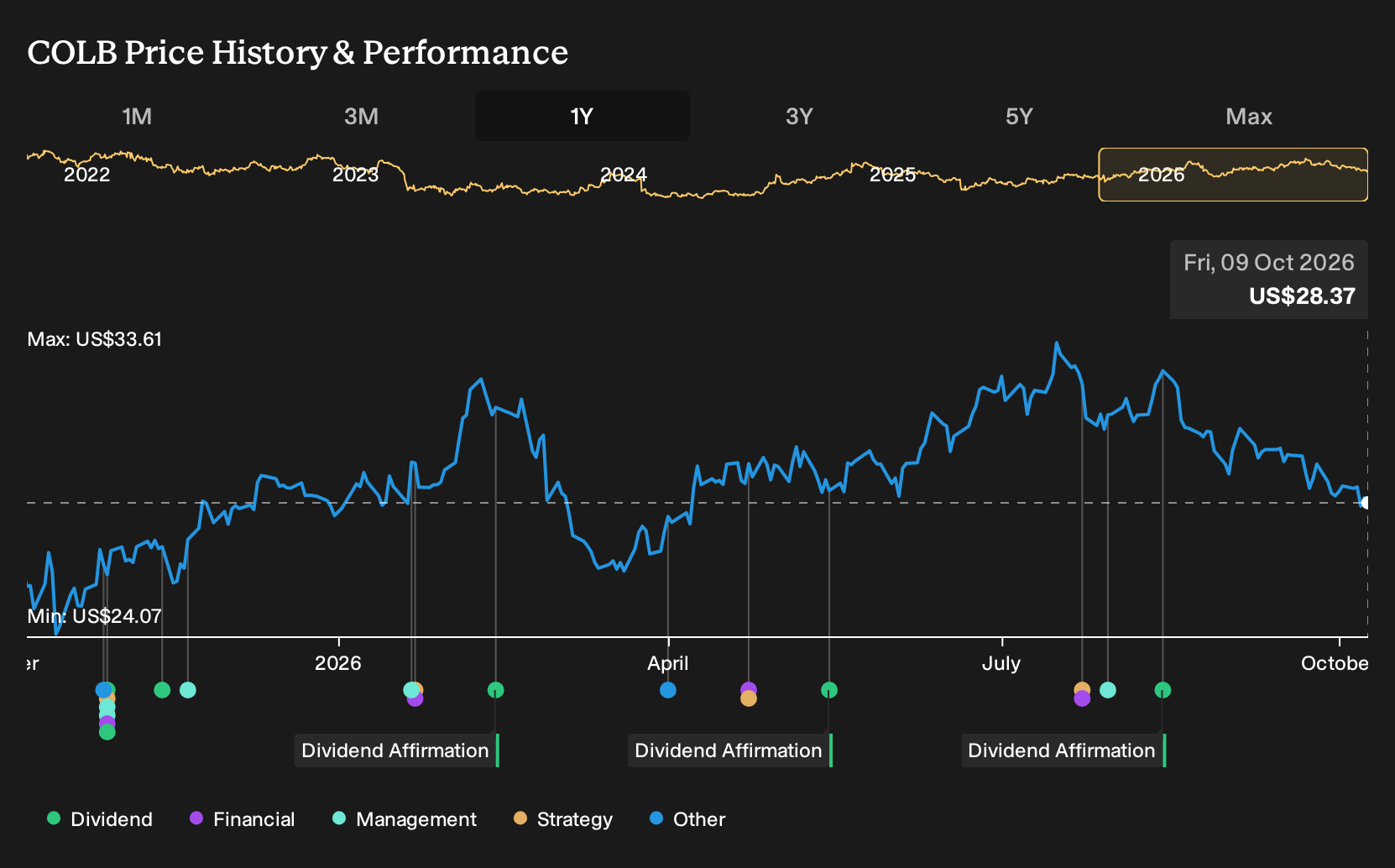
- Columbia Banking System has moved ahead with an extensive capital return and balance sheet reshaping plan, including a US$700m share repurchase authorization, a US$0.37 quarterly dividend, and the redemption of trust preferred securities using fixed to fixed subordinated notes.
- The emphasis on running off lower yielding transactional loans while leaning on low cost core deposits and relationship lending places execution risk and capital stack optimization, rather than headline growth, at the center of Columbia Banking System's near term story.
- This review examines how Columbia Banking System's investment narrative is shaped by its US$700m share repurchase and broader capital optimization.
Scan how Columbia Banking System's capital return story compares with other banks running similar playbooks by reviewing the hand picked list of solid balance sheet and fundamentals (25 results) in one place.
Columbia Banking System Investment Narrative Recap
To own Columbia Banking System, you need to be comfortable with a bank that is actively reshaping itself rather than chasing headline loan growth. The thesis leans on remixing roughly US$7b of lower yielding transactional loans toward relationship lending, keeping funding anchored in low cost core deposits, and using that base to support earnings quality. The recent capital return plans do not change that core idea. They simply make execution around funding costs, credit quality and loan mix even more important in the near term.
The biggest near term swing factor is whether Columbia Banking System can run off and reprice that transactional loan book while keeping credit losses and operating expenses in check. Western U.S. concentration in markets such as Colorado Springs, Draper and Las Vegas leaves the franchise exposed if those local economies soften. A stumble on either regional conditions or the balance sheet remix could quickly turn what looks like an efficiency and returns story into a spread and credit problem.
The US$700m share repurchase authorization is the announcement that most directly ties into this capital return narrative. That plan, alongside the US$0.37 quarterly dividend and subordinated notes that redeem trust preferred securities, effectively hard wires a multi year capital deployment path into Columbia Banking System's story. For you as a shareholder, the question is less about the headline size and more about whether core earnings and regulatory ratios comfortably support it.
If handled well, this buyback could gradually reshape per share metrics and reinforce the Excess Returns view that Columbia Banking System is earning more than its cost of equity. If handled poorly, it could leave the bank with less flexibility if Western markets weaken or if transactional loan runoff does not translate into healthier spreads and fee income. The capital plan magnifies both the upside from clean execution and the downside if operational or regional risks start to bite.
Columbia Banking System's current analyst blueprint points to revenues of US$3.0b and earnings of US$948.5m by 2029, based on 6.0% yearly revenue growth and an earnings increase of about US$239.5m from US$709.0m today.
Uncover why Columbia Banking System's fair value indicates a 19% potential upside to its current price, which could narrow quickly.
Exploring Other Perspectives
Five fair value estimates from the Simply Wall St Community cluster between about US$33.43 and US$50.30 per share, so you are looking at a fairly tight but meaningful spread in how Columbia Banking System is priced. Those views sit beside risks around Western U.S. concentration and integration costs, as well as catalysts linked to loan remixing, branch expansion and AI driven efficiency. Investor opinions can widely differ, so it is worth exploring several of these alternative viewpoints before deciding how Columbia Banking System fits into your own portfolio plan.
Explore 4 other Columbia Banking System fair value estimates, including one that suggests as much as 77% upside from the current price.
Form Your Own Verdict
Disagree with existing narratives? Extraordinary investment returns rarely come from following the herd, so consider trusting your own analysis.
- A great starting point for your Columbia Banking System research is our analysis highlighting 4 key rewards that could impact your investment decision.
- See our latest analysis for Columbia Banking System. The report includes a comprehensive fundamental analysis summarized in a single visual, the Snowflake, making it easy to evaluate Columbia Banking System's overall financial health at a glance.
Looking For More Investment Ideas Beyond Columbia Banking System?
Once you have formed a view on Columbia Banking System, it can help to line it up against other opportunities that fit different roles in your portfolio. The Simply Wall St Screener lets you do that quickly by filtering for specific qualities that match your goals, whether you care most about value, resilience or future potential.
- If you want potential mispricing on your side, compare Columbia Banking System with a curated 28 high quality undervalued stocks that already clear a quality and fundamentals bar.
- For investors who care about stability and sleep at night, weigh Columbia Banking System against a 31 resilient stocks with low risk scores that score well on financial strength.
- If you prefer to hunt where fewer people are looking, set Columbia Banking System alongside a 20 high quality undiscovered gems that pair solid fundamentals with lower market attention.
This article by Simply Wall St is general in nature. We provide commentary based on historical data and analyst forecasts only using an unbiased methodology and our articles are not intended to be financial advice. It does not constitute a recommendation to buy or sell any stock, and does not take account of your objectives, or your financial situation. We aim to bring you long-term focused analysis driven by fundamental data. Note that our analysis may not factor in the latest price-sensitive company announcements or qualitative material. Simply Wall St has no position in any stocks mentioned.
Have feedback on this article? Concerned about the content? Get in touch with us directly. Alternatively, email editorial-team@simplywallst.com