
How Investors Are Reacting To Berkshire Hathaway Stock Interest Rate Warning
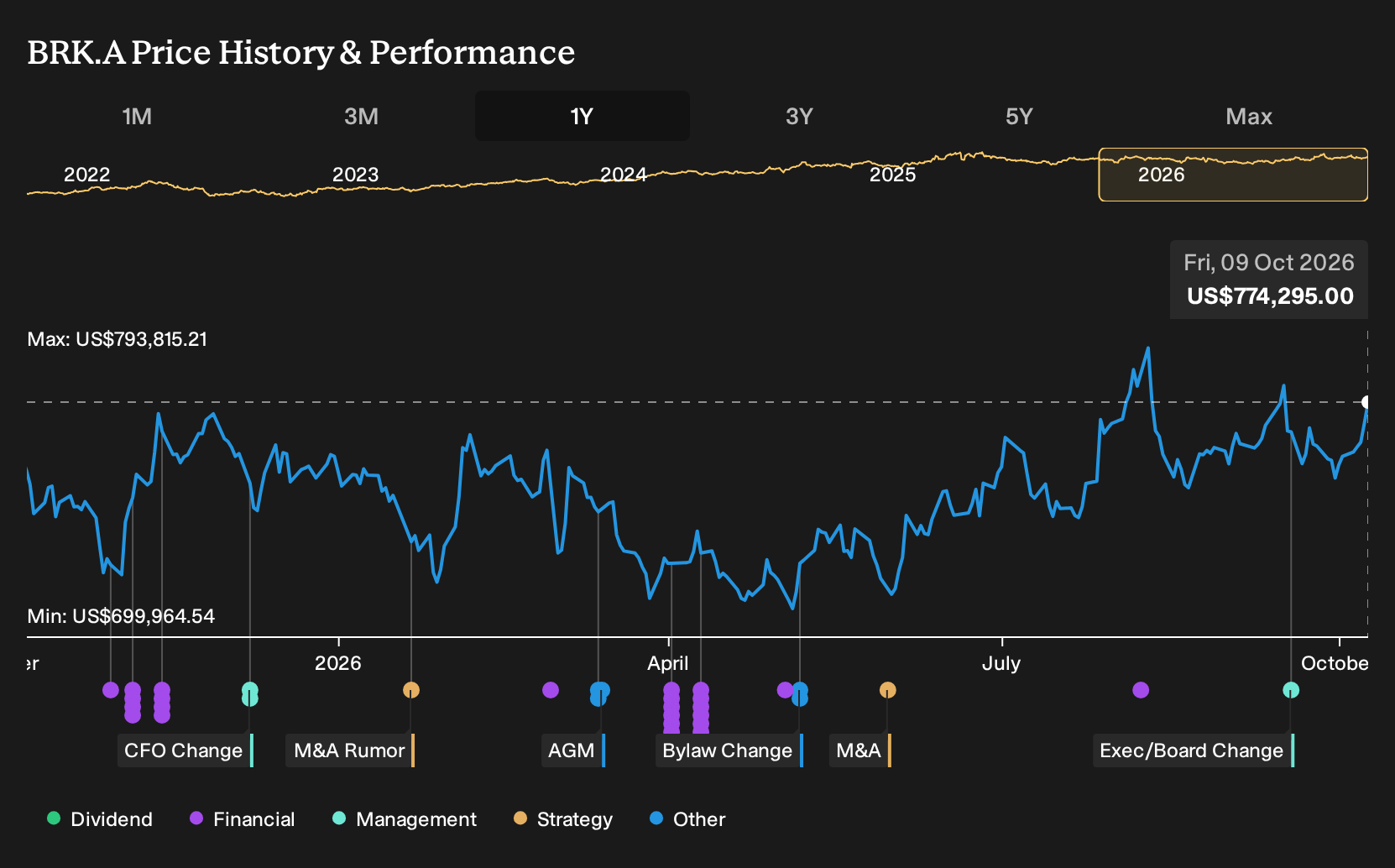
- Recent commentary from Warren Buffett has highlighted concerns about speculative trading and rising interest rates, arriving as Berkshire Hathaway adjusts its investment mix and leadership structure under Greg Abel.
- This combination of a more diversified equity approach and a sharper focus on interest rate risk management could influence how Berkshire Hathaway allocates capital across insurance, utilities, housing, and other operating units.
- We will now examine how Berkshire Hathaway's investment narrative is shaped by Buffett's interest rate warning and the leadership transition.
Berkshire Hathaway Investment Narrative Recap
To own Berkshire Hathaway, you need to be comfortable with a sprawling group that leans on insurance float, regulated utilities, rail and housing rather than rapid expansion. The investment case rests on steady operations, capital discipline and an ability to redeploy large cash flows. In the short term, the key swing factor is execution under Greg Abel as the newer management team beds in while preserving that playbook.
Recent interest rate warnings from Warren Buffett, the Texas probe into Fruit of the Loom and a shift toward index exposure do not yet alter the core operating story in a material way. The bigger watchpoints remain data center related utility projects, housing exposure and whether earnings pressure that some forecasts flag actually shows up in reported numbers.
Among the recent developments, Buffett’s renewed focus on interest rate risk ties most directly to what matters for Berkshire Hathaway now. Higher long term Treasury yields change the relative appeal of equities versus fixed income and influence the value of the investment portfolio sitting on the insurance and holding company balance sheets.
For you as a shareholder, that comment intersects with several catalysts already in motion. Insurance float can be invested in higher yielding securities, utilities and housing units still need to clear their hurdle rates, and long duration stakes in Alphabet and the Japanese trading houses carry more sensitivity to discount rates. Execution by Abel on capital allocation in this rate backdrop is the key operational test.
What The Current Forecasts Assume For Berkshire Hathaway
Berkshire Hathaway's narrative projects US$448.5b revenue and US$53.1b earnings by 2029. This is based on 5.3% yearly revenue growth and an earnings decline of US$32.7b from US$85.8b today.
Uncover how Berkshire Hathaway's fair value indicates a 3% potential upside to its current price that could narrow quickly as other investors reassess Berkshire Hathaway.
Exploring Other Perspectives
Five fair value estimates from the Simply Wall St Community span roughly US$799,503 to US$1,181,872 for Berkshire Hathaway, a wide band for one ticker. That spread reflects how differently private investors treat leadership transition, data center pushback and housing exposure. Use those gaps as a prompt to test several contrasting viewpoints yourself.
Explore 4 other Berkshire Hathaway fair value estimates, including one that suggests as much as 53% upside from the current price.
Form Your Own Verdict
Don't just follow the ticker. Dig into the data and build a conviction that's truly your own.
- A great starting point for your Berkshire Hathaway research is our analysis highlighting 3 key rewards and 1 important warning sign that could impact your investment decision.
- See our latest analysis for Berkshire Hathaway. The report includes a comprehensive fundamental analysis summarized in a single visual, the Snowflake, making it easy to evaluate Berkshire Hathaway's overall financial health at a glance.
Looking For More Investment Ideas Beyond Berkshire Hathaway?
Once you have formed a view on Berkshire Hathaway, it can help to compare that thesis with other companies that share similar qualities around balance sheet strength, income potential or return potential. The Simply Wall St Screener is a quick way to surface candidates that fit those themes while still matching your own risk tolerance.
- If capital preservation ranks high on your checklist, start with a group of companies that screen well on resilience by reviewing 31 resilient stocks with low risk scores.
- For income focused investors who want yield supported by underlying cash flows, scan through 8 dividend fortresses that aim to pair payouts with durability.
- When you want quality businesses that are not widely followed, use the Screener to surface 20 high quality undiscovered gems that combine solid fundamentals with lower market attention.
This article by Simply Wall St is general in nature. We provide commentary based on historical data and analyst forecasts only using an unbiased methodology and our articles are not intended to be financial advice. It does not constitute a recommendation to buy or sell any stock, and does not take account of your objectives, or your financial situation. We aim to bring you long-term focused analysis driven by fundamental data. Note that our analysis may not factor in the latest price-sensitive company announcements or qualitative material. Simply Wall St has no position in any stocks mentioned.
Have feedback on this article? Concerned about the content? Get in touch with us directly. Alternatively, email editorial-team@simplywallst.com