
What Japan Metropolitan Fund Investment (TSE:8953)'s Shin Yokohama Office Purchase Means For Shareholders
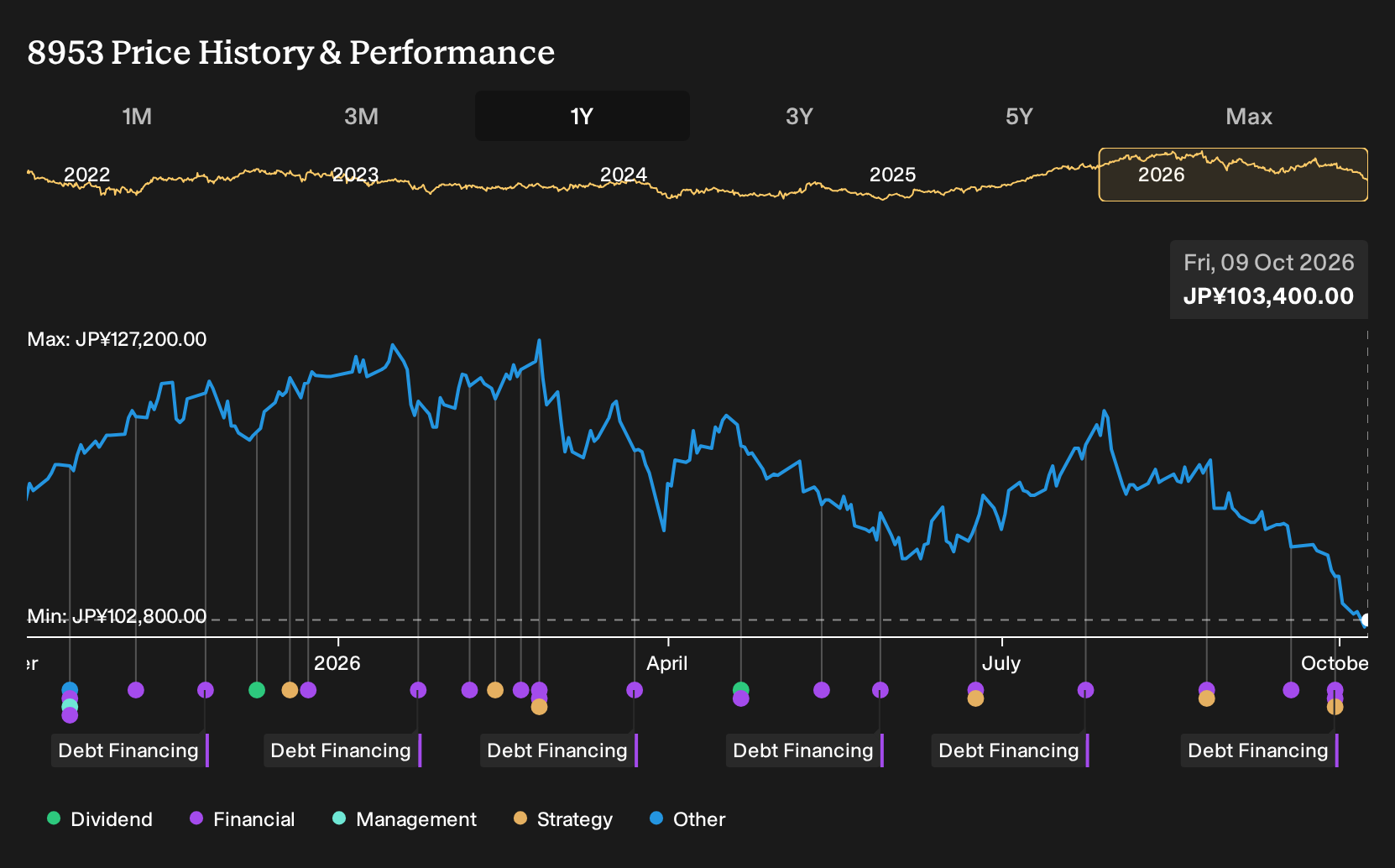
- Japan Metropolitan Fund Investment Corporation has arranged ¥9.6b of new unsecured long term loans to fund the ¥9.2b acquisition of the fully leased JMF Building Shin Yokohama 01 office property.
- The move ties fresh borrowing directly to an income producing asset with 100% occupancy, which concentrates execution risk on lease renewals and rent revision outcomes rather than initial leasing.
- We will look at how Japan Metropolitan Fund Investment's medium term earnings narrative is shaped by this debt funded Shin Yokohama acquisition.
Compare Japan Metropolitan Fund Investment's latest debt funded office deal with other income focused REITs by scanning our hand picked 28 dividend fortresses, which is built around balance sheet strength and yield resilience.
Japan Metropolitan Fund Investment Investment Narrative Recap
To own Japan Metropolitan Fund Investment, you need to be comfortable with a story that leans on stable urban rent cash flows while analysts still see earnings drifting lower over the next few years. The Shin Yokohama deal fits that view. It adds a 100% leased office asset, so the focus sits on rent revisions and renewal terms rather than initial lease up risk.
The more immediate swing factor is how aggressively management can close rent gaps across the wider portfolio between 2026 and 2028 without losing occupancy. Rising long term borrowings to ¥645.3b does not radically change that near term earnings catalyst. The larger risk remains that operating cash flow does not fully keep pace with growing debt.
The most relevant update here is the new ¥9.6b of unsecured long term loans tied directly to JMF Building Shin Yokohama 01. All three facilities are floating rate, linked to 1 month JBA yen TIBOR plus modest spreads, and they extend out to 2031 and 2034 with lump sum principal repayment. That structure keeps near term cash demands focused on interest rather than amortization.
For investors tracking catalysts, this financing choice matters because Japan Metropolitan Fund Investment already faces scrutiny around debt coverage by operating cash flow. Longer dated unsecured borrowing can support asset rotation and rent repricing plans, yet also raises sensitivity to future funding costs. Execution on lease renegotiations and asset sales will likely be watched more closely now that total borrowings and bonds have climbed to ¥646.6b.
What The Consensus Forecasts Say About Japan Metropolitan Fund Investment
Analysts looking at Japan Metropolitan Fund Investment are effectively assuming a steady top line and gently tighter economics. Revenue is expected to stay fairly flat over the next 3 years, while profit margins are projected to move from 44.8% today to 42.2% by around 2029. That sets the backdrop for how the Shin Yokohama financing choice slots into the broader earnings story.
On current estimates, earnings today of ¥45.4b are expected to ease back to a consensus of ¥42.3b by about June 2029, with the more cautious forecasts going down to ¥37.0b. The share count is assumed to be stable, so that decline flows straight through to earnings per unit, where analysts are pencilling in ¥5,881.76 by 2029. Rent outcomes on assets like JMF Building Shin Yokohama 01 and any further interest cost drift will be key swing variables against those headline projections.
Those same forecasts underpin how analysts are framing valuation. To line up with the current price targets, Japan Metropolitan Fund Investment would need to trade on a P/E of 28.3x those 2029 earnings, compared with 17.8x today and a JP retail REITs sector multiple of 18.4x. That higher implied multiple is where views often differ, because it puts more weight on the durability of urban cash flows and the credibility of capital recycling plans than on simple earnings trend lines.
Putting it together, the consensus view gathers around a revenue line of ¥100.2b and earnings of ¥42.3b by 2029, discounted back using a rate in the mid 6% range. Analyst price targets cluster at ¥138,160, with a bullish end of ¥148,000 and a bearish mark at ¥122,000, compared with a recent unit price of ¥112,400. The gap between those targets and the market level reflects a belief that the existing portfolio and new deals like Shin Yokohama are being marked on more cautious terms by investors than by the analyst community.
Japan Metropolitan Fund Investment's narrative projects ¥100.2b revenue and ¥42.3b earnings by 2029. This assumes fairly flat revenue growth and an earnings decrease of ¥3.1b from current earnings of ¥45.4b.
Uncover why Japan Metropolitan Fund Investment's fair value indicates a 34% potential upside to its current price. This gap could narrow quickly if sentiment shifts.
Decide For Yourself
Don't just follow the ticker. Dig into the data and build a conviction that's truly your own.
- A great starting point for your Japan Metropolitan Fund Investment research is our analysis highlighting 4 key rewards and 2 important warning signs that could impact your investment decision.
- See our latest analysis for Japan Metropolitan Fund Investment. The report includes a comprehensive fundamental analysis summarized in a single visual, the Snowflake, making it easy to evaluate Japan Metropolitan Fund Investment's overall financial health at a glance.
Looking For More Investment Ideas Beyond Japan Metropolitan Fund Investment?
If you want to set Japan Metropolitan Fund Investment in context, broaden your watchlist with other income and quality focused stocks using the Simply Wall St Screener. Choose the angle that fits your style, then let the data do the heavy lifting.
- For investors who care most about resilient income, scan a curated pool of higher yielding businesses that our filters highlight as potential 28 dividend fortresses with capacity to support ongoing payouts.
- If capital preservation comes first for you, start with companies that screen well on balance sheet strength and liquidity in our list of solid balance sheet and fundamentals (23 results), where financial resilience is the primary filter.
- When you want ideas that are less crowded, focus on stocks that screen well on quality metrics but attract relatively little attention, using the 74 high quality undiscovered gems to surface potential outliers before the wider market pays attention.
This article by Simply Wall St is general in nature. We provide commentary based on historical data and analyst forecasts only using an unbiased methodology and our articles are not intended to be financial advice. It does not constitute a recommendation to buy or sell any stock, and does not take account of your objectives, or your financial situation. We aim to bring you long-term focused analysis driven by fundamental data. Note that our analysis may not factor in the latest price-sensitive company announcements or qualitative material. Simply Wall St has no position in any stocks mentioned.
Have feedback on this article? Concerned about the content? Get in touch with us directly. Alternatively, email editorial-team@simplywallst.com