
Will Gasoline Defy Seasonality?
I asked whether NYMEX gasoline futures would experience seasonal weakness in an August 6, 2026, Barchart article, while the market was still in the 2026 driving season. I concluded the article with the following:
Gasoline futures are moving toward the time of year when seasonality tends to push prices lower, but the situation in the Middle East will determine whether prices explode or implode over the coming weeks and months.
Nearby NYMEX gasoline futures traded at $2.8362 per gallon wholesale on August 4. As the driving season has ended in early October, gasoline prices are higher, near the $3.30 per gallon level.
Gasoline rallies
The nearby NYMEX RBOB gasoline futures contract has made higher lows and higher highs since the $2.7565 low on June 25, 2026.
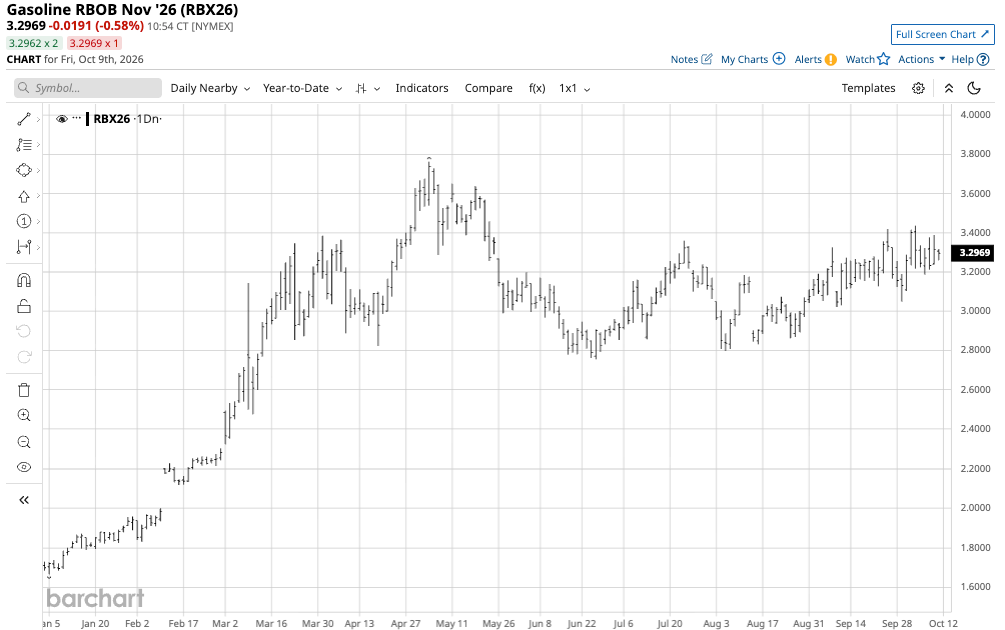
The daily continuous chart shows that after the June 25 low, gasoline futures rose to a $3.36 high on July 23, before correcting to a high $2.7975 low on August 5. Gasoline futures then rallied to a recent high of $3.4376 per gallon wholesale on October 2, and were around $3.30 on October 9.
Defying seasonality could continue
Gasoline remained in bullish mode in October 2026, even though the peak driving season ended in September. Drivers put fewer miles on their cars after the summer vacation period, making gasoline a seasonal fuel. Therefore, in past years, gasoline futures prices have risen in spring and summer and declined in fall and winter.
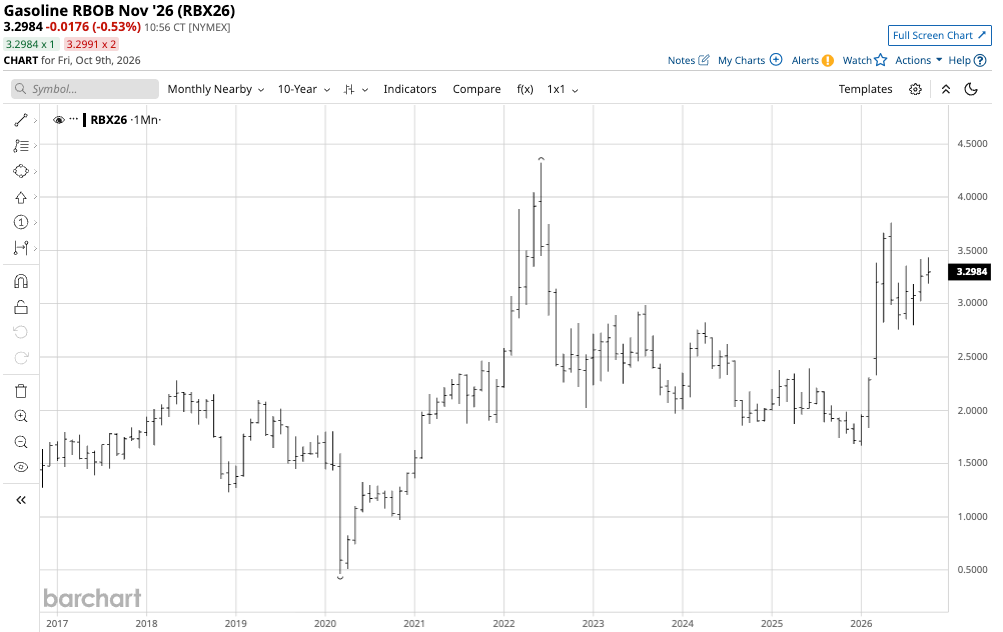
The ten-year chart shows gasoline’s seasonality, with annual price peaks in spring and summer and lows in winter.
So far, gasoline futures have defied their seasonal price pattern, but 2026 is no ordinary year, and gasoline reflects the geopolitical landscape far more than the seasonal demand factors.
The Middle East is critical
Crude oil that is refined into gasoline and distillates is the energy commodity that has dictated the price path of markets across all asset classes since late February 2026, when the U.S. and Israel attacked Iran to destroy its nuclear infrastructure. On-again-off-again negotiations have caused oil prices to move higher and lower like a yo-yo.
Meanwhile, closures or interruptions in the Strait of Hormuz, through which 20% of the world’s seaborn crude travels, and the Bab al-Mandeb Strait, through which around 7% of the world’s seaborn crude oil travels, have caused supply shortages and uncertainty. Moreover, Iranian attacks on neighboring countries supporting U.S. military assets have destroyed or damaged oil production, refining, pipeline, and logistical infrastructure.
Oil product prices have soared in 2026, with distillate and refining margins reaching sky-high levels, supporting U.S. refining companies and pushing gasoline and distillate oil prices higher.
The Middle East remains a geopolitical tinderbox, with escalation and negotiation pushing crude and product prices in opposite directions. A peaceful solution would cause oil and product prices to plunge, while escalation could push them even higher. The bottom line is that uncertainty has prevailed and has pushed gasoline prices higher despite seasonality in October 2026.
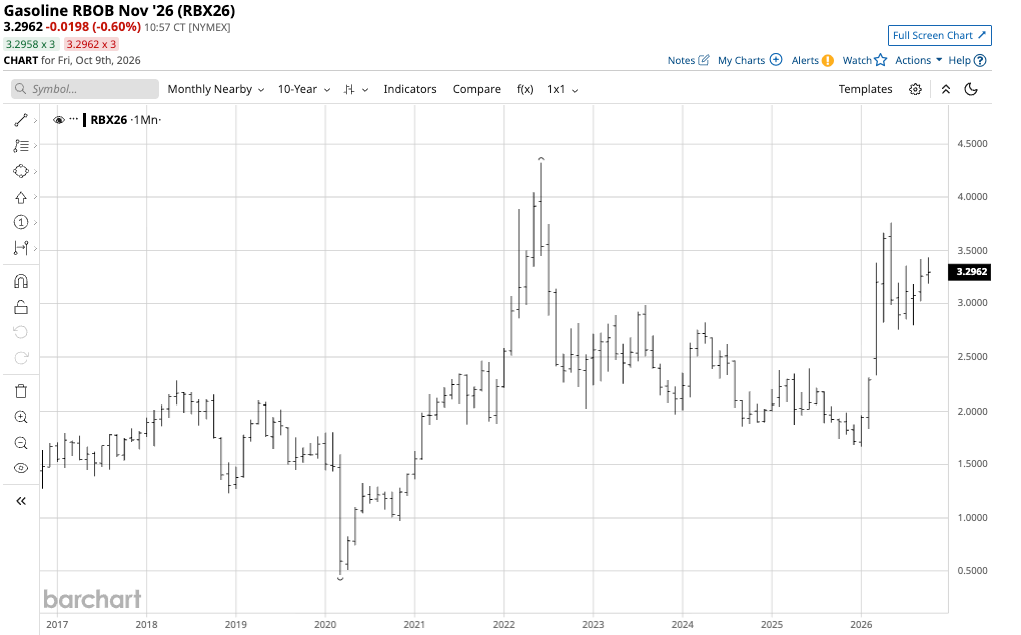
The monthly chart shows that RBOB gasoline traded in a $1.7407 to $1.9309 per gallon range in October 2025. The price is more than $1.35 higher than the October 2025 high in October 2026, reflecting uncertainty in the Middle East. The ongoing war in Ukraine and sanctions on Russia, a leading oil producer, only exacerbate supply concerns.
The U.S. SPR withdrawals will decline
The U.S. has become less reliant on Middle Eastern supplies. It is close to energy independence under the current administration’s energy policy. Still, the U.S. and other countries have been depleting their Strategic Petroleum Reserves since March 2026 to keep oil and oil product prices under control. As of October 2, 2026, the U.S. crude oil SPR at 283 million barrels is at its lowest level in decades and is 431 million barrels below capacity. Moreover, the SPR can only fall to 150-250 million barrels; below that range, it becomes difficult to remove petroleum from the salt caves where it is stored. Therefore, at the current level, the U.S. SPR is only 33 million barrels below the top end of its minimum range. Considering the U.S. produces nearly 14 million barrels per day, the current margin available from the SPR could represent under three days of production. U.S. SPR withdrawals will decline as they reach the bottom of the barrel, no pun intended.
Levels to watch over the coming months. UGA is the gasoline ETF.
Gasoline prices are likely to remain elevated during the 2026/2027 offseason for demand. Unless there is peace in the Middle East and Ukraine, gasoline prices will be substantially higher during the 2026/2027 winter than in prior years.
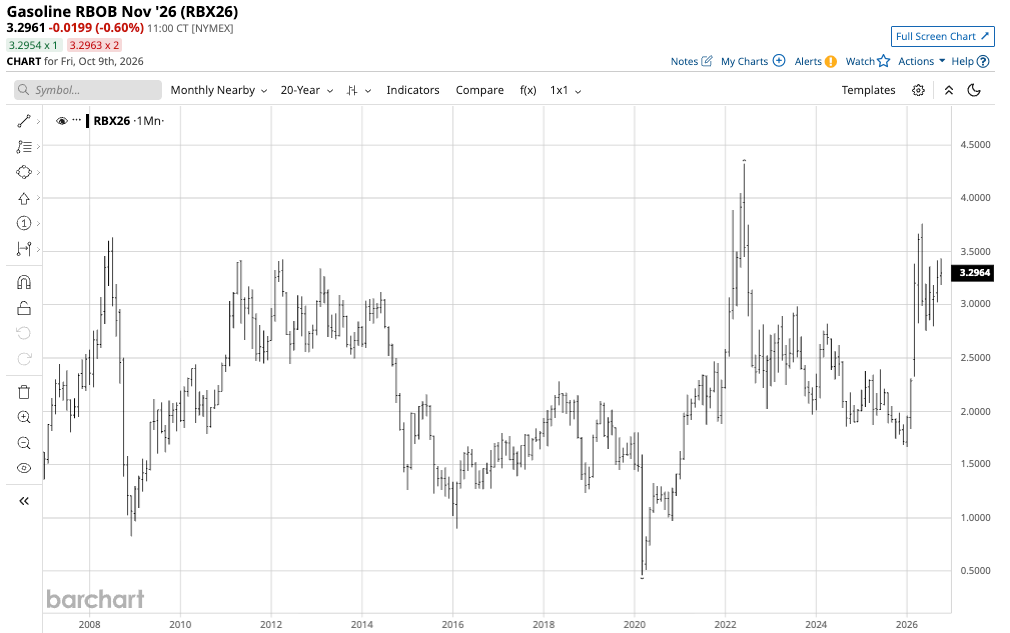
The monthly chart shows that technical support for RBOB gasoline is at the June 2026 low of $2.7565 per gallon. Below there, the January 2026 low of $1.6656 per gallon wholesale is the next technical support. Technical resistance is at the May 2026 high of $3.7640 and the June 2022 all-time high of $4.3260 per barrel wholesale. Trading gasoline with the trend could be optimal over the coming weeks and months, as trends have been a trader’s best friend until bullish trends run out of upside momentum, reverse, and become bearish trends.
The most direct route for a long or short position in gasoline is the NYMEX RBOB gasoline futures market. Each contract contains 42,000 barrels. At $3.30 per gallon, the value is $138,600. The Exchange’s original margin requirement of $10,058 means a market participant can control $138,600 of gasoline value on the long or short side for a 7.3% down payment. If equity falls below $9,144 per contract, the Exchange requires maintenance margin payments.
The U.S. Gasoline ETF (UGA) tracks NYMEX gasoline prices. At $148.64 per share, UGA is a liquid ETF with $170.8 million in assets under management. UGA trades an average of 57,562 shares per day and charges around a 1% management fee. UGA tracks the nearby NYMEX RBOB futures contract until it is within two weeks of expiration, then rolls to the next active NYMEX RBOB futures contract.
Expect lots of volatility in gasoline prices during the coming weeks and months as the fuel continues to defy its seasonality.
On the date of publication, Andrew Hecht did not have (either directly or indirectly) positions in any of the securities mentioned in this article. All information and data in this article is solely for informational purposes. For more information please view the Barchart Disclosure Policy here.